Student Success Center
MS in Applied Artificial Intelligence (Full-Time On-Campus)

Log into your courses
Welcome!
As an on-campus student, interactions with the university will include a number of various websites. For example:
- You’ll use your USD Email Address for all university-related communications.
- You’ll use Canvas to access your coursework and assignments. See Canvas Tips and Tricks page.
- You’ll use My.SanDiego.edu for tuition payments and to access most campus resources.
- You’ll use this site, your Student Success Center, to get specific information about textbook information, deadlines, and more!
- If you identify as alumni, visit our Alumni page to remain engaged.
 (619) 260-7521
Stay Connected with your Program





COMPLETE YOUR MANDATORY NEW STUDENT CHECKLIST
Our number one priority is you! Our team has prepared a checklist of items that will set you up for success and clarify all action items as a new student. After you are enrolled for your first term and receive a confirmation email from a member of our team, please complete and review all of the following before classes start.
1. View Your Mandatory New Student Welcome Webinar
This webinar will go over a comprehensive look at your program and what to expect as a student, including resources and tips for success. Each webinar should last around 30-40 minutes. Once you have been registered for classes and received a confirmation email from our team, you will be emailed the link to view your welcome webinar to your @sandiego.edu email address.
2. Schedule Your New Student Check-in Call
In this call, you’ll “meet” a member of your Student Success Team for your program. This will be a chance for us to answer any additional questions you have before you start your first term. Please be sure to have any Canvas-related, program-related, or finance-related questions prepared. After attending the Welcome Webinar, you will be prompted to schedule your call using a scheduling link.
3. Attend Your New Student Orientation - Thursday, August 27
Join us on Thursday, August 27 from 9am - 6pm on-campus for international students and 4pm - 6pm for domestic students for your New Student Orientation. Please note that this orientation is mandatory for all new students. We are excited to officially welcome you to the program and look forward to meeting you!
4. Complete Your Canvas Orientation Course - Due January 1, 2027
Once you have been registered in your classes, you will be able to access your New Student Orientation Course on Canvas within 4 hours. When accessing Canvas, please make sure to use Firefox or Chrome as your browser.
The New Student Orientation course is designed to help you navigate your way around your course's layout prior to beginning your first class. You will learn where to find the syllabus, course schedule, assignments, and discussion boards.
Your Orientation is mandatory, and must be completed before the first day of class—so we encourage you to get started! Please plan to spend about 8 hours completing the Orientation course. You can move through the Orientation at your own pace, so schedule your time accordingly.
Looking for assistance?
View the guide for navigating your Canvas Orientation course
5. Finalize Your Tuition Payment Plan
We recommend that students start this planning early, as some funding sources can take some time to process. Tuition payments should be completed in full by the first day of the semester. Visit the "Tuition and Payment Methods" section for more information.
6. View the MS-AAI Program Preparedness and Resources Document
We recommend that students review this repository of programming, technology, software installation, and academic resources.
Download a pdf version of the Program Preparedness and Resources document.
6. Review your Student Handbook
Please make sure to review your student handbook prior to the first day of class, and reference it as needed throughout your program. The handbook is where you can find information on academic expectations, drop and refund policy, technology requirements, curriculum, frequently asked questions, and more.

IMPORTANT DATES
Below is a list of significant dates regarding the registration process, payment deadlines, and other important academic and program deadlines.
Fall 2026 Dates and Deadlines
| Important Dates | Date |
|---|---|
| Registration Opens | June 29, 2026 |
| Application Deadline | July 31, 2026 |
| Registration Deadline | August 14, 2026 |
| Orientation Course Due Date | August 28, 2026 |
| Last Day to Drop with 100% Tuition Refund* | August 31, 2026 |
| Payment Due Date | September 1, 2026 |
| Semester Begins | September 1, 2026 |
| First Course Start Date | September 1, 2026 |
| Last Day to Drop with 95% Tuition Refund/ Drop Deadline* | September 4, 2026 |
| Last Day to Withdraw from Course A | September 28, 2026 |
| First Course End Date | October 19, 2026 |
| Second Course Start Date | October 20, 2026 |
| First Course Final Grade Submission Due Date | October 26, 2026 |
| Last Day to Withdraw from Course B | November 16, 2026 |
| Second Course End Date | December 7, 2026 |
| Semester Ends | December 7, 2026 |
| Second Course Final Grade Submission Due Date | December 14, 2026 |
Spring 2027 Dates and Deadlines
| Important Dates | Date |
|---|---|
| Registration Opens | November 2, 2026 |
| Application Deadline | November 30, 2026 |
| Registration Deadline | December 14, 2026 |
| Orientation Course Due Date | January 1, 2027 |
| Last Day to Drop with 100% Tuition Refund* | January 4, 2027 |
| Payment Due Date | January 5, 2027 |
| Semester Begins | January 5, 2027 |
| First Course Start Date | January 5, 2027 |
| Last Day to Drop with 95% Tuition Refund/ Drop Deadline* | January 8, 2027 |
| Last Day to Withdraw from Course A | February 1, 2027 |
| First Course End Date | February 22, 2027 |
| Second Course Start Date | February 23, 2027 |
| First Course Final Grade Submission Due Date | March 1, 2027 |
| Last Day to Withdraw from Course B | March 22, 2027 |
| Second Course End Date | April 12, 2027 |
| Semester Ends | April 12, 2027 |
| Second Course Final Grade Submission Due Date | April 19, 2027 |
Summer 2027 Dates and Deadlines
| Important Dates | Date |
|---|---|
| Registration Opens | March 1, 2027 |
| Application Deadline | April 2, 2027 |
| Registration Deadline | April 16, 2027 |
| Orientation Course Due Date | April 30, 2027 |
| Last Day to Drop with 100% Tuition Refund* | May 3, 2027 |
| Payment Due Date | May 4, 2027 |
| Semester Begins | May 4, 2027 |
| First Course Start Date | May 4, 2027 |
| Last Day to Drop with 95% Tuition Refund/ Drop Deadline* | May 7, 2027 |
| Last Day to Withdraw from Course A | May 31, 2027 |
| First Course End Date | June 21, 2027 |
| Second Course Start Date | June 22, 2027 |
| First Course Final Grade Submission Due Date | July 5, 2027 |
| Last Day to Withdraw from Course B | July 19, 2027 |
| Second Course End Date | August 9, 2027 |
| Semester Ends | August 9, 2027 |
| Second Course Final Grade Submission Due Date | August 16, 2027 |
Download a pdf of your academic calendar

Upcoming Events
Don't miss out on connecting with your University of San Diego global community through a variety of events - featuring academic workshops, cultural celebrations, networking events, and more. There’s something for everyone!
Class Registration Directions
You have most likely already filled out an Enrollment Agreement, which enables our team to register you for classes each term. No further action is required on your part.
If you are not able to register for a course or term, please contact your Program Coordinator immediately. This often happens for students who need to take a leave of absence.
Textbook information
Students are required to have their textbooks on hand by the first day of class. Unless otherwise specified, students may select any vendor they prefer (such as Amazon.com, Half.com, Alibris.com, etc.) to purchase their course materials. In the event a specific vendor is required, it will be specified in the course materials list. The best way to ensure that you have the correct book is to search by the ISBN number(s) listed on the book list.
Physical copies of books are not on hand at the USD Torero Store. The USD Torero online store does offer price comparisons for different online vendors for some books.
Although all textbooks for all courses are listed, students only need to purchase the items for the classes they are taking for the semester.
Digital Inclusive Access (IA) - Integrated VitalSource Textbooks
If your course is indicated to have a "Digital Inclusive Access" textbook, you do have the option to use the integrated Vitalsource e-textbook without needing to purchase a textbook through an outside vendor. For more information, view the "Digital Inclusive Access" FAQs document.
- Students are able to access the e-textbook directly in the course without worrying about purchasing the wrong version or textbook!
- If your course is indicated as using “Digital Inclusive Access” on the textbook list, please note that you must opt-out within the first 7 days of each course to avoid being charged for the guaranteed-lowest price textbook.
- If you do intend to use “Digital Inclusive Access”, no further action is required after you create a Vitalsource account.
- No refunds can be issued once the textbook charge has been assessed.
By using Vitalsource e-Textbooks, students are able to use study tools in Bookshelf such as highlighting, printing limited pages/chapters, sharing notes, and using the Bookshelf CoachMe tool to test their learning while they read.
PAYing for your program
Tuition at USD is billed per semester, not per course. Payment (or enrollment in an official USD payment plan) is always due by the first day of the semester. Students may not carry balances from one semester to the next.
Accounts with outstanding balances after the official payment due date may be subject to course cancellations/removal or a student account hold during the semester; related holds can prevent upcoming registration, graduation, or obtaining transcripts.
Remember: tuition is always due by the first day of each semester.
Tuition amounts shown on this website, or in other university publications or web pages, represent tuition and fees as currently approved. However, the University of San Diego reserves the right to increase or modify tuition and fees without prior notice and to make such modifications applicable to students enrolled at USD at that time as well as to incoming students. In addition, all tuition amounts and fees are subject to change at any time for correction of errors.
Program Tuition
Once you have been registered for your courses, your student account will reflect the appropriate tuition costs according to syour program. Please view the student fees breakdown per semester. Payments not received by the deadlines are subject to late fees. Your program’s tuition is the following:
- Per Unit (classes are typically 3-units) = $2,000
- Per Semester (assuming 9-12 units per semester) = $18,000 - $24,000
- Total Program Tuition Cost (3 semesters) = $60,000
Students who need to re-take or withdraw from a course may need to pay additional fees according to the Refund/Drop Deadline policies listed in your Student Handbook.
If you have any questions about your Student Account, please reach out to the Torero Hub by submitting their inquiry form or by calling (619) 260-2700. All costs and fees are subject to change and are based on the academic year of enrollment.
mandatory Student Fees
All on-campus students are required to pay for related student fees. Investing in your student fees helps power the pulse of campus life, from keeping you healthy and active to funding student-led organizations and events. These fees ensure you have access to top-tier wellness resources, community spaces, and professional growth opportunities throughout your USD journey.
Student Wellness Fee
The Student Wellness Fee provides students with access and care at all the on-campus USD Wellness Units, including the Center for Health and Wellness Promotion, Counseling Center, and Student Health Center.
Student Wellness Center Facility Fee
The three-story, 80,000 square-foot facility provides accessible indoor and outdoor spaces where the entire campus community can find connections between physical activity, diet and nutrition, mental health, inner self, engagement, and belonging. Learn more about the facility.
Student Association Fee (based on units of enrollment)
The Graduate Student Activity Fee is dedicated to funding graduate student research and/or professional development. The fees are distributed between the Graduate Student Council and the individual graduate school association or programs. Learn more about Graduate Student Life.
Student Life Pavilion Fee
The Student Life Pavilion Fee provides spaces for student government, student organizations, including fraternity and sorority life, the Changemaker Hub, Black Student Resource Commons, LGBTQ+Allies Student Commons, United Front Multicultural Commons, Women’s Commons, graduate and law students, and student media. It has become the hub of campus life, a central gathering place for fostering a sense of community among graduate, undergraduate, and law students, faculty, and staff. Learn more about the benefits.
Health Insurance (unless waived)
All actively enrolled full-time students at the University of San Diego need to submit a decision form to enroll in or waive out of the Student Health Insurance Plan by the published deadline.
Slack Pro
All students are charged a $30 fee each semester to cover a Slack Pro Account that allows you to have access to your MS-AAI Slack student and instructor community. This fee is non-refundable and cannot be waived for any students. Only active students will maintain access to their Slack Pro, and students will lose access to this account upon graduation.
Students who need to re-take or withdraw from a course may need to pay additional fees according to the Refund/Drop Deadline policies listed in your Student Handbook.
If you have any questions about your Student Account, please reach out to the Torero Hub via this request form. All costs and fees are subject to change and are based on the academic year of enrollment.
Refund Policy
Students will be registered for their prescribed courses each semester. All courses must be dropped prior to the first day of the semester to receive a 100% tuition refund and within the first three days of the start date of the semester to receive a 95% tuition refund. No refund (reversal of tuition) will be provided after the third day of the semester for any class.
DEGREE PROGRESS and COMMENCEMENT
DegreeWorks
You can track your progress toward earning your degree using the Degree Works feature in your MySanDiego student portal. Degree Works shows you which courses you have completed, grades, cumulative GPA, any outstanding graduation requirements, and more!
To access Degree Works:
- Log in to your MySanDiego student portal.
- Under the “Torero Hub” tab, click on “My Academics.”
- On the right-hand side under “My Academic Resources”, click on “Degree Works.”
Petition to Graduate
Submitting your petition to graduate is a requirement for every student. About a semester before your final term, you will be reminded by your Program Coordinator to submit your petition to graduate. Once completed, your Academic Coordinator will review your academic record and contact you if there are any outstanding requirements or issues.
Commencement timing
There is only one commencement ceremony each academic year in May. If you are planning on participating in the commencement ceremony (which means walking in your cap and gown here on campus), you will be invited by the USD Commencement Committee and the Student Success Team around the month of February.
- Fall and Spring graduates will be invited to the commencement ceremony the May after they graduate.
- Summer graduates will be invited to the commencement ceremony the May before they graduate.
Diploma Details
The Registrar will process their final audit of the degrees 6-8 weeks after grades are posted for your final semester. Once the degree is conferred in the system, the Registrar will order your diploma from the vendor, and the vendor will send it to you directly to the address that was listed on your petition to graduate.
- You will receive a digital diploma to your @sandiego.edu email address once your degree has been officially conferred.
- You will also receive a physical diploma. Mailing time is an additional 6-8 weeks from the date of order, and you will likely receive your diploma in the mail in 3-4 months after you have completed your degree requirements.
- If your mailing address changes after you submit your Petition to Graduate, please notify the Graduate Records office at (619) 260-2217 or [email protected].
Course Details
program requirements
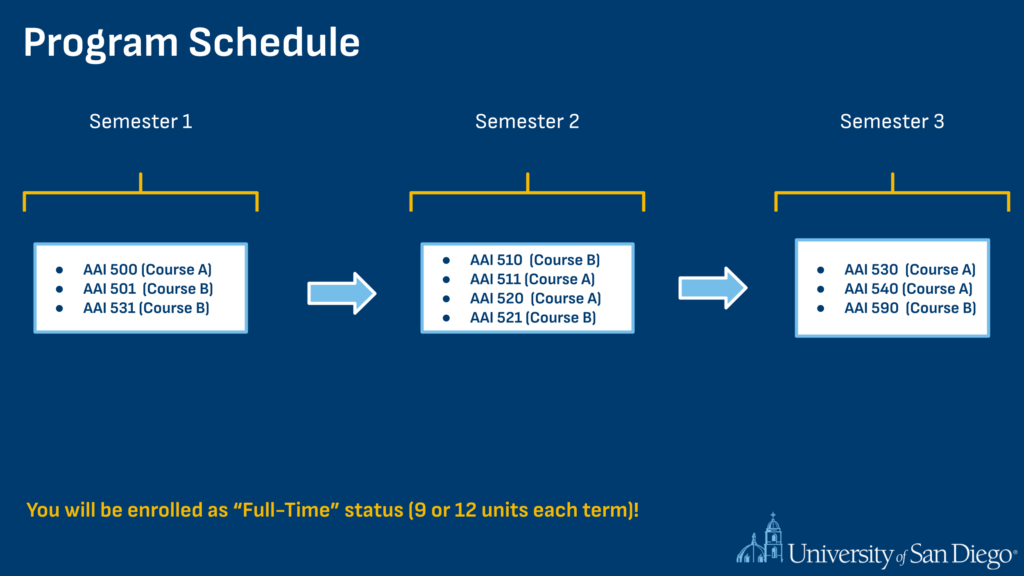
The 30 unit program will consist of ten courses. Courses will be offered year-round with two required semesters every year: Spring and Fall. Summer terms have an optional internship course, AAI 589, for students who wish to partake in an internship. Each semester will last 14 weeks. Students will take three to four courses per semester. All courses will run for seven weeks each. After each semester, students have a one or two-week break before the next semester starts. This intensive format allows students to complete the degree program in 12 months.
Please notice that attendance at the resident learning classes is mandatory and important for learning effectiveness. Missing these classes may have negative implications on your final grade; your instructor reserves the right to modify your final grade based on lack of in-person attendance. If you anticipate that you may not be able to attend a future class session, please notify your instructor at least 24 hours in advance to explore potential alternative assignments and makeup work. The instructor reserves the right to deduct points based on multiple absences.
Course Titles and Descriptions
Applied Probability and Statistics for AI (AAI 500)
This course is an introduction to probability and statistical concepts and their applications in solving real-world problems, along with an introduction to coding in Python. The course provides a solid foundation in probability and statistics that underpins modern artificial intelligence and data-driven decision-making. Topics include statistical concepts, probability theory, random and multivariate variables, data and sampling distributions, descriptive statistics, estimation of population parameters, and hypothesis testing. Students are also introduced to probabilistic reasoning concepts that form the basis for advanced AI methods, including foundational ideas relevant to Bayesian reasoning and machine learning. The course emphasizes the use of Python to perform basic statistical analyses, including numerical and graphical data exploration, elements of probability, sampling distributions, probability distribution functions, estimation, and hypothesis testing. Practical problem-solving skills are developed through applied examples, case studies, and standard organizational workflows, with an emphasis on structuring and executing analyses as they would occur in large enterprise environments. Team collaboration, professional presentation skills, and academic writing are reinforced through a final team project that integrates statistical reasoning, coding, and communication.
Introduction to Artificial Intelligence and Machine Learning (AAI 501)
Artificial Intelligence (AI) and Machine Learning (ML) are transforming society through their ability to model complex systems and compute how to act effectively and safely in a wide variety of situations. This course provides a structured introduction to the fundamental principles and core techniques that underpin AI/ML, while also exploring their practical applications and limitations. Students will engage with topics ranging from intelligent agents and heuristic search to mathematical optimization, supervised and unsupervised learning, forecasting, deep learning architectures, and reinforcement learning. The course emphasizes critical thinking about problem formulation, algorithm selection, and evaluation, preparing students to navigate the full lifecycle of AI/ML projects. Real-world applications in areas such as computer vision, natural language processing, forecasting, and decision-making are examined to connect theory with practice. By the end of the course, students will have the knowledge necessary to apply these techniques in a wide range of professional contexts.
Agentic AI Systems (AAI 510)
This course provides a comprehensive introduction to AI Agents, covering fundamental concepts, popular frameworks, essential tooling, and practical development. Students will learn to build, evaluate, and manage AI agents, culminating in an integration of subject matter expertise into agent outputs and the ethical considerations surrounding this rapidly evolving field. Prerequisites: AAI 500 and AAI 501
Neural Networks and Deep Learning (AAI 511)
Neural networks have enjoyed several waves of popularity over the past half-century. The many applications of neural networks include apps that identify people in photos, automated vision systems for large-scale object recognition, smart home appliances that recognize continuous, natural speech, self-driving cars, and software that translates from any language to any other language. In this course, students will learn the fundamental principles and concepts of neural networks and state-of-the-art approaches to deep learning using in-demand Python packages, such as TensorFlow and PyTorch. Students will learn to design neural network architectures and training methods using hands-on assignments and will perform comprehensive final projects in this course. Prerequisites: AAI 500 and AAI 501
Natural Language Processing and GenAI (AAI 520)
This course provides an in-depth examination of the foundations and applications of Natural Language Processing (NLP) and Large Language Models (LLMs). Students will explore text preprocessing, Named Entity Recognition (NER), and Part-of-Speech (PoS) Tagging, applying these techniques in tasks such as information extraction and sentiment analysis. The course then examines the evolution of language models, focusing on transformer architectures, BERT, GPT, and T5, with hands-on experience in fine-tuning pre-trained models. Students will also develop skills in prompt engineering and build Retrieval-Augmented Generation (RAG) systems using the Hugging Face ecosystem. The course culminates in a team-based capstone project where learners design and implement a multi-agent financial analysis system, demonstrating practical mastery of LLM integration, workflow design, and real-world AI applications. The hands on approach of this course will provide students with both conceptual knowledge and applied skills in NLP, LLMs, RAG, and agentic AI, preparing them to innovate at the forefront of AI-driven language technologies. Prerequisites: AAI 500 and AAI 501
Applied Computer Vision for AI (AAI 521)
This course provides an introduction to computer vision. Computer vision uses a combination of traditional AI, machine learning, image processing, and mathematical theories to provide ways of programming a computer to understand visual imagery, whether a static picture, stereo vision for a robot, or motion from video. Topics covered include fundamentals of feature detection and extraction, motion estimation and tracking, image processing, and object and scene recognition. Students will learn fundamental concepts of computer vision as well as gain hands-on experience in solving real-world vision problems. A variety of tools will be introduced in this course, but the main focus will be on Python and OpenCV, as well as TensorFlow and Keras. Prerequisites: AAI 500 and AAI 501
Large Language Model Engineering (AAI 530)
This course provides a comprehensive overview of the techniques and challenges involved in engineering and deploying large language models (LLMs) in applied settings. Students will gain hands-on experience with API-based LLM integration, prompt engineering, fine-tuning, and reinforcement learning strategies for model optimization. Emphasis will be placed on alignment, safety, and responsible AI development. By the end of the course, students will be able to design, deploy, and evaluate LLM-based systems with practical utility and ethical awareness. Prerequisites: AAI 500 and AAI 501
Applied AI Ethics (AAI 531)
This course explores the ethical, social, and environmental implications of Artificial Intelligence (AI) and related technologies through the lens of core ethical principles, including human dignity, bias, fairness, privacy, safety, explainability (XAI), transparency, responsibility, and governance. Through theoretical discussions, real-world case studies, and hands-on labs, students will examine how AI systems can be designed to mitigate bias, enhance transparency, and protect user privacy while also considering AI’s environmental impact, including its role in electronic waste, energy consumption, and resource extraction.
Students will investigate AI’s broader social, political, and economic effects, such as labor displacement, economic inequality, and systemic bias reinforcement. The course also examines how AI-driven technologies can perpetuate global power imbalances and disproportionately impact communities. To provide a structured ethical foundation, students will explore philosophical frameworks that inform AI ethics, enabling them to evaluate the ethical dimensions of AI decision-making. Through hands-on practice, students will learn to measure bias using fairness metrics, implement bias mitigation strategies, and apply XAI techniques to improve AI model transparency and accountability. They will also be introduced to ethics impact assessments, guiding them in identifying key stakeholders and evaluating risks and unintended consequences of AI systems. By engaging with real-world case studies, students will critically analyze AI’s impact, assess international regulatory frameworks, and explore governance strategies to ensure AI operates within ethical and legal boundaries.
By the end of the course, students will be equipped with both theoretical knowledge and practical skills to navigate the ethical complexities of AI development and deployment. They will learn to critically assess AI’s societal role and adapt their approach to AI innovation in ways that prioritize equity, accountability, and sustainability. Prerequisites: AAI 500 and AAI 501
Machine Learning Operations (MLOps) (AAI 540)
Interest in and usage of Machine Learning systems has increased dramatically in recent years. More and more innovative products and research rely on Machine Learning systems that leverage data to make predictions and identify trends. However, as with many cutting-edge fields, Machine Learning systems are often implemented improperly. As a result, many Machine Learning systems are unreliable, inefficient, or even useless. Machine Learning Operations (MLOps) is a methodology whose goal is to design, build, deploy, and maintain machine learning models properly. MLOps combines practices from Machine Learning, Data Engineering, and DevOps to ensure that Machine Learning models and algorithms are reliable, efficient, and, most importantly, useful. This course will introduce students to the key concepts of MLOps and a holistic method of designing suitable ML systems. Students will learn and perform the best practices for building Machine Learning systems with hands-on learning experiences and real-world applications. While students will learn about and implement some Machine Learning algorithms in this course, this course is not intended to teach them about the field of Machine Learning. Rather, students will learn how to properly design Machine Learning systems throughout the entire lifecycle. Prerequisites: AAI 510, AAI 511, AAI 520, AAI 521, and AAI 531
Directed AI Research Extension (AAI 589) - Optional
In this optional course, students engage in a faculty-supervised research experience that extends their applied training in artificial intelligence through deeper theoretical investigation and advanced experimentation. Designed to be taken prior to the Capstone Project, the course allows students to refine a problem domain, examine relevant scholarly literature, and develop a research-informed approach that can support a more advanced and rigorous Capstone experience. Students work independently or in small groups under faculty guidance to formulate research questions, design and conduct systematic experiments, and analyze results using modern AI methods and tools. Emphasis is placed on contemporary topics such as foundation and large language models, agentic and multi-agent systems, advanced deep learning techniques, responsible and ethical AI, and modern evaluation and benchmarking practices. Course outcomes may include a research plan, technical report, or extended analysis suitable for further development into a publication-ready manuscript and an expanded capstone project. Prerequisites: AAI 500 with a minimum grade of C- and AAI 501 with a minimum grade of C-; completion of at least 21 units in the MS-AAI program; permission of Academic Director.
Capstone Project (AAI 590)
In this course, students learn how the knowledge and skills acquired in the Master's program can be directly applied to develop AI-enabled systems. Students will apply skills acquired in the program to effectively address ethical, moral, and social issues in their design process. Students can work individually or in teams and participate in the identification of a problem, develop a project proposal outlining an approach to the problem’s solution, implement the proposed solution, and test or evaluate the result in this Capstone using tools and technologies that were taught throughout the entire program. Prerequisites: AAI 510, AAI 511, AAI 520, AAI 521, AAI 530, and AAI 531
Practicum in Applied Artificial Intelligence (AAI 598) - Optional
In this course, students will engage in an applied learning experience working for a business, government, or nonprofit organization. Students may be focusing on an individual project or employer-designated internship program.
Student Resources
This list includes helpful resources that will set you up for success. Haven’t written in APA formatting since your undergraduate program? We’ve got you covered! Want to know what type of computer you will need? No problem. We have listed helpful resources below.
Academic Requirements and Resources
Technical Requirements
Installation/Getting Started Resources
- Self-Assessment Test (Answer Key)
- Python (Anaconda) Installation and Navigating the Jupyter Ecosystem
- Python (An Introduction to Jupyter and Python)
- Python & Jupyter Notebook Installation Instructions
Programming and Software Resources
- IBM: Python Basics for Data Science
- Coursera: Python 3 Programming Specialization
- Dive into Python 3
- Python Standard Library
- Python Data Science Handbook
- LearnPython.org: Free Interactive Python Tutorial
- DataCamp.com: Free Interactive Intro to Python
- Slack Pro Channel ($30/semester); includes AI Teaching Assistant
- Git/GitHub (free account available)
Technical Resources and Requirements
- USD's Information Technology Services Hardware Recommendations
- Windows Operating System - Windows Operating System - 32 GB, Apple M-series (M1/M2/M3) or Intel i7/i9 (12th Gen+) and 512 GB or 1 TB Internal NVMe SSD. How-to-Check Guide Here.
- Microsoft Office is required. As a USD student, you can download Microsoft 365 (Word, PowerPoint, Excel) for free.
- Speakers or headset – to listen and record multimedia
- Webcam – for recording video
- High-speed internet connection required (DSL or better)
- Browser Plug-ins – Windows Media Player, QuickTime, Adobe Reader, and Java.
Additional Academic Resources
Slack – Your Course Messaging Tool
Each time your course starts, you will be invited to join a Slack messaging channel for your MS-AAI program. In the channel, you'll be able to easily message your peers and faculty in a dynamic way. New to Slack? No problem - there are a variety of introductory resources to get you up to speed.
Please note that we will invite your @sandiego.edu email address to the Slack channel, and we will delete personal email accounts to maintain program and student privacy.
While participating in the Slack channel, please be respectful of everyone and note that all USD student conduct policies apply to conversations in the related messaging threads.
If you are having trouble accessing your Slack channel, please email your Program Coordinator using the information at the top of this website.
Graduate Writing Expectations and Tips
All writing assignments must be formatted according to APA standards. Discussion posts must contain the appropriate APA citations. If you want additional writing support, we recommend Purdue Online Writing Lab (OWL@Purdue). In addition to general writing support, the website includes a special section dedicated to APA formatting guidelines.
Another helpful writing resource is the School of Leadership and Education Sciences (SOLES) Graduate Student Writing Center. Enrolled students can submit assignments for review by a writing professional.
Copley Library Navigation
View our virtual workshop, "Copley Library Navigation, Citations and AI-Driven Research Skills," which introduces tools that make academic work smoother, smarter, and more efficient. In this session, you’ll learn how to navigate Copley Library like a pro, use citation resources with ease, and integrate AI tools such as SCITE to strengthen your research workflow. You’ll leave with practical strategies, time‑saving tips, and a personalized roadmap for thriving as a USD scholar.
Learning Strategies
View our virtual workshop, "Learning Unlocked: Strategies, Resources & Collaboration," which will equip you with practical knowledge and skills to apply tangible strategies to learn throughout your Master's Degree!
Artificial Intelligence (AI)
With the rise of AI writing assistants, students must ensure that they use this new technology ethically and honestly. Consult this document for guidance.
Download Microsoft Office 365 (Free for USD Students)
Students at the University of San Diego are able to download Microsoft Office 365 for free! If you don’t have it already, you can download the Microsoft Office 365 suite using your USD student email.
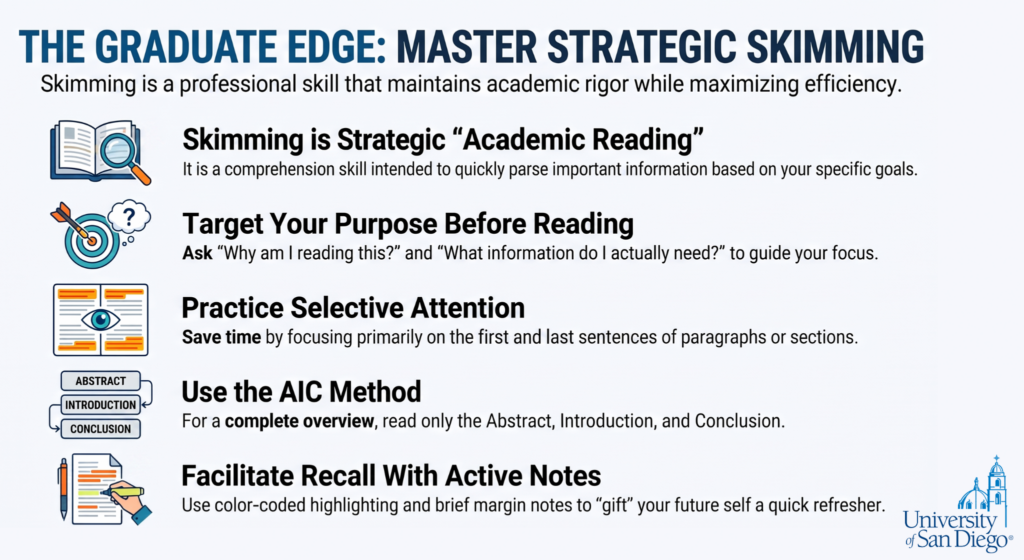
Skimming 101: Managing the Reading Load of Graduate Work
Students at the University of San Diego were invited to attend this session focused on applying strategies to accelerate their reading and information processing.
View the 3-minute summary video on academic skimming.
External Tutoring Resource
USD does not offer subject-specific tutoring resources, so students who are looking for tutoring support are encouraged to identify a tutor using Wyzant.com. Please note that Wyzant is not a USD-managed resource, so use them at your own discretion.
Career Readiness
If you're looking for assistance with career counseling, resume and interview preparation, salary negotiation guides, and student employment opportunities, view the Career Resources page to learn more. Additionally, students can leverage key networking and recruitment tools like Handshake, LinkedIn, and USD’s T.E.A.M. network, as well as explore specialized professional certifications.
Student Wellness Resources
Our community is dedicated to supporting students holistically. Our goal is to increase mental health awareness, reduce stigma, and equip students with essential skills to succeed during their program and beyond. As a student, you have access to resources to support your academic success and personal development.
On-Campus Student Handbook
Graduate Student Code of Rights and Responsibilities
Canvas @ USD
In your program, you can think of Canvas as your virtual tool to share information with professors and peers. You will use Canvas to access your course content, find course syllabi, review your assignments, and more. Be sure to use your USD credentials to log in. If you have any difficulty logging into your course, be sure to contact ITS at (619) 260-7900 or [email protected].

Netiquette Guidelines
The concept of netiquette covers proper communication online. Read our guidelines to help cultivate a supportive and productive online environment.
your partners toward success
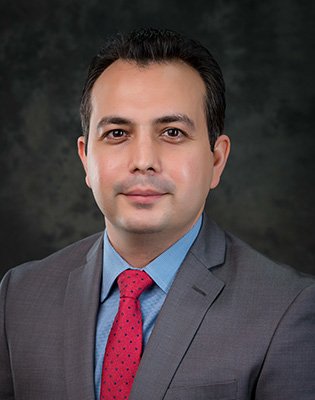
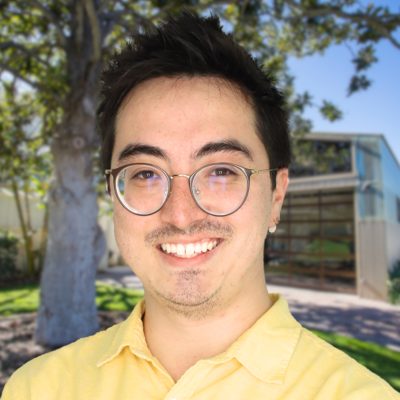
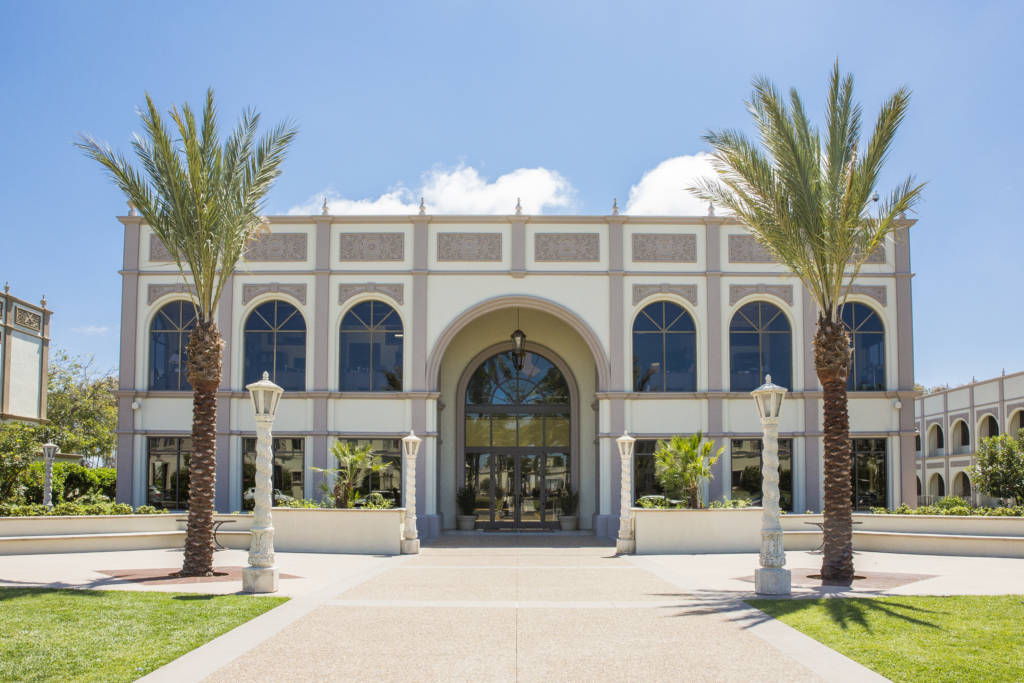
At USD, you join a community of individuals who are all committed to one common goal: your success. As you familiarize yourself with your team, take the opportunity to virtually meet and connect with the resources available to you as a student. Click on the profiles below to learn more about each office or staff member and watch a brief video about their role in supporting you through graduation.












USD Quick Links
- USD Directory (For Faculty or Staff Contact Information)
- Torero Hub
- Health and Wellness
- SOLES Graduate Writing Center
- Epstein Family Military Center
- Disability and Learning Difference Resource Center
- Copley Library
- Career Development Center
- Campus Recreation (Remote and On-Campus Classes Offered)
Career and professional resources
Whether you're hoping to find a new job or earn a promotion, USD has a wealth of resources available to prepare you for your dream role.
MS-AAI professional resources
- Recommended Conferences
- The Artificial Intelligence Group
- Machine Learning Community
- ML Model Deployment Using Docker Workshop Recording (Password: eS4%Mckn)
- Applications of Machine Learning Workshop Recording
- Intro to Careers in AI Workshop Recording
- AI in Healthcare Recording
- How to Thrive as a Newly Minted AI Practitioner Recording
- Intro to Networking and Interviewing
- AI and Data Science Product Management Recording
- AI in Action: Perplexity AI Recording
- Agentic AI Workshop: Building AI Apps with RAG and LLM Workflows
- Python for Data Science Interviews
- Agentic AI Workshop 2: Architecting Multi-Agent Systems with n8n
- Careers with Impact- Reshaping the hidden work of Healthcare with AI
- Agentic AI Workshop 3: Deploying Safe and Scalable Agentic Systems
- Towards AI: A Decision Framework for AI Projects in the Agents Era
- SQL for Data Science Interviews