Student Success Center
MS in Humanitarian Action

Log into your courses
Welcome!
As an online student, most of your interactions with the university will be done through various websites. For example:
- You'll use your USD Email Address for all university-related communications.
- You'll use Canvas for all of your coursework and assignments. See Canvas Tips and Tricks page.
- You’ll use your MySanDiego Portal for tuition payments and to access most campus resources.
- You’ll use this site, your Student Success Center, to get specific information about textbook information, deadlines, and more!
- If you identify as alumni, visit our Alumni page to remain engaged.



Your Academic Director
Stephen Commins, PhD
 (310) 666-0991
Stay Connected with your Program





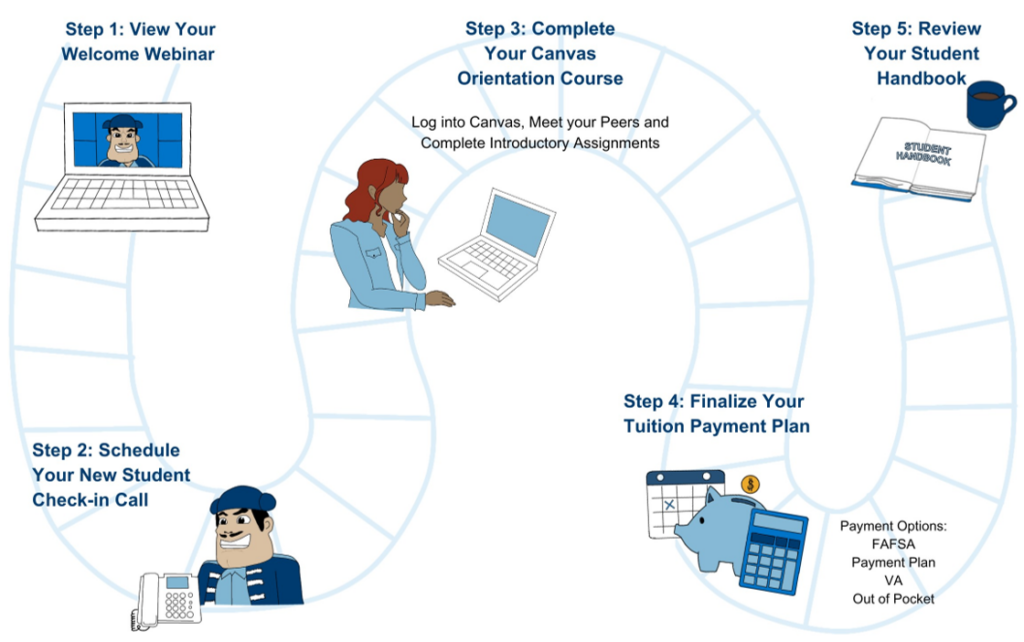
COMPLETE YOUR MANDATORY NEW STUDENT CHECKLIST
Our number one priority is you! Our team has prepared a checklist of items that will set you up for success and clarify all action items as a new student. After you are enrolled for your first term and receive a confirmation email from a member of our team, please complete and review all of the following before classes start.
1. View Your Mandatory New Student Welcome Webinar
This webinar will go over a comprehensive look at your program and what to expect as an online learner including resources and tips for success. Each webinar should last around 30-40 minutes. Once you have been registered for classes and receive a confirmation email from our team, you will be emailed the link to schedule your welcome webinar to your @sandiego.edu email address.
2. Schedule Your New Student Check-in Call
In this call, you’ll “meet” a member of your Student Success Team for your program. This will be a chance for us to answer any additional questions you have before you start your first term. Please be sure to have any Canvas-related, program-related, or finance-related questions prepared. After attending the Welcome Webinar, you will be prompted to schedule your call using a scheduling link.
3. Complete Your Canvas Orientation Course - Due January 2, 2026
Once you have been registered in your classes, you will be able to access your New Student Orientation Course on Canvas within 4 hours. When accessing Canvas, please make sure to use Firefox or Chrome as your browser.
The New Student Orientation course is designed to help you navigate your way around the course's layout prior to beginning your first class. You will learn where to find the syllabus, course schedule, assignments, and discussion boards.
Your Orientation is mandatory, and must be completed before the first day of class—so we encourage you to get started! Please plan to spend about 6-8 hours completing the Orientation course. You can move through the Orientation at your own pace, so schedule your time accordingly.
Looking for assistance?
4. Finalize Your Tuition Payment Plan
We recommend that students start this planning early as some funding sources can take some time to process. Tuition payments should be completed in full by the first day of the semester. Visit the "Tuition and Payment Methods" section for more information.
5. Review your Student Handbook
Please make sure to review your student handbook prior to the first day of class, and reference it as needed throughout your program. The handbook is where you can find information on academic expectations, drop and refund policy, technology requirements, curriculum, frequently asked questions, and more.
IMPORTANT DATES
Below is a list of significant dates regarding the registration process, payment deadlines, and other important academic and program deadlines.
Fall 2025 Dates and Deadlines
| Important Dates | Date |
|---|---|
| Registration Opens | June 30, 2025 |
| Application Deadline | August 1, 2025 |
| Registration Deadline | August 15, 2025 |
| Orientation Course Due Date | August 29, 2025 |
| Last Day to Drop with 100% Tuition Refund* | September 1, 2025 |
| Payment Due Date | September 2, 2025 |
| Semester Begins | September 2, 2025 |
| First Course Start Date | September 2, 2025 |
| Last Day to Drop with 95% Tuition Refund/ Drop Deadline* | September 5, 2025 |
| Last Day to Withdraw from Course A | September 29, 2025 |
| First Course End Date | October 20, 2025 |
| Second Course Start Date | October 21, 2025 |
| First Course Final Grade Submission Due Date | November 3, 2025 |
| Last Day to Withdraw from Course B | November 17, 2025 |
| Second Course End Date | December 8, 2025 |
| Semester Ends | December 8, 2025 |
| Second Course Final Grade Submission Due Date | December 22, 2025 |
Spring 2026 Dates and Deadlines
| Important Dates | Date |
|---|---|
| Registration Opens | November 3, 2025 |
| Application Deadline | December 1, 2025 |
| Registration Deadline | December 15, 2025 |
| Orientation Course Due Date | January 2, 2026 |
| Last Day to Drop with 100% Tuition Refund* | January 5, 2026 |
| Payment Due Date | January 6, 2026 |
| First Course Start Date | January 6, 2026 |
| Last Day to Drop with 95% Tuition Refund/ Drop Deadline* | January 9, 2026 |
| Last Day to Withdraw from Course A | February 2, 2026 |
| First Course End Date | February 23, 2026 |
| Second Course Start Date | February 24, 2026 |
| First Course Final Grade Submission Due Date | March 9, 2026 |
| Last Day to Withdraw from Course B | March 23, 2026 |
| Second Course End Date | April 13, 2026 |
| Semester Ends | April 13, 2026 |
| Second Course Final Grade Submission Due Date | April 27, 2026 |
Summer 2026 Dates and Deadlines
| Important Dates | Date |
|---|---|
| Registration Opens | March 2, 2026 |
| Application Deadline | April 3, 2026 |
| Registration Deadline | April 17, 2026 |
| Orientation Course Due Date | May 2, 2026 |
| Last Day to Drop with 100% Tuition Refund* | May 4, 2026 |
| Payment Due Date | May 5, 2026 |
| Semester Begins | May 5, 2026 |
| First Course Start Date | May 5, 2026 |
| Last Day to Drop with 95% Tuition Refund/ Drop Deadline* | May 8, 2026 |
| Last Day to Withdraw from Course A | June 1, 2026 |
| First Course End Date | June 22, 2026 |
| Second Course Start Date | June 23, 2026 |
| First Course Final Grade Submission Due Date | July 6, 2026 |
| Last Day to Withdraw from Course B | July 20, 2026 |
| Second Course End Date | August 10, 2026 |
| Semester Ends | August 10, 2026 |
| Second Course Final Grade Submission Due Date | August 24, 2026 |
* During the first semester of enrollment, any tuition refund amounts will not include the non-refundable enrollment deposit amount (5% of tuition).
Download a pdf of your academic calendar

Upcoming Events
Don't miss out on connecting with your University of San Diego global community through a variety of events - featuring academic workshops, cultural celebrations, networking events, and more. There’s something for everyone!
Class Registration Directions
You have most likely already filled out an Enrollment Agreement, which enables our team to register you for classes each term. No further action is required on your part.
If you are not able to register for both of your courses in a given term, please contact your program coordinator immediately. This often happens for students who need to take a leave of absence.
Textbook information
Students are required to have their textbooks on hand by the first day of class. Unless otherwise specified, students may select any vendor they prefer (such as Amazon.com, Half.com, Alibris.com, etc.) to purchase their course materials. In the event a specific vendor is required, it will be specified in the course materials list. The best way to ensure that you have the correct book is to search by the ISBN number(s) listed on the book list.
Physical copies of books are not on hand at the USD Torero Store. The USD Torero online store does offer price comparisons for different online vendors for some books.
Although all textbooks for all courses are listed, students only need to purchase the items for the classes they are taking for the semester.
Digital Inclusive Access (IA) - Integrated VitalSource Textbooks
If your course is indicated to have a "Digital Inclusive Access" textbook, you do have the option to use the integrated Vitalsource e-textbook without needing to purchase a textbook through an outside vendor. For more information, view the "Digital Inclusive Access" FAQs document.
- Students are able to access the e-textbook directly in the course without worrying about purchasing the wrong version or textbook!
- If your course is indicated as using “Digital Inclusive Access” on the textbook list, please note that you must opt-out within the first 7 days of each course to avoid being charged for the guaranteed-lowest price textbook.
- If you do intend to use “Digital Inclusive Access”, no further action is required after you create a Vitalsource account.
- No refunds can be issued once the textbook charge has been assessed.
By using Vitalsource e-Textbooks, students are able to use study tools in Bookshelf such as highlighting, printing limited pages/chapters, sharing notes, and using the Bookshelf CoachMe tool to test their learning while they read.
PAYing for your program
Tuition at USD is billed per semester, not per course. Payment (or enrollment in an official USD payment plan) is always due by the first day of the semester. Students may not carry balances from one semester to the next.
Accounts with outstanding balances after the official payment due date may be subject to course cancellations/removal or a student account hold during the semester; related holds can prevent upcoming registration, graduation, or obtaining transcripts.
Remember: tuition is always due by the first day of each semester.
Tuition amounts shown on this website, or in other university publications or web pages, represent tuition and fees as currently approved. However, the University of San Diego reserves the right to increase or modify tuition and fees without prior notice and to make such modifications applicable to students enrolled at USD at that time as well as to incoming students. In addition, all tuition amounts and fees are subject to change at any time for correction of errors.
In addition to the payment options found above, MSHA students have another scholarship resource via Student Opportunity Grants (SOGs). Students enrolled in the MS in Humanitarian Actions program are eligible for up to $700 with a max of 4 awards annually.
Program Tuition
Once you have been registered for your courses, your student account will reflect the appropriate tuition costs according to your program. Payments not received by the deadlines are subject to late fees. Your program’s tuition is the following:
- Per Unit (classes are typically 3-units) = $710
- Per Semester (assuming 6-units per semester) = $4,260
- Total Program Cost (including 5 semesters) = $21,300
Students who need to re-take or withdraw from a course may need to pay additional fees according to the Refund/Drop Deadline policies listed in your Student Handbook.
If you have any questions about your Student Account, please reach out to the Torero Hub by submitting their inquiry form or phone at 619-260-2700. All costs and fees are subject to change and are based on the academic year of enrollment.
ENROLLMENT DEPOSIT
Please note that students in USD’s MS in Humanitarian Action program are required to submit a one-time 5% non-refundable deposit. The payment will automatically be applied to your first-semester tuition.
Refund Policy
Students will be registered for their prescribed courses each semester. All courses must be dropped prior to the first day of the semester to receive a 100% tuition refund* and within the first three days of the start date of the semester to receive a 95% tuition refund*. No refund (reversal of tuition) will be provided after the third day of the semester for any class. *During the first semester of enrollment, any tuition refund amounts will not include the non-refundable enrollment deposit amount (5% of tuition).
DEGREE PROGRESS and COMMENCEMENT
DegreeWorks
You can track your progress toward earning your degree using the Degree Works feature in your MySanDiego student portal. Degree Works shows you which courses you have completed, grades, cumulative GPA, any outstanding graduation requirements, and more!
To access Degree Works:
- Log in to your MySanDiego student portal.
- Under the “Torero Hub” tab, click on “My Academics.”
- On the right-hand side under “My Academic Resources”, click on “Degree Works.”
Petition to Graduate
Submitting your petition to graduate is a requirement for every student. About a semester before your final term, you will be reminded by your Program Coordinator to submit your petition to graduate. Once completed, your Academic Coordinator will review your academic record and contact you if there are any outstanding requirements or issues.
Commencement timing
If you are planning on participating in the commencement ceremony (which means walking in your cap and gown here on campus), you will be invited to come to the University of San Diego to participate in the ceremony. Commencement details and information will be sent from your Student Success Team around the month of February.
- There is only one commencement ceremony each academic year in May.
- Fall and Spring graduates will be invited to the commencement ceremony the May after they graduate.
- Summer graduates will be invited to the commencement ceremony the May before they graduate.
Diploma Details
The Registrar will process their final audit of the degrees 6-8 weeks after grades are posted for your final semester. Once the degree is conferred in the system, the Registrar will order your diploma from the vendor and the vendor will send it to you directly to the address that was listed on your petition to graduate.
If your mailing address changes after you submit your Petition to Graduate, please notify the Graduate Records office at (619) 260-2217 or [email protected].
You will receive a digital diploma to your @sandiego.edu email address once your degree has been officially conferred.
You will also receive a physical diploma. Mailing time is an additional 6-8 weeks from the date of order, and you will likely receive your diploma in the mail in 3-4 months after you have completed your degree requirements.
Course Details
program requirements
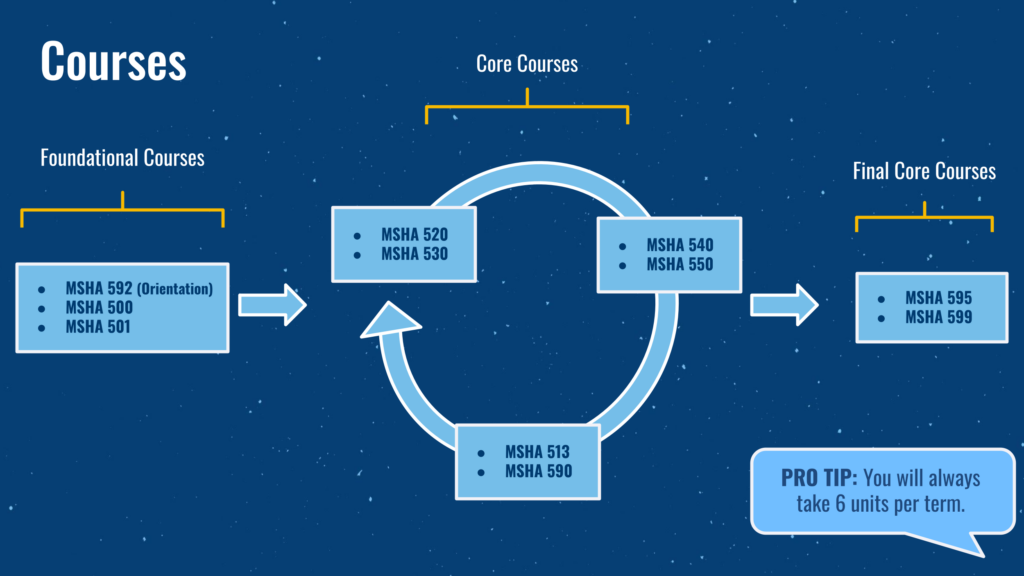
Completion of all the courses in the prescribed curriculum, of ten 3-unit courses for a total of 10 courses and 30 units, is required to successfully complete this program.
course titles and descriptions
Foundations: Peace, Justice and Social Change (MSHA 500)
The course introduces students to a series of big ideas for making the world more peaceful and just, and how to apply them in shaping their own lives and careers of purpose. The first half of the course features lectures and discussion sections that explore foundational theories behind peace, justice, and social innovation; where they overlap; and where they are in tension. The second half of the course explores specific fields of inquiry and practice in a more intimate setting, with an emphasis on comparing diverse approaches to common problems. Throughout the course, students will be challenged not simply to learn a spectrum of ideas and practices, but to understand how they fit together, where and how to learn more, and how to craft their own educational and professional trajectories so that they can be part of the change they want to see in the world.
Foundations of Humanitarian Action (MSHA 501)
The distinction between development aid and humanitarian aid is fast dissolving as complex humanitarian emergencies (CHEs) become protracted and global climate change leads to the increasing scope and frequency of natural disasters. This course will discuss the principles and politics that shape humanitarian practice and give students the tools to pursue positive outcomes in an increasingly complex humanitarian space. The course will provide an overview of the evolution of humanitarian assistance and an analysis of how this evolution shaped the current humanitarian regime. It will give students a sophisticated sense of the current humanitarian landscape and its different actors, from government donors to UN agencies and local and international NGOs. It will discuss best practices in key humanitarian sectors and give students the knowledge necessary to engage the key conversations and controversies currently shaping humanitarian practice and policy.
Program Monitoring and Evaluation (MSHA 513)
Humanitarian interventions take place in conflict-affected and politically-sensitive contexts. Humanitarian actors have the ethical responsibility to ensure that their work has a positive impact and avoids doing harm. Moreover, there is increasing pressure from donors that limited resources are used in programs to maximize relevance, effectiveness, efficacy, efficiency, impact, and sustainability of funded programs. Accordingly, design, monitoring, and evaluation (DME) have become indispensable parts of humanitarian and peacebuilding programming. This course is designed to prepare students to design, monitor, and evaluate humanitarian interventions. It will feature case studies, hands-on exercises, and specialist guest lectures to develop familiarity with planning tools, evaluation types and designs, metrics and indicators, data collection methods, and human subjects research ethics. Students will be required for their final project to produce an evaluation plan for an appropriate intervention of their choosing. Prerequisites: MSHA 500 & MSHA 501.
Disaster Management and Prevention (MSHA 520)
Climate change and ecological collapse pose growing threats to people, states, and economies. It has been estimated that a 1-degree increase in global temperatures would require a near tripling in disaster response spending over 15 years just to match the current level of humanitarian coverage. However, it has also been shown some truth to the old proverb about ounces of prevention: for every dollar spent on reducing vulnerability to disaster, two dollars are avoided on future damages. This course is designed to introduce students to the basic theories, strategies, and best practices for reducing the risk of hazards and technological disasters in an age of environmental and political instability. Along the way, it will encourage students to think critically about the so-called “triple nexus” between humanitarianism, development, and peacebuilding. Prerequisites: MSHA 500 & MSHA 501.
Humanitarian Diplomacy (MSHA 530)
This course is designed to provide students with two critical frameworks for accessing and operating in humanitarian crises. On the one hand, it explores official, state-level (Track I) bi- or multi-lateral diplomatic efforts to prevent, mitigate, or resolve humanitarian crises. On the other hand, it explores the unofficial (Track II) and micro-level initiatives of humanitarian negotiations engaged in by non-state actors to obtain access to crisis-affected populations, facilitate dialogue among parties to conflict or rivals for resources, and even broker truces, peace agreements, or other arrangements with the potential to reduce human suffering in Complex Humanitarian Emergencies. Prerequisites: MSHA 500 & MSHA 501.
Displacement, Climate and Humanitarian Action (MSHA 540)
Climate change is one of the urgent challenges of our time, and disaster displacement is one of its most devastating consequences. Populations worldwide are suffering the impacts, affecting people living in some of the most fragile and conflict-affected countries disproportionately. This course is designed to address the increasingly important links between climate change and mass migration, illustrating key challenges to, and new horizons of, humanitarian action in the coming decades. Prerequisites: MSHA 500 & MSHA 501.
Humanitarian Safety and Security (MSHA 550)
This course will introduce students to basic concepts, strategies, and practices for promoting safety and security in a humanitarian emergency. It will include modules on international humanitarian law, the system of global governance designed to tackle “problems without passports,” the responsibility to protect (R2P), humanitarian access negotiations, and best practices in the field. Prerequisites: MSHA 500 & MSHA 501.
Data Visualization and Analytics for Humanitarian Action (MSHA 590)
Long considered a “soft” area of practice, more art than science, humanitarianism and adjacent professional fields increasingly rely on using data to design, garner support for, and evaluate their initiatives. Data visualization comprises a powerful set of tools and techniques used to explore and present information. Combined with program research skills and fluency in statistics, it can help us understand problems we confront, interventions we craft to solve them, and the effects of those interventions. It can help us to communicate, telling visual stories that can convince our target audience, be they colleagues, policymakers, funders, or the general public. This course is designed to cultivate basic data visualization and statistical skills that can provide a solid professional advantage in the job market. Prerequisites: MSHA 500 & MSHA 501.
Logistics for Humanitarian Relief (MSHA 595)
This course serves as an introduction to many of the most common technical aspects of humanitarian aid delivery, including camp coordination and camp management (CCCM), water & sanitation, food aid, public health planning, and rapid needs assessments. Prerequisites: MSHA 500, MSHA 501, MSHA 520, MSHA 530, MSHA 540, MSHA 550, MSHA 513, & MSHA 590.
Humanitarian Crisis Simulation (MSHA 599)
This multi-module virtual simulation explores complex humanitarian emergencies, designed to engage advanced students in synthesizing and applying the knowledge and skills acquired throughout the MSHA program. Emphasizing collaboration, critical thinking, crisis management, and communication, the simulation employs multimedia elements to place students in the role of professional humanitarian workers employed by the fictional NGO, Kroc Corps. Participants will undergo an intensive “new hire” training program before deploying to a country experiencing a humanitarian crisis. During deployment, they will work in teams to conduct stakeholder interviews, engaging with a diverse array of actors, including politicians, law enforcement officials, migrants, and local civilians, in order to assess conditions on the ground. Confronted with real-time emergencies in the field, students must formulate a strategic plan for Kroc Corps and its partners, addressing the multidimensional challenges of the crisis with analytical rigor and professional competence.
Prerequisites: MSHA 500, MSHA 501, MSHA 520, MSHA 530, MSHA 540, MSHA 550, MSHA 513, & MSHA 590.
Student Resources
This list is helpful resources that will set you up for success. Haven’t written in APA formatting since your undergraduate program? We’ve got you covered! Want to know what type of computer you will need? No problem. We have listed helpful resources below.
Online Student Handbook
Graduate Student Code of Rights and Responsibilities
Canvas @ USD
In your program, you can think of Canvas as your virtual tool to share information with professors and peers. You will use Canvas to access your course content, find course syllabi, review your assignments, and more. Be sure to use your USD credentials to log in. If you have any difficulty logging into your course, be sure to contact ITS at (619) 260-7900 or [email protected].

Netiquette Guidelines
The concept of netiquette covers proper communication online. Read our guidelines to help cultivate a supportive and productive online environment.
your partners toward success
At USD, you join a community of individuals who are all committed to one common goal: your success. As you familiarize yourself with your team, take the opportunity to virtually meet and connect with the resources available to you as a student. Click on the profiles below to learn more about each office or staff member and watch a brief video about their role in supporting you through graduation.















USD Quick Links
- USD Directory (For Faculty or Staff Contact Information)
- Torero Hub
- Health and Wellness
- SOLES Graduate Writing Center
- Military and Veterans Program Center
- Disability and Learning Difference Resource Center
- Copley Library
- Career Development Center
- Campus Recreation (Remote and On-Campus Classes Offered)
Career and professional resources
Whether you're hoping to find a new job or earn a promotion, USD has a wealth of resources available to prepare you for your dream role.