Student Success Center
MSN in Nursing Leadership (Online)

Log into your courses
Welcome!
As an online student, most of your interactions with the university will be done through various websites. For example:
- You’ll use your USD Email Address for all university-related communications.
- You’ll use Canvas for all of your coursework and assignments. See Canvas Tips and Tricks page.
- You’ll use your MySanDiego portal for tuition payments and to access most campus resources.
- You’ll use this site, your Student Success Center, to get specific information about textbook information, deadlines, and more!
 (619) 260-7672



Stay Connected with your Program




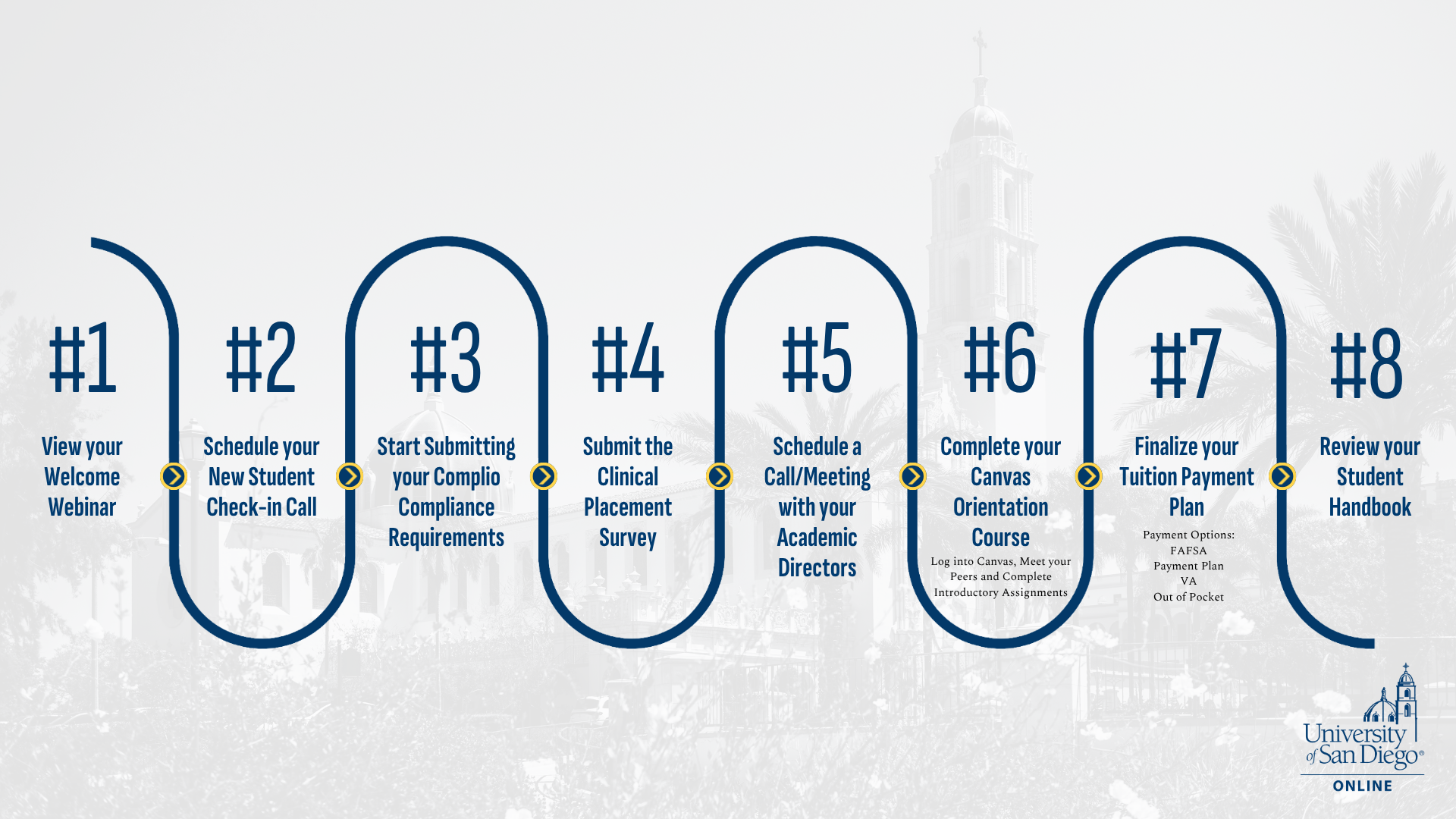
COMPLETE YOUR MANDATORY NEW STUDENT CHECKLIST
Our number one priority is you! Our team has prepared a checklist of items that will set you up for success and clarify all action items as a new student. After you are enrolled for your first term and receive a confirmation email from a member of our team, please complete and review all of the following before classes start.
1. View your Mandatory New Student Welcome Webinar
This webinar will provide a comprehensive look at your program and what to expect as an online learner, including resources and tips for success. Each webinar should last around 30-40 minutes. Once you have been registered for classes and received a confirmation email from our team, you will be emailed the link to schedule your welcome webinar to your @sandiego.edu email address.
2. Schedule your New Student Check-in Call
In this call, you’ll “meet” a member of your Student Success Team for your program. This will be a chance for us to answer any additional questions you have before you start your first term. Please be sure to have any Canvas-related, program-related, or finance-related questions prepared. After attending the Welcome Webinar, you will be prompted to schedule your call using a scheduling link.
3. Submit your Complio Compliance Requirements
Complio is a repository of mandatory health requirements based on the San Diego Nursing Consortium. All students are required to have their background check and drug screening completed prior to their first day of the program. All Complio requirements must be approved/completed within 3 weeks of being registered. Completing the compliance onboarding requirements can take some time to complete - start the process now!
- If you are new to Complio, create a new account using your @sandiego.edu email address.
- If you are a returning Complio user, you may use your existing account, but you are required to set the primary email address as your @sandiego.edu email address.
- The system will prompt you to submit all requirements including but not limited to: background check, drug screening, TB tests, blood tests, medical records, immunizations, etc.
The Hahn School of Nursing and Health Science (HSON) has a dedicated compliance team to assist with clinical placements, out of compliance risk reminders,and more. Contact the HSON Compliance team at [email protected].
4. Submit the Clinical Placement Survey
USD will help you find a clinical placement for the clinical practicum courses in the program. In order to best assist you, please submit the Clinical Placement Survey if you have not already done so. If you have a clinical site or preceptor in mind, please include that information in your submission.
5. Schedule a Call/Meeting with your Academic Directors
The Clinical Placement survey must be submitted before this meeting/call is scheduled. This phone call/zoom meeting is an opportunity to review your Clinical Placement Survey response and discuss next steps in the clinical placement process. If you have a clinical site or preceptor in mind, please include that information in your submission.
6. Complete Your Canvas Orientation Course - Due January 1, 2027
Once you have been registered in your classes, you will be able to access your New Student Orientation Course (MSNC 501) on Canvas within 4 hours. When accessing Canvas, please make sure to use Firefox or Chrome as your browser.
The New Student Orientation course is designed to help you navigate your way around your course's layout prior to beginning your first class. You will learn where to find the syllabus, course schedule, assignments, and discussion boards.
Your Orientation is mandatory, and must be completed before the first day of class—so we encourage you to get started! Please plan to spend about 16-20 hours completing the Orientation course. You can move through the Orientation at your own pace, so schedule your time accordingly.
Looking for assistance?
7. Finalize your Tuition Payment Plan
We recommend that students start this planning early as some funding sources can take some time to process. Tuition payments should be completed in full by the first day of the semester. Visit the "Tuition and Payment Methods" section for more information.
8. Review your Student Handbook
Please make sure to review your student handbook prior to the first day of class, and reference it as needed throughout your program. The handbook is where you can find information on academic expectations, drop and refund policy, technology requirements, curriculum, frequently asked questions, and more.
IMPORTANT DATES
Below is a list of significant dates regarding the registration process, payment deadlines, and other important academic and program deadlines.
Fall 2026 Dates and Deadlines
| Important Dates | Date |
|---|---|
| Registration Opens | June 29, 2026 |
| Application Deadline | July 31, 2026 |
| Registration Deadline | August 14, 2026 |
| Orientation Course Due Date | August 28, 2026 |
| Last Day to Drop with 100% Tuition Refund* | August 31, 2026 |
| Payment Due Date | September 1, 2026 |
| Semester Begins | September 1, 2026 |
| First Course Start Date | September 1, 2026 |
| Last Day to Drop with 95% Tuition Refund/ Drop Deadline* | September 4, 2026 |
| Last Day to Withdraw from Course A | September 28, 2026 |
| First Course End Date | October 19, 2026 |
| Second Course Start Date | October 20, 2026 |
| First Course Final Grade Submission Due Date | October 26, 2026 |
| Last Day to Withdraw from Course B | November 16, 2026 |
| Second Course End Date | December 7, 2026 |
| Semester Ends | December 7, 2026 |
| Second Course Final Grade Submission Due Date | December 14, 2026 |
Spring 2027 Dates and Deadlines
| Important Dates | Date |
|---|---|
| Registration Opens | November 2, 2026 |
| Application Deadline | November 30, 2026 |
| Registration Deadline | December 14, 2026 |
| Orientation Course Due Date | January 1, 2027 |
| Last Day to Drop with 100% Tuition Refund* | January 4, 2027 |
| Payment Due Date | January 5, 2027 |
| Semester Begins | January 5, 2027 |
| First Course Start Date | January 5, 2027 |
| Last Day to Drop with 95% Tuition Refund/ Drop Deadline* | January 8, 2027 |
| Last Day to Withdraw from Course A | February 1, 2027 |
| First Course End Date | February 22, 2027 |
| Second Course Start Date | February 23, 2027 |
| First Course Final Grade Submission Due Date | March 1, 2027 |
| Last Day to Withdraw from Course B | March 22, 2027 |
| Second Course End Date | April 12, 2027 |
| Semester Ends | April 12, 2027 |
| Second Course Final Grade Submission Due Date | April 19, 2027 |
Summer 2027 Dates and Deadlines
| Important Dates | Date |
|---|---|
| Registration Opens | March 1, 2027 |
| Application Deadline | April 2, 2027 |
| Registration Deadline | April 16, 2027 |
| Orientation Course Due Date | April 30, 2027 |
| Last Day to Drop with 100% Tuition Refund* | May 3, 2027 |
| Payment Due Date | May 4, 2027 |
| Semester Begins | May 4, 2027 |
| First Course Start Date | May 4, 2027 |
| Last Day to Drop with 95% Tuition Refund/ Drop Deadline* | May 7, 2027 |
| Last Day to Withdraw from Course A | May 31, 2027 |
| First Course End Date | June 21, 2027 |
| Second Course Start Date | June 22, 2027 |
| First Course Final Grade Submission Due Date | July 5, 2027 |
| Last Day to Withdraw from Course B | July 19, 2027 |
| Second Course End Date | August 9, 2027 |
| Semester Ends | August 9, 2027 |
| Second Course Final Grade Submission Due Date | August 16, 2027 |
Download a pdf of your academic calendar

Upcoming Events
Don't miss out on connecting with your University of San Diego global community through a variety of events - featuring academic workshops, cultural celebrations, networking events, and more. There’s something for everyone!
Class Registration Directions
You have most likely already filled out an Enrollment Commitment, which enables our team to register you for classes each term. No further action is required on your part, but you may view your course registration on your MySanDiego portal.
If you are not able to register for both of your courses in a given term, please contact your Program Coordinator or email [email protected] immediately. This often happens for students who need to take a leave of absence.
Textbook information
Students are required to have their textbooks on hand by the first day of class. Unless otherwise specified, students may select any vendor they prefer (such as Amazon.com, Half.com, Alibris.com, etc.) to purchase their course materials. In the event a specific vendor is required, it will be specified in the course materials list. The best way to ensure that you have the correct book is to search by the ISBN number(s) listed on the book list.
Physical copies of books are not on hand at the USD Torero Store. The USD Torero online store does offer price comparisons for different online vendors for some books.
Although all textbooks for all courses are listed, students only need to purchase the items for the classes they are taking for the semester.
Digital Inclusive Access (IA) - Integrated VitalSource Textbooks
If your course is indicated to have a "Digital Inclusive Access" textbook, you do have the option to use the integrated Vitalsource e-textbook without needing to purchase a textbook through an outside vendor. For more information, view the "Digital Inclusive Access" FAQs document.
- Students are able to access the e-textbook directly in the course without worrying about purchasing the wrong version or textbook!
- If your course is indicated as using “Digital Inclusive Access” on the textbook list, please note that you must opt-out within the first 7 days of each course to avoid being charged for the guaranteed-lowest price textbook.
- If you do intend to use “Digital Inclusive Access”, no further action is required after you create a Vitalsource account.
- No refunds can be issued once the textbook charge has been assessed.
By using Vitalsource e-Textbooks, students are able to use study tools in Bookshelf such as highlighting, printing limited pages/chapters, sharing notes, and using the Bookshelf CoachMe tool to test their learning while they read.
PAYing for your program
Tuition at USD is billed per semester, not per course. Payment (or enrollment in an official USD payment plan) is always due by the first day of the semester. Students may not carry balances from one semester to the next.
Accounts with outstanding balances after the official payment due date may be subject to course cancellations/removal or a student account hold during the semester; related holds can prevent upcoming registration, graduation, or obtaining transcripts.
Remember: tuition is always due by the first day of each semester.
Tuition amounts shown on this website, or in other university publications or web pages, represent tuition and fees as currently approved. However, the University of San Diego reserves the right to increase or modify tuition and fees without prior notice and to make such modifications applicable to students enrolled at USD at that time as well as to incoming students. In addition, all tuition amounts and fees are subject to change at any time for correction of errors.
Program Tuition
Once you have been registered for your courses, your student account will reflect the appropriate tuition costs according to your program. In the MSN-NL program, your total enrollment/units will vary each semester (6-9 units), so your semester tuition will depend on the total units enrolled. Payments not received by the deadlines are subject to late fees. Your program’s tuition is the following:
- Per Unit (classes are typically 3-units) = $995
- Per Semester (assuming 6-units per semester) = $5,970
- Total Program Cost (36 units for Nursing Leadership) = $35,820
- Total Program Cost (45 units for Nursing Educator or Informatics) = $44,775
- Total Program Cost (46 units for DUIN Nursing Leadership/Informatics) = $45,770
Depending on the total units in each semester, you will be considered "part-time" (4.5-8.99 units) or "full-time" (9+ units); these statuses may impact your financial aid or military/veteran benefits. Contact the Torero Hub team or Military and Veterans Program at [email protected] for details.
Students who need to re-take or withdraw from a course may need to pay additional fees according to the Refund/Drop Deadline policies listed in your Student Handbook.
If you have any questions about your Student Account, please reach out to the Torero Hub by submitting their inquiry form or phone at 619-260-2700. All costs and fees are subject to change and are based on the academic year of enrollment.
Technology and compliance fee
Please note that students in USD’s MSN in Nursing Leadership program are required pay a $110 technology and compliance fee each semester which covers compliance subscriptions and clinical logging/portfolio applications (Project Concert and Complio) associated with the degree programs. This fee is subject to change annually.
scholarships
Registered nurses enrolled in the Hahn School of Nursing’s MSN Nursing Leadership programs are eligible for a number of external scholarships. Students are encouraged to visit the Hahn School of Nursing scholarship webpage. Relevant information can be filtered by program. The Hahn School of Nursing is also excited to announce internal scholarships for some newly enrolled students in the MSN Nursing Leadership program for the 2025-2026 academic year. Eligibility is based on criteria in the Nursing Leadership program application. Students that have accepted their offer of admission will be notified of the awards in mid-August.
For more information, please contact Amy Wright, Director of Student Services, at [email protected].
Refund Policy
Students will be registered for their prescribed courses each semester. All courses must be dropped prior to the first day of the semester to receive a 100% tuition refund and within the first three days of the start date of the semester to receive a 95% tuition refund. No refund (reversal of tuition) will be provided after the third day of the semester for any class.
DEGREE PROGRESS and COMMENCEMENT
DegreeWorks
You can track your progress toward earning your degree using the Degree Works feature in your MySanDiego student portal. Degree Works shows you which courses you have completed, grades, cumulative GPA, any outstanding graduation requirements, and more!
To access Degree Works:
- Log in to your MySanDiego student portal.
- Under the “Torero Hub” tab, click on “My Academics.”
- On the right-hand side under “My Academic Resources”, click on “Degree Works.”
Petition to Graduate
Submitting your petition to graduate is a requirement for every student. About a semester before your final term, you will be reminded by your Program Coordinator to submit your petition to graduate. Once completed, your Academic Coordinator will review your academic record and contact you if there are any outstanding requirements or issues.
Commencement timing
If you are planning on participating in the commencement ceremony (which means walking in your cap and gown here on campus), you will be invited to come to the University of San Diego to participate in the ceremony. Commencement details and information will be sent from your Student Success Team around the month of February.
- There is only one commencement ceremony each academic year in May.
- Fall and Spring graduates will be invited to the commencement ceremony the May after they graduate.
- Summer graduates will be invited to the commencement ceremony the May before they graduate.
Diploma Details
The Registrar will process their final audit of the degrees 6-8 weeks after grades are posted for your final semester. Once the degree is conferred in the system, the Registrar will order your diploma from the vendor and the vendor will send it to you directly to the address that was listed on your petition to graduate.
If your mailing address changes after you submit your Petition to Graduate, please notify the Graduate Records office at (619) 260-2217 or [email protected].
You will receive a digital diploma to your @sandiego.edu email address once your degree has been officially conferred.
You will also receive a physical diploma. Mailing time is an additional 6-8 weeks from the date of order, and you will likely receive your diploma in the mail in 3-4 months after you have completed your degree requirements.
Course Details
program requirements
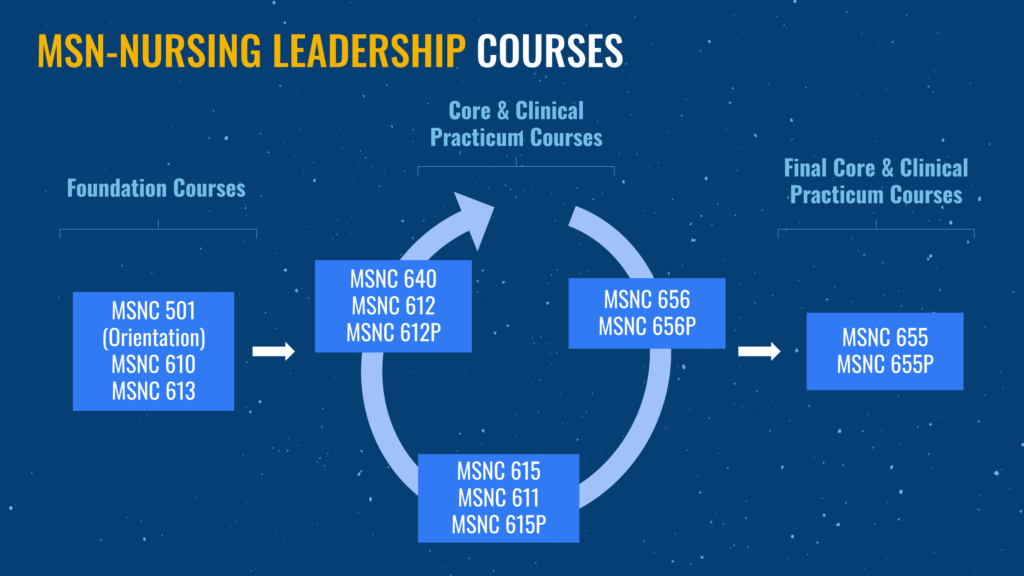
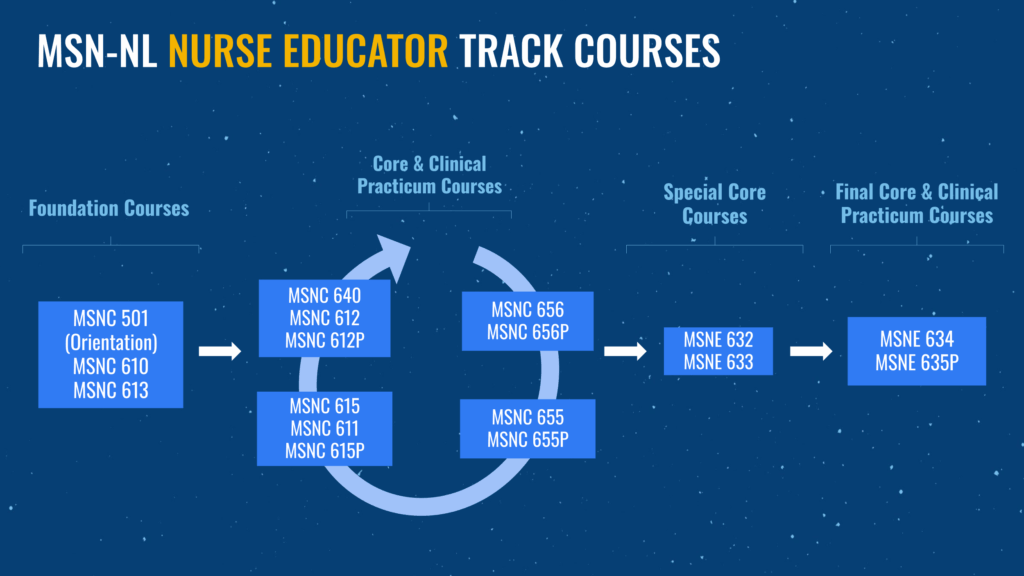
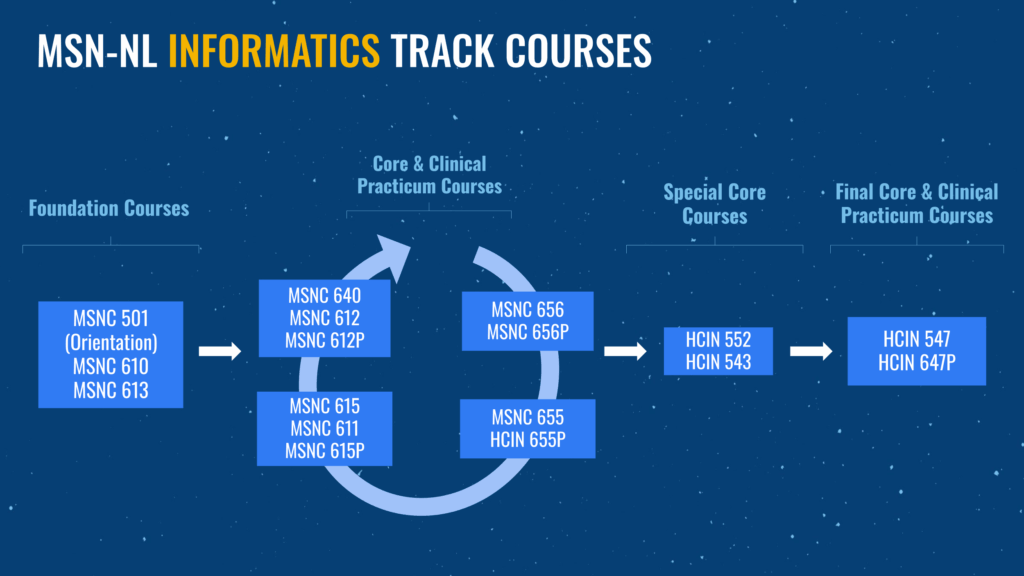
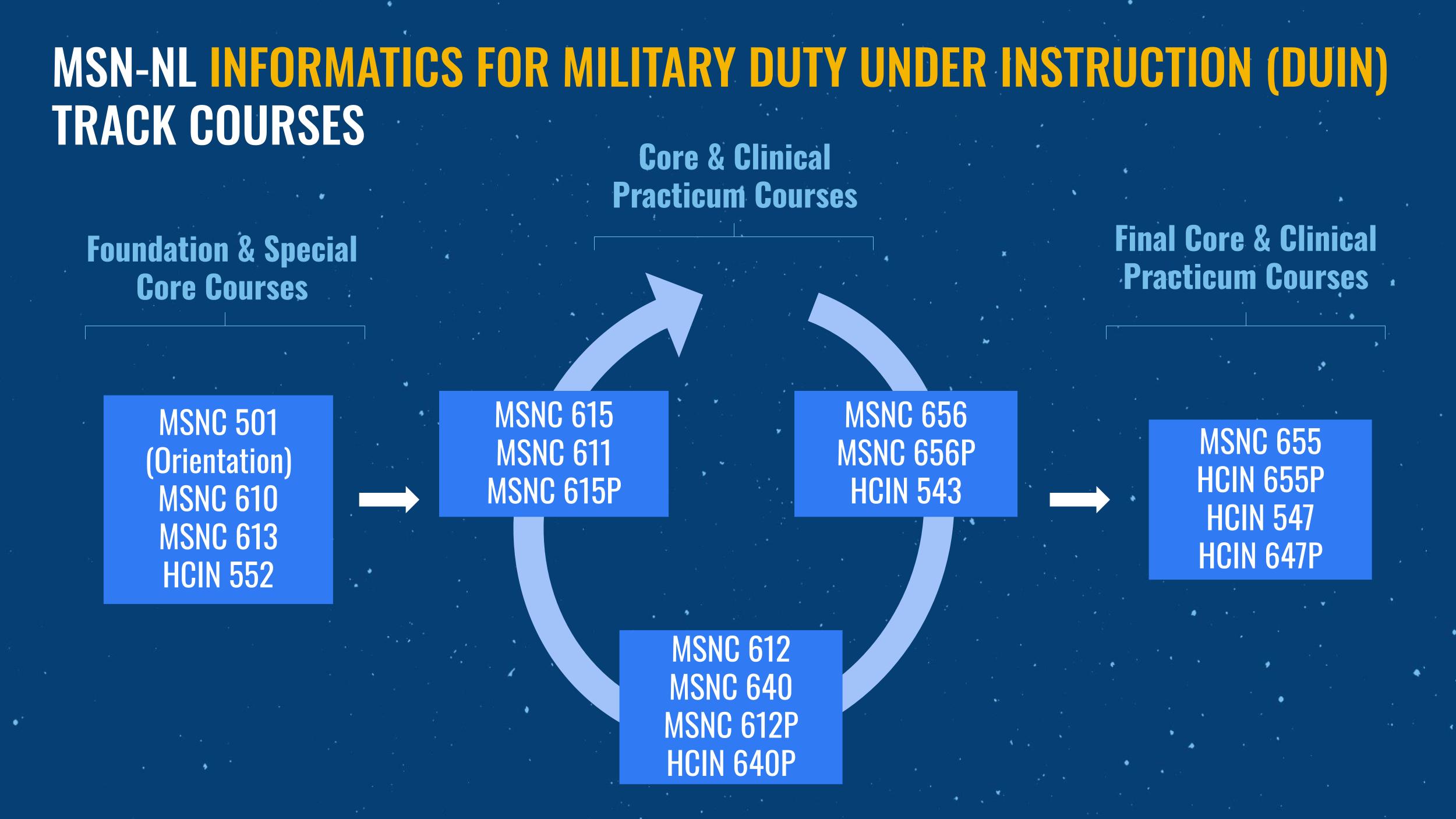
There are four potential tracks in the MSN-NL program: Nursing Leadership, Nursing Educator, Informatics, or Informatics for Duty under Instruction. Completing all of the courses in your prescribed curriculum is required for program graduation.
View your Program's Course Carousel
The total unit degree requirements vary depending on your track. In most semesters, students will enroll in 2-4 asynchronous online courses, which may include a practicum course involving a hands-on learning experience in a real-world setting (often a professional environment). All tracks have foundational courses that must be completed during the first semester. After the first semester is complete, students enter the "carousel", meaning that students will enroll in whatever core courses are offered during that semester. The carousel schedule allows students to interact with other students in the program beyond their initial course classmates.
- MSN in Nursing Leadership = 36 units
- MSN in Nursing Leadership, Nurse Educator = 45 units
- MSN in Nursing Leadership, Informatics = 45 units
- MSN in Nursing Leadership, Informatics for Duty under Instruction = 46 units
Course Titles and Descriptions
Advanced Nursing Practice: Foundations and Specialty Roles (MSNC 610)
The course introduces the foundational underpinnings of advanced professional nursing practice. The acquisition and use of nursing knowledge are discussed. An overview of person-centered care, population health, quality improvement, safety, and informatics is presented. The concepts of clinical judgment, compassionate care, ethics, diversity, equity, and inclusion, and social determinants of health are emphasized. Prerequisites: None
Foundations of Evidence-Based Practice in Nursing (MSNC 611)
This course focuses on the generation, translation, synthesis, application, and dissemination of nursing knowledge. The theoretical foundations of nursing and other sciences are discussed including how theory has influenced the practice of nursing and clinical decision-making. The concepts of clinical judgment, ethics, and evidence-based practice are emphasized. Prerequisites: None
Population Health (MSNC 612)
This course focuses on population health from disease prevention to disease management. Collaborative partnerships, advocacy strategies, and health policies for improved population health outcomes are also discussed. Emergency preparedness for public health emergencies is explored. The concepts of health policy, social determinants of health, and diversity, equity, and inclusion, are emphasized. Prerequisites: None
Population Health Practicum (MSNC 612P)
In collaboration with community partners, this practicum focuses on analyzing health data to identify trends, disparities, and risk factors. It uses evidence-based strategies to inform public health interventions. The design, implementation, and evaluation of public health programs in collaboration with interdisciplinary teams and community stakeholders to improve health outcomes for diverse populations is examined. The concepts of communication, social determinants of health, and diversity, equity, and inclusion are emphasized. Prerequisites: None
Transformational Leadership (MSNC 613)
This course focuses on leadership and the acquisition of leadership skills. The theoretical and practical perspectives of the role are discussed. An introduction to interprofessional partnerships and systems-based practice is presented. A more detailed discussion of the nurse leader’s role with population health is examined. The concepts of ethics, communication, health policy, and diversity, equity and inclusion are emphasized. Prerequisites: None
Advanced Pathophysiology, Physical Assessment, and Pharmacology in Patients and Populations (MSNC 615)
This course applies an evidence-based approach to understanding common pathophysiological processes across the lifespan, employing physical examination techniques to distinguish abnormal and normal disease presentation, and applying pharmacotherapeutics for monitoring treatment plans in patients and populations. Emphasis is on an integrated approach to mastery of advanced scientific knowledge, vital to clinical judgment and practicing in an advanced specialty role. Concepts of compassionate care, clinical judgment, and ethics of health are emphasized. Prerequisites: None
Advanced Nurse Clinician Practicum (MSNC 615P)
In collaboration with community partners, this practicum focuses on acquiring advanced patient assessment and management skills, integrating advanced scientific knowledge with context-driven reasoning to manage patients with complex health problems effectively. Emphasis is on the proficient use of information and communication technologies to support patient care, facilitate seamless interprofessional communication, and optimize healthcare workflows. Through this practicum, students will also cultivate socially responsible leadership skills and uphold ethical standards in clinical practice and scholarly activities, ensuring adherence to relevant laws, policies, and regulations. The concepts of clinical judgment, compassionate care, and evidence-based practice are emphasized. Prerequisites: None
Health Care Information and Communication Management (MSNC 640)
This course focuses on using information and communication technologies to improve patient care, enhance healthcare outcomes, and optimize healthcare processes. The technologies, the users interacting with the technologies, and the work product are discussed, along with the impact of the data collected, information formed, decisions made, and the knowledge generated. It also addresses regulatory, patient privacy, information security, and reimbursement issues. The concepts of clinical judgment, communication, social determinants of health, and ethics are emphasized. Prerequisites: None
Health Care Information and Communication Management Practicum (HCIN 640P)
In collaboration with community partners, this practicum focuses on using information and communication technologies to improve patient care, healthcare outcomes, and healthcare processes. It examines the use of electronic health records to enhance care delivery, reduce errors, and meet regulatory requirements. It also explores the application of human factors in selecting clinical documentation tools, the importance of safeguarding health information systems, and strategies for successful EHR implementation and workflow optimization. The concepts of communication, ethics, and clinical judgment are emphasized. Prerequisites: None
Systems-Based Practice (MSNC 655)
This course focuses on managing complex healthcare systems to optimize system effectiveness. The theoretical underpinnings of systems theory and its application to healthcare are explored. Strategic planning, healthcare policy, and healthcare economics are discussed. Interprofessional partnerships and professional development are examined. The concepts of evidence-based practice, ethics, diversity, equity, and inclusion, and health policy are emphasized. Prerequisites: None
Systems-Based Practice Practicum (MSNC 655P)
In collaboration with community partners, this practicum focuses on managing complex healthcare systems to optimize system effectiveness. The practical aspects of leading an interprofessional team, implementing and evaluating a system-wide initiative, and developing a policy are experienced. Leadership and advocacy skills in a complex environment are mastered. The concepts of evidence-based practice, ethics, and health policy are emphasized. Prerequisites: None
Management of Quality and Safety (MSNC 656)
This course focuses on the evaluation and management of quality and safety issues from individual and systems perspectives. The theoretical and methodological foundations for understanding, identifying, and managing quality and safety concerns are explored. The application of quality improvement initiatives and the development of a culture of safety for patients and healthcare personnel are discussed. The concepts of communication, evidence-based practice, and diversity, equity, and inclusion are emphasized.
Management of Quality and Safety Practicum (MSNC 656P)
In collaboration with community partners, this practicum focuses on the evaluation and management of quality and safety issues from an individual and systems perspective. The practical aspects of identifying and managing quality and safety concerns in the clinical setting are experienced. The application of quality improvement initiatives and the development of a culture of safety for patients and healthcare personnel are mastered. The concepts of communication, evidence-based practice, and ethics are emphasized. Prerequisites: None
Theory of Nursing Education (MSNE 632)
This course focuses on the theories and implementation of higher education, nursing education, and the faculty role. The impact of social, technological, economic, political, ethical, and institutional factors on the instructional process is presented. Analysis of program and curriculum design, outcome assessment and evaluation strategies are examined. The concepts of the nurse educator as a change agent and leader, diversity, equity, and inclusion in education, and interprofessional collaboration are emphasized. Prerequisites: None
Curriculum Development (MSNE 633)
This course focuses on evidence-based curriculum development and revision strategies that support diverse learners, promote professional development, and foster a culture of scholarly inquiry. Analysis of the use of assessment and evaluation strategies in the curriculum design process and the evaluation of program outcomes are examined. The impact of social, technological, economic, political, ethical, and institutional factors on curriculum development is emphasized. Prerequisites: None
Assessment and Evaluation Strategies for Nursing Education (MSNE 634)
This course focuses on the development of evidence-based assessment and evaluation strategies in nursing education across the cognitive, psychomotor, and affective domains. Varied data analysis techniques that facilitate learner development and review of program plans will be covered. The impact of social, technological, economic, political, ethical, and institutional factors on learners, assessment, and evaluation are emphasized. Prerequisites: None
Nurse Educator Practicum (MSNE 635P)
In collaboration with community partners, this practicum focuses on the development of learning outcomes, curriculum design, learning activities, and assessment and evaluation strategies in nursing education across the cognitive, psychomotor, and affective domains. Practical application of analysis of data, both assessment and evaluation, that facilitate learner development and support review of program plans are experienced. The impact of social, technological, economic, political, ethical, and institutional factors on learners, assessment, and evaluation are emphasized. Prerequisites: None
Database Design and Knowledge Management (HCIN 543)
This course offers opportunities for students to acquire advanced database skills. Applied skills, emphasizing database design, data structuring, modeling and the development of database management systems are examined. Fundamental competencies in knowledge management, change management, and system engineering as they pertain to the healthcare environment and related fields are explored. Students will design and manipulate databases using software applications, such as Structured Query Language (SQL), to resolve selected operational problems. Prerequisites: HCIN 540.
Health Care Analytics (HCIN 547)
The course emphasizes the practical application of data analytics in addressing specific clinical queries, crafting clinical decision support rules, and employing precision medicine concepts. Students will develop the practical skills necessary to use various types of clinical data in addressing clinical inquiries using an evidenced-based approach. A range of clinical data sets will be examined including those at the population level. Through clinical case studies students will develop their data analytics expertise. Prerequisites: HCIN 543
Clinical Documentation: Electronic Medical Record Systems (HCIN 552)
Students will engage in a comprehensive exploration of clinical documentation systems. This course offers a blend of theoretical knowledge and practical application, with a strong focus on experiential learning using an academic electronic health record system. Students will trace the historical trajectory of clinical documentation systems, gaining insight into their development and evolution over time. Students will examine the intricate hardware and software requirements essential for Electronic Health Records (EHRs). A problem-based learning approach is employed to cultivate students' proficiency in developing clinical rules and alert systems for clinical information systems. These skills will be applied for purposes such as quality assessment, risk analysis, billing processes, bioinformatics, genomics, and research applications. Emphasis is placed on understanding the regulatory landscape surrounding EHRs, including compliance with the Health Insurance Portability and Accountability Act (HIPAA), the Genetic Information Nondiscrimination Act (GINA), requirements from the Centers for Medicare and Medicaid Services (CMS), and information security regulations.
Nurse Informatics Practicum (HCIN 647P)
In collaboration with community partners, this practicum focuses on integrating clinical knowledge with informatics to improve patient care, enhance clinical workflows, and support data-driven decision-making. It involves collaborating with interprofessional teams to design, implement, and evaluate informatics solutions, critically assessing emerging technologies, and leading projects that align with organizational and patient care goals. Emphasis is placed on the ethical use of health information systems, ensuring data privacy, security, and compliance with legal and regulatory standards. The practicum aims to prepare students for leadership roles in nursing informatics, equipping them with the skills to drive innovation and improve healthcare outcomes through technology and data management. The concepts of clinical judgment, evidence-based practice, and communication are emphasized. Prerequisites: None
Systems-Based Practice Informatics Practicum (HCIN 655P)
In collaboration with community partners, this practicum focuses on managing complex healthcare systems to optimize system effectiveness. The practical aspects of leading an interprofessional team, implementing and evaluating a system-wide initiative, and developing a policy are experienced. Leadership and advocacy skills in a complex environment are mastered. The concepts of evidence-based practice, ethics, and health policy are emphasized. Prerequisites: None
Student Resources
This list is helpful resources that will set you up for success. Haven’t written in APA formatting since your undergraduate program? We’ve got you covered! Want to know what type of computer you will need? No problem. We have listed helpful resources below.
Academic Requirements and Resources
Technical Requirements
You must own or have unrestricted access to a computer for this program. A fast Internet connection is also mandatory. Computers should be Windows- or Mac-based and have a minimum of 512 GB SSD storage, 16-32 GB memory (RAM), and a processor of Intel Core i5 13th Gen or above.
Courses will utilize a variety of technologies and multimedia. To complete course activities and to access course content, please verify that you have the following technologies and plug-ins available:
- Browser Plug-ins – Windows Media Player, QuickTime, Shockwave, Adobe Reader, and Java.
- Mozilla Firefox or Google Chrome are the recommended browsers.
- Microsoft Office or the Google Suite is recommended. If you are using Office 2003 or earlier, download and install the Microsoft Office Compatibility pack. Students may log in using USDOne credentials and install applications directly on the Microsoft Portal.
- Speakers or headset – to listen to multimedia.
- Webcam – for recording video.
- Email – To contact your faculty.
- High-speed internet connection strongly encouraged (100mbps or better)
Complio
Complio is a repository of mandatory health requirements based on the San Diego Nursing Consortium. The system will prompt you to submit all agency requirements including but not limited to: background check, drug screening, TB tests, blood tests, medical records, immunizations, etc.
It is required for all students to set the @sandiego.edu email address as their primary email in Complio. Important announcements, reminders, and deadlines will be communicated to the @sandiego.edu email address. If you have an existing account, you must update the primary email to reflect the @sandiego.edu email address.
The Hahn School of Nursing and Health Science (HSON) has a dedicated compliance team to assist with clinical placements, out of compliance risk reminders, rejected documents, and more. You may be contacted with weekly compliance reminders if you are at risk of falling out of compliance. For any questions or assistance, please contact the HSON Compliance team at [email protected].
Project Concert
This tool will be used to help students plan, track, and evaluate their learning activities throughout the program. Students can validate clinical hours (time logs, assignments, etc.) and reflect on their clinical practicum experiences directly in Project Concert. Access to the platform will be granted within 24 hours after registration. In some instances, access may not start until the first day of class.
Questions and technical concerns can be reported to the Innovative Learning Department via Google Form.
Graduate Writing Expectations and Tips
All writing assignments must be formatted according to APA standards. Discussion posts must contain the appropriate APA citations. If you want additional writing support, we recommend Purdue Online Writing Lab (OWL@Purdue). In addition to general writing support, the website includes a special section dedicated to APA formatting guidelines.
Another helpful writing resource is the School of Leadership and Education Sciences (SOLES) Graduate Student Writing Center. Enrolled students can submit assignments for review by a writing professional.
The Copley Library at USD has prepared two guides: the Nursing LibGuide and the Health Care Informatics LibGuide. These guides have video tutorials, helpful websites, preprint sites, nursing journal feeds, and APA resources that can help with discussion and research-based assignments.
Copley Library Navigation
View our virtual workshop, "Copley Library Navigation, Citations and AI-Driven Research Skills," which introduces tools that make academic work smoother, smarter, and more efficient. In this session, you’ll learn how to navigate Copley Library like a pro, use citation resources with ease, and integrate AI tools such as SCITE to strengthen your research workflow. You’ll leave with practical strategies, time‑saving tips, and a personalized roadmap for thriving as a USD scholar.
Online Learning Strategies
View our virtual workshop, "Online Learning Unlocked: Strategies, Resources & Collaboration," which will equip you with practical knowledge and skills to apply tangible strategies to learn online in an asynchronous environment throughout your Master's Degree!
Artificial Intelligence (AI)
With the rise of AI writing assistants, students must ensure that they use this new technology ethically and honestly. Consult this document for guidance.
View the Navigating Generative AI Workshop recording.
Review the Mastering Research in the AI and Digital Age recording.
NotebookLM is an AI-powered research assistant that can help you get to critical insights faster and easier, all grounded in the information you provide. Upload your sources and NotebookLM will summarize your information and make interesting connections between topics. Listen and learn on the go by turning your sources into engaging audio and video discussions. Access it through any web browser or via its mobile app (iOS and Android). Leveraging NotebookLM for Your Graduate Studies at USD guide.
Download Microsoft Office 365 (Free for USD Students)
Students at the University of San Diego are able to download Microsoft Office 365 for free! If you don’t have it already, you can download the Microsoft Office 365 suite using your USD student email.
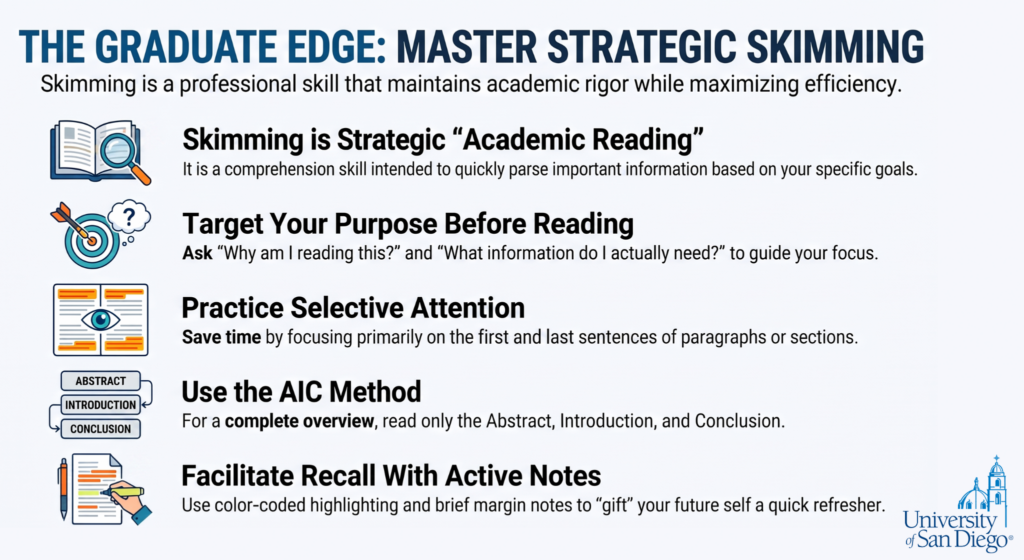
Skimming 101: Managing the Reading Load of Graduate Work
Students at the University of San Diego were invited to attend this session focused on applying strategies to accelerate their reading and information processing.
View the 3-minute summary video on academic skimming.
External Tutoring Resource
USD does not offer subject-specific tutoring resources, so students who are looking for tutoring support are encouraged to identify a tutor using Wyzant.com. Please note that Wyzant is not a USD-managed resource, so use them at your own discretion.
Career Readiness
If you're looking for assistance with career counseling, resume and interview preparation, salary negotiation guides, and student employment opportunities, view the Career Resources page to learn more. Additionally, students can leverage key networking and recruitment tools like Handshake, LinkedIn, and USD’s T.E.A.M. network, as well as explore specialized professional certifications.
Student Wellness Resources
Our community is dedicated to supporting students holistically. Our goal is to increase mental health awareness, reduce stigma, and equip students with essential skills to succeed during their program and beyond. As a student, you have access to resources to support your academic success and personal development.
Online student handbook
graduate student code of rights and responsibilities
Canvas @ USD
In your program, you can think of Canvas as your virtual tool to share information with professors and peers. You will use Canvas to access your course content, find course syllabi, review your assignments, and more. Be sure to use your USD credentials to log in. If you have any difficulty logging into your course, be sure to contact ITS at (619) 260-7900 or [email protected].

Netiquette Guidelines
The concept of netiquette covers proper communication online. Read our guidelines to help cultivate a supportive and productive online environment.
your partners toward success
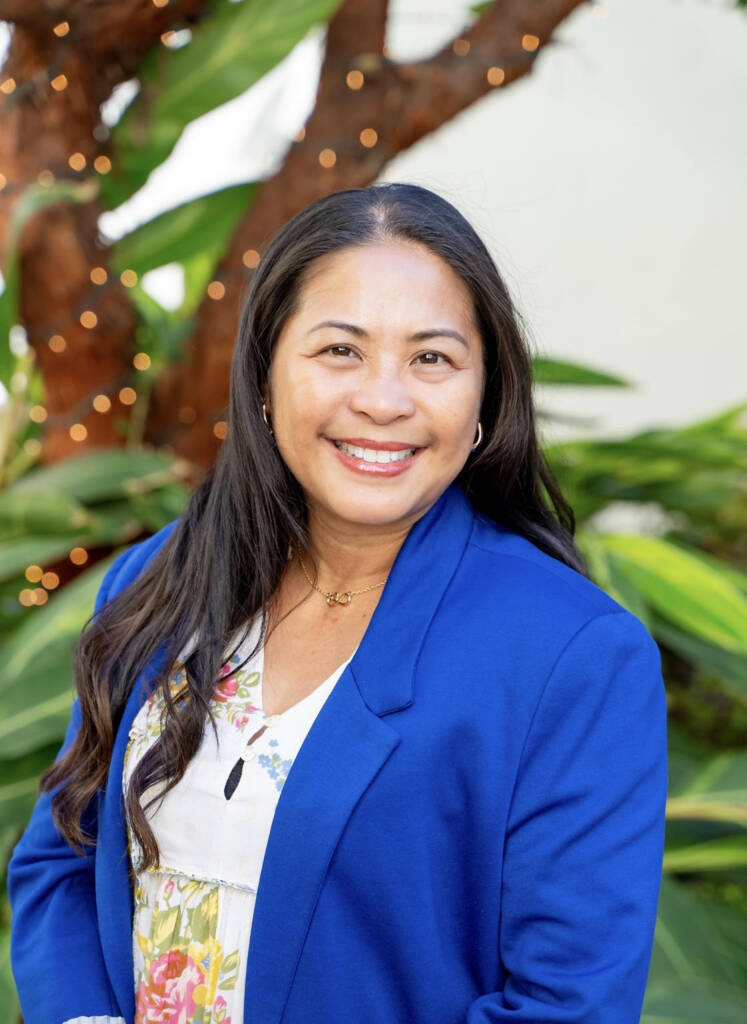
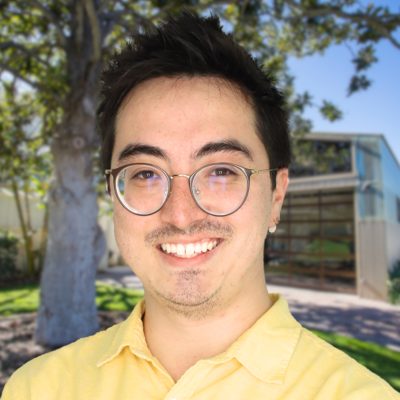
At USD, you join a community of individuals who are all committed to one common goal: your success. As you familiarize yourself with your team, take the opportunity to virtually meet and connect with the resources available to you as a student.














USD Quick Links
- USD Directory (For Faculty or Staff Contact Information)
- Torero Hub
- Health and Wellness
- SOLES Graduate Writing Center
- Epstein Family Military Center
- Disability and Learning Difference Resource Center
- Copley Library
- Career Development Center
- Campus Recreation (Remote and On-Campus Classes Offered)
Career and professional resources
Whether you're hoping to find a new job or earn a promotion, USD has a wealth of resources available to prepare you for your dream role.
Certification Opportunities
Upon graduation, students may qualify for the following certification opportunities based on their professional experience. Be sure to check the eligibility requirements for detailed information.
- NLN Certified Nurse Educator (CNE®) — National League for Nursing (NLN)
- Certified Academic Clinical Nurse Educator (CNEcl®) — National League for Nursing (NLN)
- Clinical Nurse Leader (CNL) Certification — American Association of Colleges of Nursing (AACN)
- Certified Nurse Manager and Leader Certification (CNML) — American Organization for Nursing Leadership™ (AONL)
- Nurse Executive Certification (NE-BC®) — American Nurses Association (ANA)
- Certified in Executive Nursing Practice (CENP®) Certification — (AONL)
- Informatics Nursing Certification (NI-BC™) — American Nurses Credential Center- American Nurses Association (ANCC )(ANA)
Professional organizations and memberships
Nursing Leadership and Administration
- American Organization for Nursing Leadership (AONL): The premier association for nursing leaders, offering resources, education, and certifications such as the Certified Nurse Manager and Leader (CNML) and Certified in Executive Nursing Practice (CENP).
www.aonl.org - American College of Healthcare Executives (ACHE): A multidisciplinary association for senior healthcare leaders, ideal for those looking to expand into broader executive roles.
- Sigma Theta Tau International Honor Society of Nursing (Sigma): Focuses on nursing leadership, scholarship, and advancement across disciplines.
- National League for Nursing (NLN): Strong for nurse leaders within academia and administration.
Clinical Nurse Leader (CNL)
- American Association of Colleges of Nursing (AACN): Governs the CNL role and certification.
- Clinical Nurse Leader Association (CNLA): Provides resources, networking, and best practices for CNLs.
Nurse Educators
- National League for Nursing (NLN): Advocates for nursing education and provides certification for nurse educators.
- American Association of Colleges of Nursing (AACN): Provides guidance and resources for nursing education.
Nursing Informatics
- American Nursing Informatics Association (ANIA): Supports nursing informatics professionals with networking and education.
- Healthcare Information and Management Systems Society (HIMSS): An interdisciplinary organization focusing on health IT and nursing informatics. As a University of San Diego Online MSN-NL student, you are eligible for a free student membership with HIMSS. Benefits include Networking and Career Resources, Access to a Private Networking Hub (including previous conference recordings), and Online/In-person Education (including discounts on CPHIMS, CAHIMS and CPDHTS certification exams).