Student Success Center
RN-to-BSN (Online)

Log into your courses
Welcome!
As an online student, most of your interactions with the university will be done through various websites. For example:
- You’ll use your USD Email Address for all university-related communications.
- You’ll use Canvas for all of your coursework and assignments. See Canvas Tips and Tricks page.
- You’ll use your MySanDiego portal for tuition payments and to access most campus resources.
- You’ll use this site, your Student Success Center, to get specific information about textbook information, deadlines, and more!
 (619) 260-7672



Stay Connected with your Program




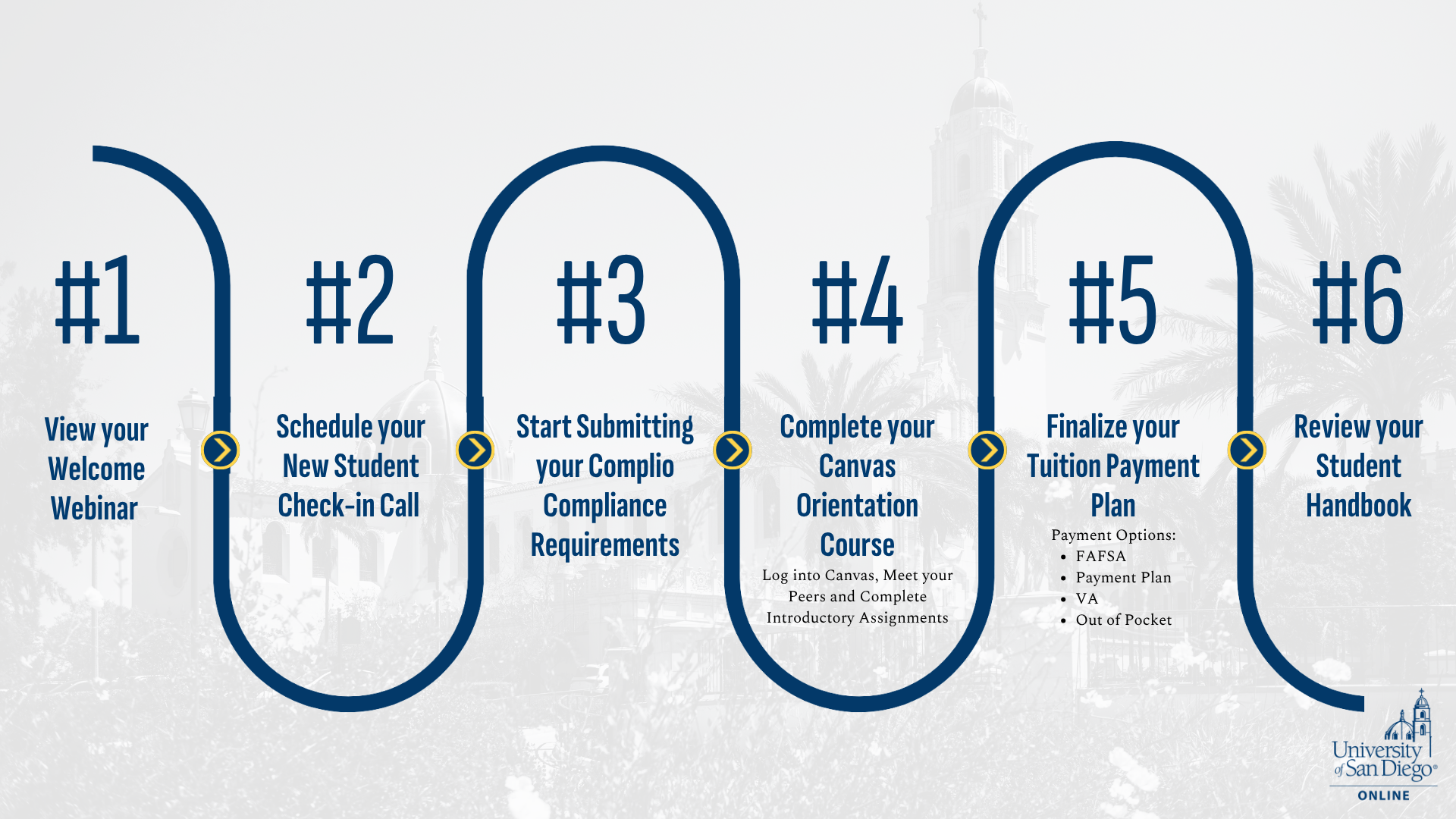
COMPLETE YOUR MANDATORY NEW STUDENT CHECKLIST
Our number one priority is you! Our team has prepared a checklist of items that will set you up for success and clarify all action items as a new student. After you are enrolled for your first term and receive a confirmation email from a member of our team, please complete and review all of the following before classes start.
1. View your Mandatory New Student Welcome Webinar
This webinar will go over a comprehensive look at your program and what to expect as an online learner, including resources and tips for success. Each webinar should last around 30-40 minutes. Once you have been registered for classes and received a confirmation email from our team, you will be emailed the link to schedule your welcome webinar to your @sandiego.edu email address.
2. Schedule your New Student Check-in Call
In this call, you’ll “meet” a member of your Student Success Team for your program. This will be a chance for us to answer any additional questions you have before you start your first term. Please be sure to have any Canvas-related, program-related, or finance-related questions prepared. After attending the Welcome Webinar, you will be prompted to schedule your call using a scheduling link.
3. Submit your Complio Compliance Requirements
Complio is a repository of mandatory health requirements based on the San Diego Nursing Consortium. All students are required to have their background check and drug screening completed prior to their first day of the program. All Complio requirements must be approved/completed within 3 weeks of being registered. Completing the compliance onboarding requirements can take some time to complete - start the process now!
- If you are new to Complio, create a new account using your @sandiego.edu email address.
- If you are a returning Complio user, you may use your existing account, but you are required to set the primary email address to your @sandiego.edu email address.
- The system will prompt you to submit all requirements, including but not limited to: background check, drug screening, TB tests, blood tests, medical records, immunizations, etc.
The Hahn School of Nursing and Health Science (HSON) has a dedicated compliance team to assist with clinical placements, out-of-compliance risk reminders, and more. Contact the HSON Compliance team at [email protected].
4. Complete Your Canvas Orientation Course - Due January 1, 2027
Once you have been registered in your classes, you will be able to access your New Student Orientation Course on Canvas within 6 hours. When accessing Canvas, please make sure to use Firefox or Chrome as your browser.
The New Student Orientation course is designed to help you navigate your way around your course's layout prior to beginning your first class. You will learn where to find the syllabus, course schedule, assignments, and discussion boards.
Your Orientation is mandatory, and must be completed before the first day of class—so we encourage you to get started! Please plan to spend about 16-20 hours completing the Orientation course. You can move through the Orientation at your own pace, so schedule your time accordingly.
Looking for assistance?
5. Finalize your Tuition Payment Plan
We recommend that students start this planning early, as some funding sources can take some time to process. Tuition payments should be completed in full by the first day of the semester. Visit the "Tuition and Payment Methods" section for more information.
6. Review your Student Handbook
Please make sure to review your student handbook prior to the first day of class, and reference it as needed throughout your program. The handbook is where you can find information on academic expectations, drop and refund policy, technology requirements, curriculum, frequently asked questions, and more.
IMPORTANT DATES
Below is a list of significant dates regarding the registration process, payment deadlines, and other important academic and program deadlines.
Fall 2026 Dates and Deadlines
| Important Dates | Date |
|---|---|
| Registration Opens | June 29, 2026 |
| Application Deadline | July 31, 2026 |
| Registration Deadline | August 14, 2026 |
| Orientation Course Due Date | August 28, 2026 |
| Last Day to Drop with 100% Tuition Refund* | August 31, 2026 |
| Payment Due Date | September 1, 2026 |
| Semester Begins | September 1, 2026 |
| First Course Start Date | September 1, 2026 |
| Last Day to Drop with 95% Tuition Refund/ Drop Deadline* | September 4, 2026 |
| Last Day to Withdraw from Course A | September 28, 2026 |
| First Course End Date | October 19, 2026 |
| Second Course Start Date | October 20, 2026 |
| First Course Final Grade Submission Due Date | October 26, 2026 |
| Last Day to Withdraw from Course B | November 16, 2026 |
| Second Course End Date | December 7, 2026 |
| Semester Ends | December 7, 2026 |
| Second Course Final Grade Submission Due Date | December 14, 2026 |
Spring 2027 Dates and Deadlines
| Important Dates | Date |
|---|---|
| Registration Opens | November 2, 2026 |
| Application Deadline | November 30, 2026 |
| Registration Deadline | December 14, 2026 |
| Orientation Course Due Date | January 1, 2027 |
| Last Day to Drop with 100% Tuition Refund* | January 4, 2027 |
| Payment Due Date | January 5, 2027 |
| Semester Begins | January 5, 2027 |
| First Course Start Date | January 5, 2027 |
| Last Day to Drop with 95% Tuition Refund/ Drop Deadline* | January 8, 2027 |
| Last Day to Withdraw from Course A | February 1, 2027 |
| First Course End Date | February 22, 2027 |
| Second Course Start Date | February 23, 2027 |
| First Course Final Grade Submission Due Date | March 1, 2027 |
| Last Day to Withdraw from Course B | March 22, 2027 |
| Second Course End Date | April 12, 2027 |
| Semester Ends | April 12, 2027 |
| Second Course Final Grade Submission Due Date | April 19, 2027 |
Summer 2027 Dates and Deadlines
| Important Dates | Date |
|---|---|
| Registration Opens | March 1, 2027 |
| Application Deadline | April 2, 2027 |
| Registration Deadline | April 16, 2027 |
| Orientation Course Due Date | April 30, 2027 |
| Last Day to Drop with 100% Tuition Refund* | May 3, 2027 |
| Payment Due Date | May 4, 2027 |
| Semester Begins | May 4, 2027 |
| First Course Start Date | May 4, 2027 |
| Last Day to Drop with 95% Tuition Refund/ Drop Deadline* | May 7, 2027 |
| Last Day to Withdraw from Course A | May 31, 2027 |
| First Course End Date | June 21, 2027 |
| Second Course Start Date | June 22, 2027 |
| First Course Final Grade Submission Due Date | July 5, 2027 |
| Last Day to Withdraw from Course B | July 19, 2027 |
| Second Course End Date | August 9, 2027 |
| Semester Ends | August 9, 2027 |
| Second Course Final Grade Submission Due Date | August 16, 2027 |
Download a pdf of your academic calendar

Upcoming Events
Don't miss out on connecting with your University of San Diego global community through a variety of events - featuring academic workshops, cultural celebrations, networking events, and more. There’s something for everyone!
Class Registration Directions
You have most likely already filled out an Enrollment Commitment, which enables our team to register you for classes each term. No further action is required on your part, but you may view your course registration on your MySanDiego portal.
If you are not able to register for both of your courses in a given term, please contact your Program Coordinator or email [email protected] immediately. This often happens for students who need to take a leave of absence.
Textbook information
Students are required to have their textbooks on hand by the first day of class. Unless otherwise specified, students may select any vendor they prefer (such as Amazon.com, Half.com, Alibris.com, etc.) to purchase their course materials. In the event a specific vendor is required, it will be specified in the course materials list. The best way to ensure that you have the correct book is to search by the ISBN number(s) listed on the book list.
Physical copies of books are not on hand at the USD Torero Store. The USD Torero online store does offer price comparisons for different online vendors for some books.
Although all textbooks for all courses are listed, students only need to purchase the items for the classes they are taking for the semester.
Digital Inclusive Access (IA) - Integrated VitalSource Textbooks
If your course is indicated to have a "Digital Inclusive Access" textbook, you do have the option to use the integrated Vitalsource e-textbook without needing to purchase a textbook through an outside vendor. For more information, view the "Digital Inclusive Access" FAQs document.
- Students are able to access the e-textbook directly in the course without worrying about purchasing the wrong version or textbook!
- If your course is indicated as using “Digital Inclusive Access” on the textbook list, please note that you must opt-out within the first 7 days of each course to avoid being charged for the guaranteed-lowest price textbook.
- If you do intend to use “Digital Inclusive Access”, no further action is required after you create a Vitalsource account.
- No refunds can be issued once the textbook charge has been assessed.
By using Vitalsource e-Textbooks, students are able to use study tools in Bookshelf such as highlighting, printing limited pages/chapters, sharing notes, and using the Bookshelf CoachMe tool to test their learning while they read.
PAYing for your program
Tuition at USD is billed per semester, not per course. Payment (or enrollment in an official USD payment plan) is always due by the first day of the semester. Students may not carry balances from one semester to the next.
Accounts with outstanding balances after the official payment due date may be subject to course cancellations/removal or a student account hold during the semester; related holds can prevent upcoming registration, graduation, or obtaining transcripts.
Remember: tuition is always due by the first day of each semester.
Tuition amounts shown on this website, or in other university publications or web pages, represent tuition and fees as currently approved. However, the University of San Diego reserves the right to increase or modify tuition and fees without prior notice and to make such modifications applicable to students enrolled at USD at that time as well as to incoming students. In addition, all tuition amounts and fees are subject to change at any time for the correction of errors.
Program Tuition
Once you have been registered for your courses, your student account will reflect the appropriate tuition costs according to your program. In the RN-to-BSN program, your total enrollment/units will vary each semester (6-9 units), so your semester tuition will depend on the total units enrolled. Payments not received by the deadlines are subject to late fees. Your program’s tuition is the following:
- Per Unit (classes are typically 3-units) = $600
- Per Semester (assuming 9-units per semester) = $5,400
- Total Program Cost (43 units) = $25,800
For the entirety of the program, students will be considered "part-time" (6-11.99 units); your financial aid or military/veteran benefits options may be enrollment status dependent. Contact the Torero Hub team or the Military and Veterans Program at [email protected] for details.
Students who need to re-take or withdraw from a course may need to pay additional fees according to the Refund/Drop Deadline policies listed in your Student Handbook.
If you have any questions about your Student Account, please reach out to the Torero Hub by submitting their inquiry form or by phone at 619-260-2700. All costs and fees are subject to change and are based on the academic year of enrollment.
Technology and compliance fee
Please note that students in USD’s RN-to-BSN program are required to pay a $110 technology and compliance fee each semester, which covers compliance subscriptions and clinical logging/portfolio applications (Project Concert and Complio) associated with the degree programs. This fee is subject to change annually.
scholarships
Registered nurses enrolled in the Hahn School of Nursing’s RN-to-BSN program may be eligible for a number of external scholarships. Students are encouraged to visit the Hahn School of Nursing scholarship webpage. Relevant information can be filtered by program.
Refund Policy
Students will be registered for their prescribed courses each semester. All courses must be dropped prior to the first day of the semester to receive a 100% tuition refund and within the first three days of the start date of the semester to receive a 95% tuition refund. No refund (reversal of tuition) will be provided after the third day of the semester for any class.
DEGREE PROGRESS and COMMENCEMENT
DegreeWorks
You can track your progress toward earning your degree using the Degree Works feature in your MySanDiego student portal. Degree Works shows you which courses you have completed, grades, cumulative GPA, any outstanding graduation requirements, and more!
To access Degree Works:
- Log in to your MySanDiego student portal.
- Under the “Torero Hub” tab, click on “My Academics.”
- On the right-hand side under “My Academic Resources”, click on “Degree Works.”
Petition to Graduate
Submitting your petition to graduate is a requirement for every student. About a semester before your final term, you will be reminded by your Program Coordinator to submit your petition to graduate. Once completed, your Academic Coordinator will review your academic record and contact you if there are any outstanding requirements or issues.
Commencement timing
If you are planning on participating in the commencement ceremony (which means walking in your cap and gown here on campus), you will be invited to come to the University of San Diego to participate in the ceremony. Commencement details and information will be sent from your Student Success Team around the month of February.
- There is only one commencement ceremony each academic year in May.
- Fall and Spring graduates will be invited to the commencement ceremony the May after they graduate.
- Summer graduates will be invited to the commencement ceremony the May before they graduate.
Diploma Details
The Registrar will process their final audit of the degrees 6-8 weeks after grades are posted for your final semester. Once the degree is conferred in the system, the Registrar will order your diploma from the vendor, and the vendor will send it to you directly to the address that was listed on your petition to graduate.
If your mailing address changes after you submit your Petition to Graduate, please notify the Office of the Registrar at (619) 260-2700 or [email protected].
You will receive a digital diploma to your @sandiego.edu email address once your degree has been officially conferred.
You will also receive a physical diploma. Mailing time is an additional 6-8 weeks from the date of order, and you will likely receive your diploma in the mail in 3-4 months after you have completed your degree requirements.
Course Details
program requirements
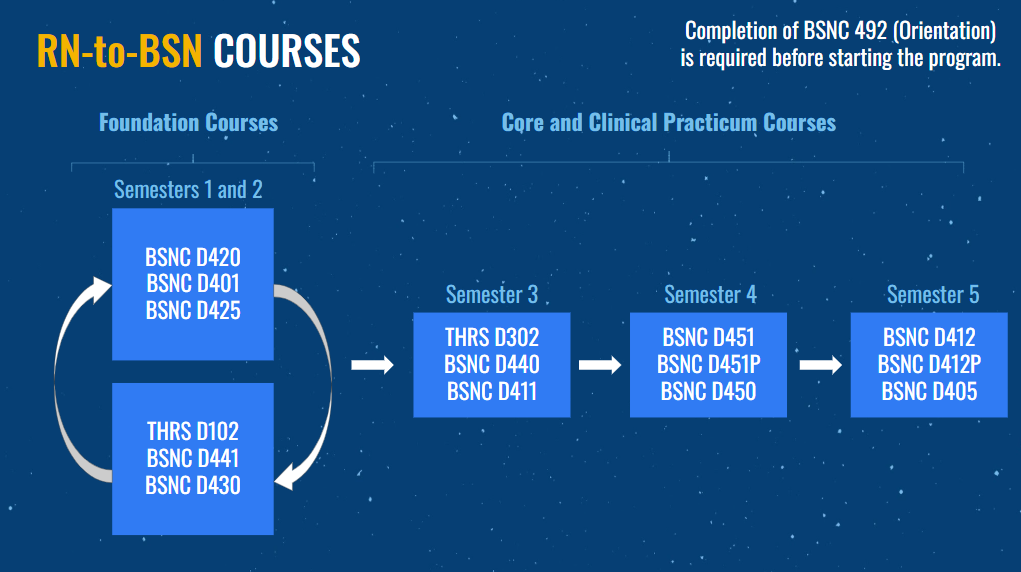
Completing all of the courses in your prescribed curriculum is required for program graduation. The RN-to-BSN program requires completion of 43 units to be eligible for graduation.
View your Program's Course Carousel
In all semesters, students will enroll in 3 asynchronous online courses, which may include a practicum course involving a hands-on learning experience in a real-world setting (often a professional environment). Foundational courses must be completed during the first and second semesters. After the second semester is complete, students will proceed through their core and clinical practicum courses.
Course Titles and Descriptions
Writing and Communication (BSNC D401)
This course supports the development of the nurse’s effective, respectful, and constructive verbal and written communication skills in the health care sphere. Students will apply relevant communication theories to demonstrate competency in formal and informal written and verbal communications. Students will further tailor their messages in terms of argument, clarity, organization, and style to the appropriate audience (e.g., patients, professional colleagues, the public), purpose, and context. Course content includes ethical considerations, cultural competence, and special situations that occur in healthcare such as communicating with the help of an interpreter.
Patient Stories (BSNC D405)
This course surveys a form of artistic expression combined with an examination of the experience of being a health care patient. Depictions of patient signs, symptoms, and health care interactions in an art form such as theatre, visual art, music, cinema, storytelling, or dance will be used to appreciate the characteristics, conventions, and theoretical orientations of that art form within its sociocultural context. Students will further apply the nursing process and other nursing-specific methodologies to analyze the “stories” underlying the artworks under study. The combination of modes of appreciation specific to an art form with nursing-specific ways of knowing will allow students to pursue a holistic understanding of the patient experience.
Evidence-Based Nursing: From Theory to Practice (BSNC D411)
This course examines the historical and scientific evolution of nursing as both a discipline and a field of study. Students will explore foundational concepts, theories, and models that shape nursing knowledge and practice. They will enhance their clinical reasoning and judgment skills while integrating evidence-based practices into healthcare settings. The course highlights the connection between research, theory, and evidence-based practice, guiding students through the evidence-based practice process and its application to clinical questions. Practical experience in translating research findings into practice will be emphasized, along with an emphasis on ethical considerations and resource management. By prioritizing ethical scholarship, students will be equipped to contribute to the nursing profession with integrity, ensuring safe and effective care. By the end of the course, they will demonstrate the ability to apply evidence-based principles professionally, promoting continuous improvement in healthcare.
Population Health and Advocacy in Nursing (BSNC D412)
This course explores population health management, highlighting the crucial role of nurses in promoting health equity and social justice in diverse communities. Students will analyze health data, assess community needs, and create culturally responsive healthcare interventions. The curriculum covers public health policy evaluation, collaborative action plans, advocacy strategies, and disaster preparedness. Through various activities, students will gain proficiency in epidemiological methods, ethical decision-making, and sustainable health interventions for vulnerable populations, equipping them to lead initiatives, and advocate for improvements in public health outcomes.
Population Health and Advocacy in Nursing practicum (BSNC D412P)
In collaboration with community partners, this practicum focuses on principles of population health and addresses the health needs of diverse groups. Students explores the role of nurses as advocates and educators in promoting health equity and improving health outcomes. Key areas of focus include social determinants of health, epidemiological methods, and evidence-based interventions. Additionally, the course involves analyzing health data to identify trends and risk factors. It also covers the design, implementation, and evaluation of public health programs in partnership with interdisciplinary teams and community stakeholders, aiming to enhance health outcomes for various populations. This course meets the requirement for a California Public Health Nurse Certificate.
Nursing in Literature (BSNC D420)
This course examines the profession of nursing as depicted in literature which may include fiction, nonfiction, memoir, poetry, biography, film, and other genres. There will be a particular emphasis on understanding the history and cultural development of nursing through the lens of literature. Students will engage with literature purposefully, critically, and contextually to explore narratives that depict the evolution of nurses, patients, and healthcare systems across time and place. Through their writings and class discussion contributions, students will use literary theories to analyze and interpret texts thus revealing issues related to gender roles, ethics, social/political context, and more.
Ethical Foundations of Nursing (BSNC D425)
This course explores the ethical foundations of nursing practice, providing students with the knowledge and skills to navigate complex moral dilemmas in healthcare. The course aims to provide a thorough introduction to the key themes in nursing ethics, including ethical principles, ethical decision-making, safeguarding privacy and confidentiality, professional standards, promoting ethical conduct in research and practice, and ensuring human rights and social justice. Students will examine major ethical theories, including deontology, utilitarianism, and virtue ethics, and apply core ethical principles such as autonomy, beneficence, nonmaleficence, and justice to real-world nursing scenarios. This course satisfies the ethical inquiry core foundation (FETI) requirement and advanced writing flag requirement (CADW).
Philosophical Foundations of Nursing Practice (BSNC D430)
This course explores the philosophical foundations of nursing, examining key questions about the nature of care, personhood, health, and responsibility. Utilizing historical and theoretical foundations in nursing, students will critically analyze fundamental nursing and philosophical issues using systematic questioning and argument evaluation. Through the study of value theory, epistemology, and metaphysics, students will engage with philosophical perspectives unique to the profession and demonstrate the integration of philosophical principles into practice. Students will read various philosophical perspectives unique to the nursing discipline, critically examining arguments in light of our own knowledge and experience. Students will engage with these tools in class to build the skills necessary to effectively defend their positions in written assignments.
Health Information Technology: Enhancing Care and Communication (BSNC D440)
This course focuses on the information and communication technologies(ICT) used in healthcare delivery to improve patient outcomes, ensure safety, and facilitate communication across diverse settings. Students explore practical applications and ethical considerations while emphasizing the importance of communication and compassionate care. Students examine how technologies enhance patient care and optimize processes, discussing data collection, decision-making, and knowledge generation. Key topics include regulatory issues, patient privacy, information security, and reimbursement, along with an emphasis on clinical judgment, social determinants of health, and ethics.
Data Visualization (BSNC D441)
This course supports the nurse’s ability to a) reliably interpret the data visualizations routinely encountered in their role, and b) create data visualizations in commonly used formats that adhere to the conventions and constraints of those formats. Learners will combine knowledge of visualization formats, human perception, and audience needs with data skills, design discernment, and adherence to ethical principles to create visualizations that help viewers accurately answer pertinent questions about the topic at hand. Learners will explore data at multiple levels: individual patient data, population health data, and systems/policy-level data. In accompanying written work, learners will state their visualization objectives, explain the assumptions and limitations underlying their source data and selected visualization format(s), justify their design choices, and draw conclusions about the selected topic.
Healthcare Systems Leadership: Promoting Quality, Safety, and Innovation (BSNC D450)
This course equips nursing professionals to navigate complex healthcare systems by exploring organizational structures, healthcare delivery models, and quality evaluation strategies. Students will focus on quality improvement, safety, and the nurse’s role in fostering a culture of respect and high reliability in healthcare environments. Leadership development skills, including communication, team dynamics, and collaboration, are emphasized. Additionally, students will learn about the use of information technologies, such as electronic health records and telehealth, to enhance patient outcomes and safety. The course highlights the integration of evidence-based practice, diversity, equity, inclusion, and ethical decision-making in leadership. Lastly, personal health and well-being are underscored as vital for effective leadership and resilience in healthcare.
Professionalism and Leadership in Nursing Practice (BSNC D451)
This course focuses on the nursing profession as both a science and a discipline, exploring its historical evolution, professional roles, and core concepts of nursing practice. Emphasis is placed on developing a strong professional identity grounded in accountability, advocacy, integrity, and leadership while effectively collaborating with interdisciplinary teams. Students examine the use of leadership skills to optimize care across the continuum, apply information and communication technologies to support decision-making, and explore cost-effective, innovative strategies to improve healthcare outcomes. Personal and professional growth are fostered through self-care, reflective practice, and the application of theory and research-based knowledge to promote intellectual curiosity and social responsibility.
Nursing Leadership Practicum (BSNC D451P)
In collaboration with community partners, this practicum offers hands-on experience applying theoretical knowledge and evidence-based practices in professional healthcare settings. Designed to enhance students’ clinical reasoning, decision-making, care delivery skills, and leadership abilities, the practicum also engages students in quality improvement initiatives that emphasize ethical conduct, social responsibility, and advocacy for health equity and patient rights. Interprofessional collaboration and effective communication are key components, fostering improved patient outcomes and supporting team-based care.
As part of the culminating Integrative Core Project, the student will develop a quality improvement proposal, which will encourage students to synthesize the knowledge and skills gained throughout their coursework. Building on their earlier integrative learning experiences, students will make meaningful connections across disciplines, apply knowledge in diverse contexts, and bridge curricular and co-curricular learning to demonstrate Core competencies essential for success in the evolving field of nursing.
Cry of the Poor: An Introduction to Catholic Theology (THRS D102)
This course is an introduction to the academic study of Catholic theology focusing on Catholic interpretations of essential biblical texts, fundamental Christian beliefs and practices, and the significance of the option for the poor throughout the Catholic tradition and today. Students will also engage other academic disciplines along with Catholic theology in order to better understand the realities of economic inequality and student’s own positions in relation to social constructions of power and privilege. This course is designed for USD's online undergraduate degree completion programs and may not be applied to the requirements for any in-person undergraduate degree program that USD offers.
Cry of the Earth: Religion, the Environment, and Social Justice (THRS D302)
This course is an exploration of the implications of religious ideas and practices for the ways people view and value the natural world, with special attention to the global complexities of diversity, inclusion, and social justice at an advanced level. Throughout this course, students will consider such questions as: What is the religious significance of nature, if any? How have religious attitudes evolved in response to the religious crisis? What role should religion play in helping to solve the ecological crisis, if any? How can the concept of intersectionality help to mobilize a more critical and inclusive approach to religion and the environmental crisis? This course is designed for USD's online undergraduate degree completion programs and may not be applied to the requirements for any in-person undergraduate degree program that USD offers.
Student Resources
This list is a helpful resource that will set you up for success. Haven’t written in APA formatting since your undergraduate program? We’ve got you covered! Want to know what type of computer you will need? No problem. We have listed helpful resources below.
Academic Requirements and Resources
Technical Requirements
You must own or have unrestricted access to a computer for this program. A fast Internet connection is also mandatory. Computers should be Windows- or Mac-based and have a minimum of 512 GB SSD storage, 16-32 GB memory (RAM), and a processor of Intel Core i5 13th Gen or above.
Courses will utilize a variety of technologies and multimedia. To complete course activities and to access course content, please verify that you have the following technologies and plug-ins available:
- Browser Plug-ins – Windows Media Player, QuickTime, Shockwave, Adobe Reader, and Java.
- Mozilla Firefox and/or Google Chrome are the recommended browsers.
- Microsoft Office or the Google Suite is recommended. Students may log in using USDOne credentials and install applications directly on the Microsoft Portal.
- Speakers or headset – to listen to multimedia.
- Webcam – for recording video.
- Email – To contact your faculty.
- High-speed internet connection strongly encouraged (100mbps or better)
Complio
Complio is a repository of mandatory health requirements based on the San Diego Nursing Consortium. The system will prompt you to submit all agency requirements, including but not limited to: background check, drug screening, TB tests, blood tests, medical records, immunizations, etc.
It is required for all students to set the @sandiego.edu email address as their primary email in Complio. Important announcements, reminders, and deadlines will be communicated to the @sandiego.edu email address. If you have an existing account, you must update the primary email to reflect the @sandiego.edu email address.
The Hahn School of Nursing and Health Science (HSON) has a dedicated compliance team to assist with clinical placements, out-of-compliance risk reminders, rejected documents, and more. You may be contacted with weekly compliance reminders if you are at risk of falling out of compliance. For any questions or assistance, please contact the HSON Compliance team at [email protected].
Project Concert
This tool will be used to help students plan, track, and evaluate their learning activities throughout the program. Students can validate clinical hours (time logs, assignments, etc.) and reflect on their clinical practicum experiences directly in Project Concert. Access to the platform will be granted within 24 hours after registration. In some instances, access may not start until the first day of class.
Questions and technical concerns can be reported to the Innovative Learning Department via Google Form.
Clinical Placements
USD will help you find a clinical placement for the clinical practicum courses in the program. Students will be prompted to submit the Clinical Placement Survey during their second semester of the program (two semesters before their clinical placements). If you have a clinical site or preceptor in mind, please include that information in your submission.
After submitting the Clinical Placement survey, students will be prompted to schedule a meeting/call with their Academic Directors. This phone call/Zoom meeting is an opportunity to review your Clinical Placement Survey response and discuss next steps in the clinical placement process.
Undergraduate Writing Expectations and Tips
All writing assignments must be formatted according to APA standards. Discussion posts must contain the appropriate APA citations. If you want additional writing support, we recommend Purdue Online Writing Lab (OWL@Purdue). In addition to general writing support, the website includes a special section dedicated to APA formatting guidelines.
For students local to San Diego, another helpful writing resource is the College of Arts and Sciences (CAS) Writing Center. Enrolled students can submit assignments for review by a writing professional in person on campus.
The Copley Library at USD has prepared two guides: the Nursing LibGuide and the Health Care Informatics LibGuide. These guides have video tutorials, helpful websites, preprint sites, nursing journal feeds, and APA resources that can help with discussion and research-based assignments.
Copley Library Navigation
View our virtual workshop, "Copley Library Navigation, Citations and AI-Driven Research Skills," which introduces tools that make academic work smoother, smarter, and more efficient. In this session, you’ll learn how to navigate Copley Library like a pro, use citation resources with ease, and integrate AI tools such as SCITE to strengthen your research workflow. You’ll leave with practical strategies, time‑saving tips, and a personalized roadmap for thriving as a USD scholar.
Online Learning Strategies
View our virtual workshop, "Online Learning Unlocked: Strategies, Resources & Collaboration," which will equip you with practical knowledge and skills to apply tangible strategies to learn online in an asynchronous environment throughout your Master's Degree!
Artificial Intelligence (AI)
With the rise of AI writing assistants, students must ensure that they use this new technology ethically and honestly. Consult this document for guidance.
View the Navigating Generative AI Workshop recording.
Review the Mastering Research in the AI and Digital Age recording.
NotebookLM is an AI-powered research assistant that can help you get to critical insights faster and easier, all grounded in the information you provide. Upload your sources and NotebookLM will summarize your information and make interesting connections between topics. Listen and learn on the go by turning your sources into engaging audio and video discussions. Access it through any web browser or via its mobile app (iOS and Android).
Download Microsoft Office 365 (Free for USD Students)
Students at the University of San Diego are able to download Microsoft Office 365 for free! If you don’t have it already, you can download the Microsoft Office 365 suite using your USD student email.
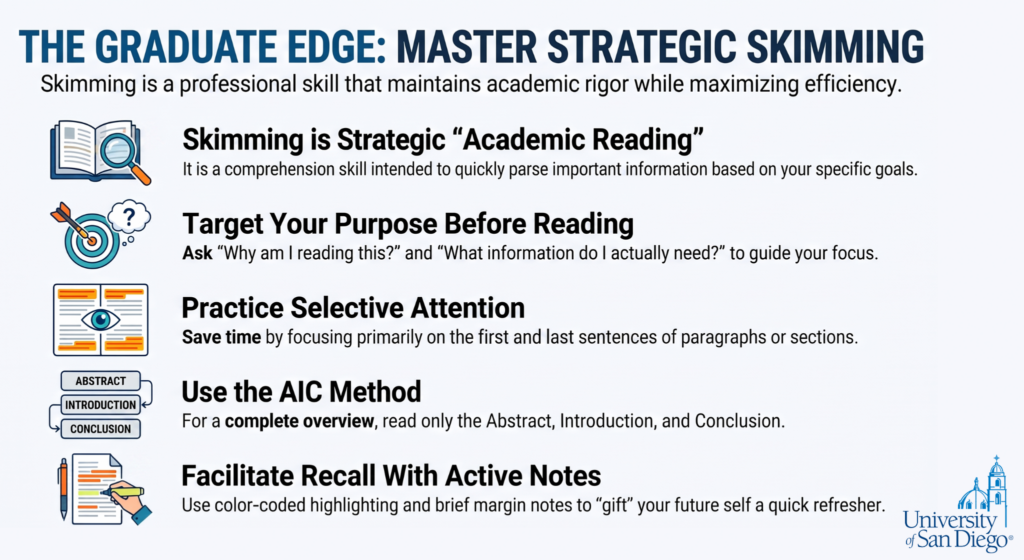
Skimming 101: Managing the Reading Load of Undergraduate Work
Students at the University of San Diego were invited to attend this session focused on applying strategies to accelerate their reading and information processing.
View the 3-minute summary video on academic skimming.
External Tutoring Resource
USD does not offer subject-specific tutoring resources, so students who are looking for tutoring support are encouraged to identify a tutor using Wyzant.com. Please note that Wyzant is not a USD-managed resource, so use it at your own discretion.
Career Readiness
If you're looking for assistance with career counseling, resume and interview preparation, salary negotiation guides, and student employment opportunities, view the Career Resources page to learn more. Additionally, students can leverage key networking and recruitment tools like Handshake, LinkedIn, and USD’s T.E.A.M. network, as well as explore specialized professional certifications.
Student Wellness Resources
Our community is dedicated to supporting students holistically. Our goal is to increase mental health awareness, reduce stigma, and equip students with essential skills to succeed during their program and beyond. As a student, you have access to resources to support your academic success and personal development.
Online student handbook
student code of rights and responsibilities
Canvas @ USD
In your program, you can think of Canvas as your virtual tool to share information with professors and peers. You will use Canvas to access your course content, find course syllabi, review your assignments, and more. Be sure to use your USD credentials to log in. If you have any difficulty logging into your course, be sure to contact ITS at (619) 260-7900 or [email protected].

Netiquette Guidelines
The concept of netiquette covers proper communication online. Read our guidelines to help cultivate a supportive and productive online environment.
your partners toward success
At USD, you join a community of individuals who are all committed to one common goal: your success. As you familiarize yourself with your team, take the opportunity to virtually meet and connect with the resources available to you as a student.











USD Quick Links
- USD Directory (For Faculty or Staff Contact Information)
- Torero Hub
- Health and Wellness
- On Campus Writing Center
- Military and Veterans Program Center
- Disability and Learning Difference Resource Center
- Copley Library
- Career Development Center
- Campus Recreation (Remote and On-Campus Classes Offered)
Career and professional resources
Whether you're hoping to find a new job or earn a promotion, USD has a wealth of resources available to prepare you for your dream role.
Professional organizations and memberships
Nursing Leadership and Administration
- Sigma Theta Tau International Honor Society of Nursing (Sigma): Focuses on nursing leadership, scholarship, and advancement across disciplines.
- National League for Nursing (NLN): Strong for nurse leaders within academia and administration.