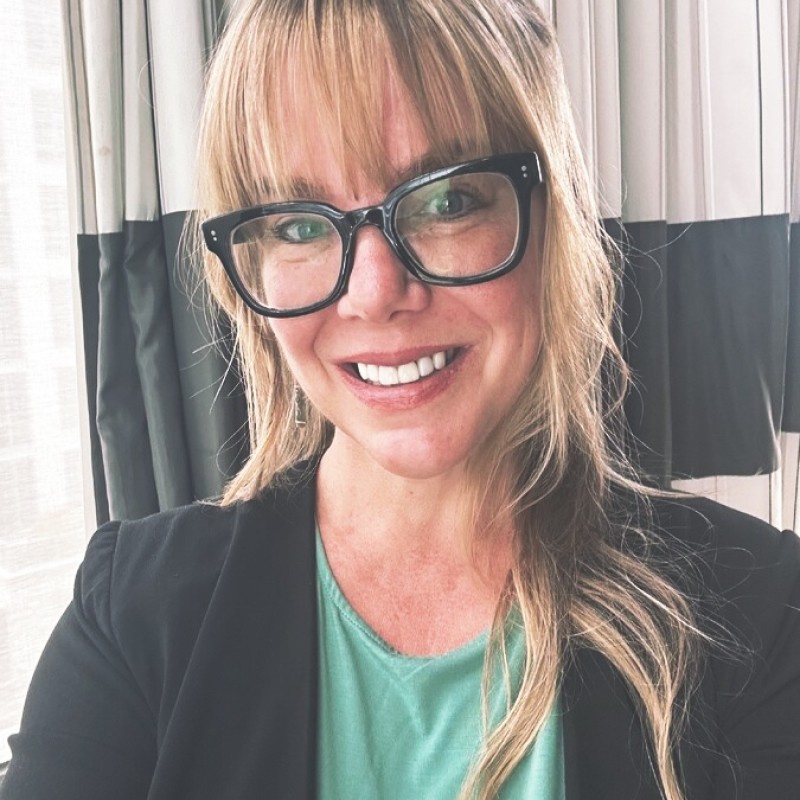
Catherine Greenberg is the Founder and Executive Director of Bright Light Volunteers and Vice President of the San Diego World Affairs Council. Her work focuses on global education, humanitarian action, international affairs, and community engagement. She holds an M.S. in Humanitarian Action from the University of San Diego’s Kroc School of Peace Studies and has extensive experience developing international service-learning programs, building cross-sector partnerships, and creating opportunities that connect people with global issues and communities.
Tell us about your career
I am the Founder and Executive Director of Bright Light Volunteers, a nonprofit organization that develops international service-learning programs connecting students and other groups with community-led projects around the world. I oversee organizational strategy, partnerships, program development, operations, and stakeholder engagement. I also serve as Vice President of the San Diego World Affairs Council, a volunteer-run nonprofit focused on international affairs and global engagement. In that role, I help lead programming, partnerships, organizational strategy, and community outreach.
Why did you choose the MSHA program?
I chose the MS in Humanitarian Action because it connected directly to the work I was already doing through Bright Light Volunteers while giving me the opportunity to deepen my understanding of the larger humanitarian system. I had years of practical experience working internationally and with communities, but I wanted a stronger academic foundation in humanitarian action, ethics, policy, and the complexities of how we respond to global challenges. What made the MSHA program stand out was its interdisciplinary and applied approach. I wasn’t looking for a program that was purely theoretical—I wanted something that would challenge me academically while still being relevant to real-world work. The Kroc School’s focus on peace, human dignity, and practical problem-solving really resonated with me. The combination of the Kroc School’s mission, the flexibility of the program, and its connection between academic learning and practice ultimately made MSHA the right fit for me.
How did the MSHA program help you achieve your personal and/or career goals?
My job title did not change while I was in the MSHA program, but the program absolutely advanced my career and expanded the way I approach my work. As the Founder and Executive Director of Bright Light Volunteers, I was able to immediately apply what I was learning to an organization I had already been leading for many years. The program gave me a much deeper understanding of humanitarian action, ethics, policy, migration, and the importance of locally led and community-centered approaches. It also gave me new frameworks for critically examining work that I had previously learned largely through experience. So, while my advancement was not a traditional promotion or change in job title, MSHA significantly broadened my professional network, strengthened my leadership, and expanded the scope of the work I am doing. It helped connect years of practical experience with a stronger academic foundation and gave me greater confidence and credibility to engage in humanitarian and international affairs in new ways.
What advice would you share with prospective MSHA applicants?
My advice would be to come into the MSHA program with curiosity and a willingness to have some of your assumptions challenged. Humanitarian action is incredibly complex, and one of the most valuable parts of the program was learning to look at issues from perspectives I had not necessarily considered before. I would also encourage students to take advantage of the people around them. Your professors and classmates bring very different professional, cultural, and personal experiences to the experience, and I learned as much from those relationships and conversations as I did from the coursework itself. Finally, don’t feel like you need to have a traditional humanitarian career path mapped out before you begin. I entered the program after many years of professional experience and found that MSHA helped me see new possibilities for how my existing work, skills, and interests could contribute to the humanitarian field. Be open to where the experience takes you. The program can expand not only what you know, but also how you see your own role in the world!
Who was your favorite instructor in the program?
My favorite instructor was Hector Vivero. What stood out most about Hector was the way he connected academic concepts with the realities of humanitarian work. He brought a depth of professional experience into the classroom that made discussions feel practical, relevant, and grounded in the complexities of working with real people and communities. I especially appreciated his willingness to challenge us to think critically rather than simply accept conventional approaches to humanitarian action. He also took the time to provide individualized video feedback on each major submission, which made the learning experience feel particularly personal and helped me think more deeply about both the coursework and my own professional practice. Hector was incredibly approachable and genuinely invested in his students. His combination of real-world experience, thoughtful instruction, and personal engagement made him an especially memorable and impactful professor.
What were you balancing while participating in the MSHA program?
While completing the MSHA program, I was balancing family life, professional responsibilities, volunteer leadership, and graduate school. I was continuing to run Bright Light Volunteers as Founder and Executive Director, while also becoming increasingly involved in leadership and programming with the San Diego World Affairs Council. At the same time, I was balancing family responsibilities and maintaining commitments to other organizations and community initiatives. There were certainly periods when managing everything at once was challenging, but one of the things I appreciated about the MSHA program was that it was possible to integrate graduate school into an already very full life. In many ways, having significant professional and volunteer responsibilities actually enhanced my experience because I could immediately connect what I was learning in the classroom to situations and challenges I was encountering in my work. For prospective students who may be looking at their own busy lives and wondering whether graduate school is possible, I would say that it absolutely can be. It requires organization, flexibility, and sometimes a lot of juggling, but you do not have to put the rest of your life on hold to successfully complete the program.
How did you stay motivated throughout the program in the face of competing priorities in your life?
I stayed motivated by continually connecting what I was learning to the work I was already doing and to the kind of impact I wanted to have moving forward. The program rarely felt disconnected from my professional or volunteer life. I was often able to take something I learned in class and immediately apply it to my work with Bright Light Volunteers, the San Diego World Affairs Council, or other community initiatives. There were definitely weeks when the goal was simply to keep moving forward! Giving myself permission to prioritize differently at different times, rather than expecting perfect balance, helped make the program manageable. Ultimately, seeing the connection between what I was learning and the work I cared about made it much easier to stay motivated.
MSHA Graduating Class
2026