Whether you’ve had your sights set on becoming an engineering manager from the beginning of your career or recently decided that the management track is the right path for you, it’s important to have a clearly defined set of steps that lead to landing the role you want. One of these stepping stones is understanding the skills you’ll need to not only become an engineering manager but to be a successful leader.
Keep reading to find out what these skills are and learn how you can develop them — or build them from scratch — to ensure that you have the best possible chances of achieving your career goals.
What Does an Engineering Manager Do?
Before we take a more focused look at the skills and characteristics needed to lead an engineering team, let’s get a better idea of what an engineering manager does. As with any role, engineering managers have a set of overarching responsibilities that they’re held accountable for. These can include (but aren’t limited to) the following:
- Analyzing, proposing and managing project resources and budgets
- Planning strategies for keeping projects on-schedule and on-budget
- Collaborating with other team members, managers, stakeholders and contractors
- Delegating and supervising tasks and deliverables
- Evaluating team members’ performance
- Hiring and employee development
- Providing input when faced with challenges
- Creating technical documentation and project roadmaps
Additionally, engineering managers also have day-to-day duties, which encompass the activities, meetings and tasks that fill up most of their time on a daily basis. Common duties include:
- Leading daily standup meetings
- Keeping the team on track
- Preparing for and running one-on-one meetings with team members
- Project management
- Administrative duties (such as tracking performance metrics, preparing reports and performance reviews and improving processes)
- Attending stakeholder meetings
When an engineering manager executes these duties regularly, they ensure their team has everything it needs to succeed. Here’s how daily tasks work to support a manager’s larger responsibilities.
An Engineering Manager’s Responsibilities and Supporting Tasks
| Manage Project Resources and Budgets – Monitor resource usage – Review project financials – Track actuals vs. projections – Prepare budget updates for stakeholders | Keep Projects On-schedule and On-budget – Utilize project management tools – Track task progress – Update timelines and roadmaps – Mitigate risks proactively |
| Collaborate Across Teams and Stakeholders – Attend cross-functional meetings – Share project updates – Facilitate clear team communication – Manage external vendor coordination | Delegate and Supervise Tasks – Lead efficient daily meetings – Assign work based on team capacity – Conduct check-ins to keep team aligned – Review status updates |
| Evaluate Team Performance – Conduct one-on-one meetings – Gather feedback – Track individual contributions and KPIs – Prepare performance reviews | Support Hiring and Development – Review resumes and conduct interviews – Identify team skill gaps – Recommend training opportunities – Support mentoring or coaching efforts |
| Address Technical and Team Challenges – Troubleshoot technical blockers – Support decision-making in meetings – Escalate issues appropriately – Advise on scope trade-offs | Develop Documentation and Roadmaps – Draft and review documentation – Maintain project backlogs and timelines – Communicate changes clearly – Share roadmaps with stakeholders |
That’s a lot to keep track of, which is why engineering managers need to develop the following skills to excel in their positions.
[Downloadable PDF] How to Transition Your Engineering Career from the Technical Track to Management Path.
15 Engineering Manager Skills Needed for Success
Truly great engineering managers can adapt to any situation, whether in the lab or out in the field. They’re able to provide advice for solving technical problems just as easily as resolving personnel issues or finding ways to address a budgeting shortfall.
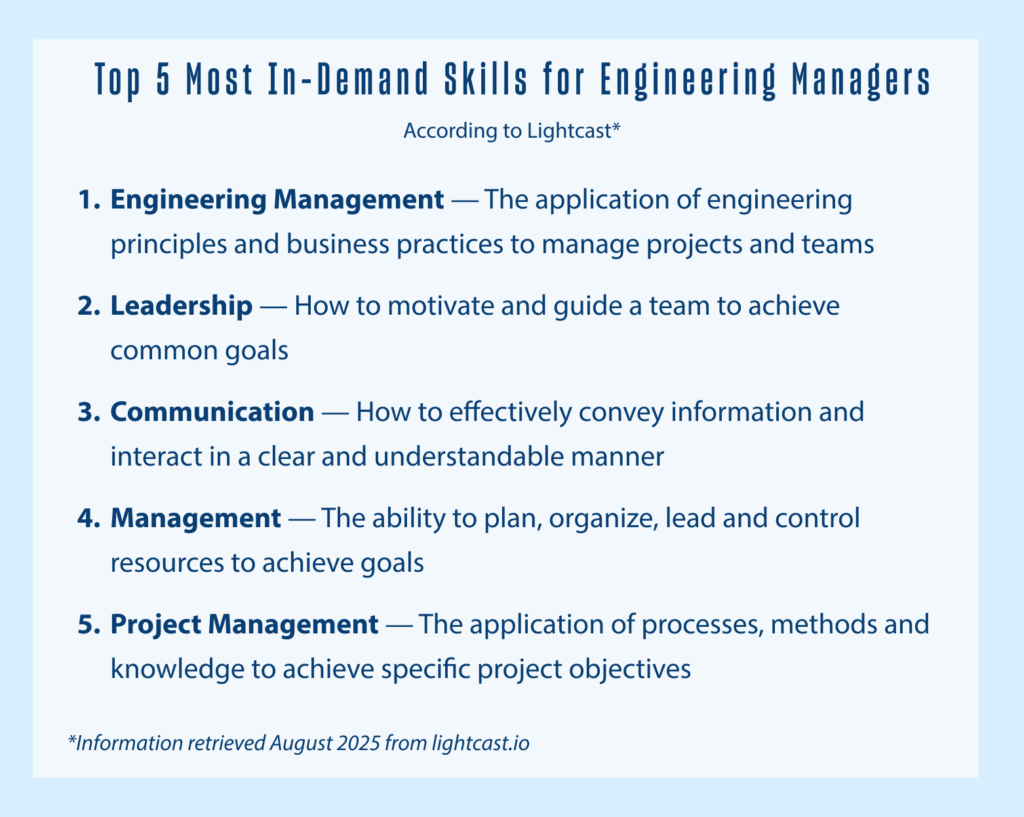
That means today’s engineering managers need a balance of technical skills, soft skills and managerial skills. If you want to be an engineering manager, here are the top skills you’ll need to get the job done.
Technical Skills
Good engineering technical skills are important, but engineering managers have to be more than experts in their fields. Great engineering managers need to be able to work across disciplines, which means being able to adapt to and collaborate with other departments.
- Technical Acumen
While it’s ideal for an engineering manager to have a background in the discipline they’re managing, at the very least, you should have a working knowledge of all of your team’s disciplines. That includes technical know-how and skill, such as knowledge of best practices, processes and frameworks. You don’t need to be a technical expert in every field, but be capable of understanding diverse and dynamic teams. Not only does this help when justifying the value of your team’s work to higher-ups, but it builds credibility with your staff as well. - Tool Mastery
Engineering managers who understand the tools their teams use, whether it’s version control systems, CI/CD pipelines, project tracking platforms or cloud environments, are able to earn trust and provide guidance. Coaching junior engineers or onboarding new hires is more effective when the manager can demonstrate best practices within the same technical tools. Understanding how to employ tools reinforces a learning culture and sets quality standards for the team. - Measuring Outcomes
As an engineering manager, it’s essential to know how to measure outcomes (such as reduced downtime, fewer customer-impacting bugs and meeting KPIs) rather than just outputs (such as lines of code or tickets closed, for example). Focusing only on production can drive unhealthy behaviors and miss the real impact of the team’s work. Being transparent about what’s being measured and why helps teams align on meaningful goals, stay motivated and deliver results that truly matter to the business. - Continuous Learning
Technology moves fast, and what you know now may not be relevant within 10 or even five years. Success requires adaptability, and to be adaptable means understanding how to remain up to date on technological advancements and industry trends. Managers need to take the lead in welcoming continuous learning and encouraging it within their teams. As a manager, you should also be comfortable asking your team members if they have any recommendations for novel platforms or tools.
“I’ve made the mistake of paying attention only to those voices that aligned with my own thought process. And, looking back, I realize there were greater opportunities in paying more attention to those opinions. The most important approach for any leader is to have the empathy for others and the courage to try different approaches out. Too often we think of leaders as the ones who impart knowledge, when in reality, they should be the ones most open to learning.”
— Dr. GB Singh, USD EML Program Director
Interpersonal Skills
These so-called “soft skills” are essential to being an effective engineering manager. You succeed when your team succeeds, and understanding how to motivate them, resolve conflicts and provide support will transform a good team into a great one. Conversely, even a team of the best engineers will fall apart due to constant miscommunication, frustrations, and misunderstandings.
- Problem-solving
As a leader, it’s not a matter of if your team will come to you for help with problems or issues; it’s a question of when it will happen. Whether it’s a personality clash between co-workers, reigning in a project that’s fallen outside of scope or placating an unhappy stakeholder, thinking critically to come up with effective solutions is an important part of the job. - Leadership
This goes without saying. As the head of your team, it’s your responsibility to provide direction for the engineers you oversee as well as provide the support and motivation they need to do their best work. One of the best ways to lead is by example, and a confident manager who works toward positive outcomes will inspire their team to do the same. - Communication
Ensuring that channels of communication between team members, stakeholders and senior management remain open and cordial is one of the most important jobs you’ll have as an engineering manager. All engineering disciplines are highly technical, and you may find yourself needing to explain complex processes to people who aren’t technically savvy, so being clear and concise is equally crucial. - Collaboration
Knowing how to foster collaboration is one of a manager’s most valuable assets. Being able to build a good rapport with the employees you oversee and others enables you to establish strong working relationships between your team and project stakeholders. Fostering a positive work environment and building trust are fundamental to a team’s success. - Constructive Feedback
A good manager is invested in both the success of the projects they oversee and their employees’ professional growth; from time to time, these responsibilities involve providing constructive feedback. This feedback can be positive reinforcement (such as congratulations for a job well done) or a critique (highlighting areas for improvement or addressing mistakes, for example) — but no matter the nature of the criticism, thoughtful delivery is key.
Business Skills
Managers have a responsibility to ensure their teams are supporting the company’s larger goals. This can require staying on top of industry changes and disruptions to avoid falling behind competitors. Accordingly, engineering managers need to be able to account for business elements such as profitability, project costs and budgeting.
- Project Management
Even though most companies work with dedicated project managers, having project management skills is still an important part of the role. As an engineering manager, part of your responsibilities will be to oversee all stages of a project — from concept to finished product — and that includes resource allocation, staying organized, ensuring deadlines are met, budgeting and more. - Decision-making
The ability to make confident and informed decisions is an important part of being a team leader. As the person in charge, your team will look to you for guidance and answers to important questions such as “how should we proceed?” or “what should we do to fix this?’ when faced with obstacles or challenges. You’ll need to be able to inform your decisions with the right data and be able to clearly and directly explain your reasoning. - Delegation
Strategically distributing tasks, responsibilities and projects across staff members is a great way to ensure that your team runs like a well-oiled machine. And when done well, sharing the load in this way can have benefits for your direct reports — opening the door for possibilities like skills development, learning opportunities and professional growth. - Strategic Thinking
The ability to think strategically makes it possible for engineering managers to anticipate the outcomes of the decisions they make and how those decisions can impact both their teams and the projects they work on. We’ve already touched on how this skill impacts decision-making, but it’s also especially useful when it comes to delegating responsibilities and solving problems. - Responsibility
As the primary decision-maker for the team, engineering managers assume most of the responsibility for the results of those decisions — both the good and the bad. In this role, you should be equally prepared to celebrate the successes with your team and to own up to and learn from the mistakes you make. - Ethical Practice
Every decision an engineering manager makes can ripple through teams, systems and society. Understanding what’s involved with the ethical practice of engineering builds trust, supports inclusive teams and ensures responsible use of technology. It also helps navigate complex trade-offs — like balancing speed with safety or privacy with performance — while modeling accountability and fairness across the organization.
4 Ways to Build the Skills Needed to Be an Engineering Manager
Don’t have all (or any) of the skills mentioned above? That’s ok! It’s possible to improve on the ones you do have and develop the ones you don’t. Some of the best ways to do this include:
- Earning an advanced degree in engineering management. Going back to school to pursue a master’s degree is a big investment in terms of both time and cost. However, if you have your sights set on landing a job as an engineering manager, it’s one that’s worthwhile. By enrolling in a specialized engineering management program, such as the University of San Diego’s Master of Science in Engineering Management and Leadership, you’ll benefit from a targeted curriculum that’s specifically designed to build the skills needed for a career in engineering management.
- Proactively looking for on-the-job experience. There’s no substitute for first-hand experience, and if going back to school isn’t in the cards, it can also be a valuable alternative to formal education. Look for opportunities at work to develop the skill set you’ll need in your future role as an engineering manager. Volunteering to help head up a project, lead a meeting or manage a budget are all great places to start.
- Building your professional network and connecting with mentors. Mentors offer guidance, share real-world leadership challenges and help you avoid common pitfalls. A strong network broadens your perspective, exposes you to new tools and practices and creates opportunities for collaboration and growth. These connections are some of the most effective ways to accelerate your transition from individual contributor to engineering leader.
- Pursuing continuing education. Aside from advanced degree programs, continuing education can take the form of specialized courses, workshops that focus on building the kinds of skills you’re hoping to improve or even certificate programs that show future employers that you’re committed to advancing your career.
The best part about developing your engineering management skills is that they will stay with you throughout your career. Engineering management is a stepping stone to many higher-level positions, including engineering director, chief engineer, vice president of engineering and different executive positions.
Interested in transitioning from a technical engineering position to a leadership role? Download this free eBook to learn how.
Engineering Manager FAQs
Do I need technical skills to become an engineering manager?
Even though an engineering manager’s job description doesn’t leave much room for technical tasks, the person in this role must have a technical background. Not only does having this kind of know-how make explaining complex concepts easier to non-technical stakeholders, clients and higher-ups, it builds credibility with the engineers you’ll manage.
What hard skills do engineering managers need to have?
Good engineering managers need to be good engineers, even if they don’t get to be as hands-on as the rest of their team. In addition to engineering skills, such as proficiency in programming languages (or other technical concepts), developing hard business skills such as process development and budget setting can make your job as an engineering manager easier.
What soft skills do you need to be an engineering manager?
Engineering managers need a blend of interpersonal and leadership skills. Strong communication, the ability to give and receive feedback and explaining decisions clearly are key to building trust with your team. On the leadership side, effective project management, problem solving and smart delegation help keep projects on track and teams aligned.
What’s the best way to become an engineering manager?
There’s no one right path to follow on the road to becoming an engineering manager. However, earning an advanced degree (such as a master’s in engineering management), getting on-the-job experience in your current role and pursuing continuing education opportunities are all good starting points.
How can I build the skills needed to become an engineering manager?
It’s possible to improve the skill set you already have, or develop new skills from the ground up, as you set out on your journey toward becoming an engineering manager. You can cultivate the skills you’ll need by earning a master’s degree, through current work experience and continuing education.
What makes a great engineering manager?
A great engineering manager is one who has the skills to be a situational leader, meaning to be the best type of manager in any particular moment. Managers are the ones who need to create the conditions that enable their team to thrive. They not only have a mastery of technical skills, but also the business skills to understand their organization’s value chain and the interpersonal skills to inspire and motivate their team.