Key Takeaways
- International social workers help disadvantaged communities around the world, addressing issues from refugee rights to global health.
- Salaries range from $55,000 to $70,000+ per year, depending on organization and location.
- Most international affairs jobs fall in one of four sectors: public, private, non-governmental organization (NGO) and multilateral.
- Careers include diplomat, foreign service officer, foundation program officer, humanitarian coordination, intelligence specialist, humanitarian worker, international lawyer, interpreter, nonprofit program coordinator, policy analyst, political scientist, public affairs specialist and legislative aide.
Social work is a challenging yet rewarding career. There is a need for compassionate, knowledgeable leaders who are interested in helping others and ready and willing to use their skills and knowledge on a global scale.
International social workers are more than just skilled professionals or clinicians — they are valued humanitarians who are trained to help individuals and communities in need across the world.
Are you interested in rising to the challenge? Keep reading for our complete career guide on international social work, including salary information, typical responsibilities, common questions about the profession and potential organizations where you could work.
What Is International Social Work?
International social work is a practice in which trained professionals help disadvantaged or victimized individuals and communities around the world. One of the hallmarks of social work is its emphasis on human relations: it is often conducted between people, rather than via public policies, the media or technological interventions. People in these positions are often employed by international organizations and often deal with such critical issues as women’s rights, poverty, global health, food insecurity, social justice, abuse, sexual assault, refugee rights, HIV/AIDS, addiction, children’s issues and rights and mental health.
An international social worker is also considered a humanitarian — a person who expresses concern for others while promoting human welfare.
What Does an International Social Worker Do?
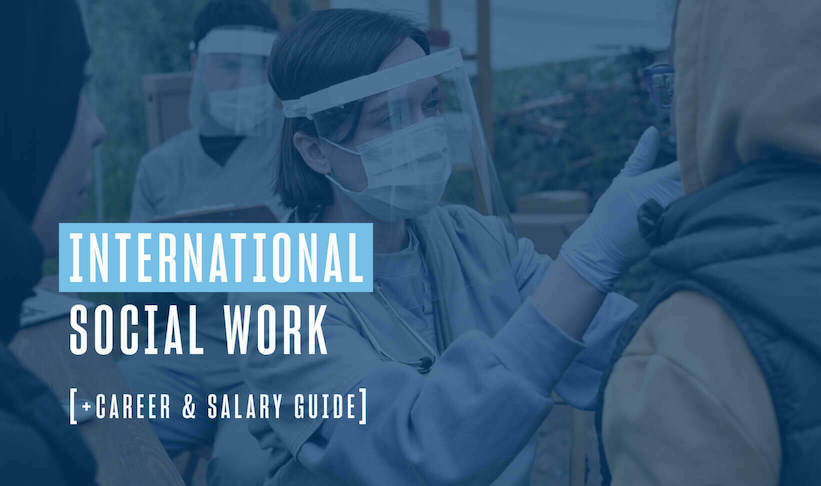
An international social worker provides help and support to individuals and offers aid to vulnerable populations who are facing challenges or hardships. They may also help train other humanitarians and are often called upon to help in the aftermath of a natural disaster or crisis.
Typical social work responsibilities include:
- Identifying those in need of assistance
- Assessing the support networks needed
- Helping individuals adjust to changes and challenges
- Researching and advocating for community resources
- Responding to crisis situations
There are also different types of social work — public health, mental health, advocacy and medical, to name a few.
International Social Worker Salary
The salary for this position will depend on the organization or company you work for, in addition to where you are located and how much experience is required. Indeed, the U.S. Bureau of Labor Statistics and ZipRecruiter offer salary amounts ranging from approximately $55,000 to $70,000+ per year. Please note that salary information will fluctuate in real time due to changing data and will imply different purchasing power depending on what country you are living and working in.
Companies Hiring
While you can find positions on popular job resources such as LinkedIn and Indeed, there are sites specifically dedicated to humanitarian-related work, such as ReliefWeb, Idealist and Devex. There are many national and global organizations looking to hire skilled international social workers, though you’ll find that most listed positions are local and specific to certain geographic regions, cities or communities. Here is just a sample of companies hiring for these types of positions:
- Boys & Girls Clubs
- CARE
- Catholic Relief Services
- International Federation of Red Cross and Red Crescent Societies (IFRC)
- International Medical Corps
- International Rescue Committee
- Mercy Corps
- Refugees International
- Save the Children
- UNICEF
- UNHCR
- U.S. Bureau of Population, Refugees, and Migration
- U.S. Committee for Refugees and Immigrants
- World Vision
- YMCA
- YWCA
It’s important to note that international social workers may also work within the United States, depending on the organization, company or position.
Skills Needed
Social work is a career that requires mental and emotional stamina. In addition to the right type of education and certification, you must be able to balance empathy, patience, communication and professionalism in situations that are often troublesome and challenging.
Additional skills and characteristics needed to succeed in social work include:
- Active listening
- Advocacy
- Boundary setting
- Critical thinking
- Cultural competency
- Emotional intelligence
- Leadership
- Organization
- Patience
Being an international social worker, however, also means developing and maintaining humanitarian-related skills such as:
- Ability to speak a second language (or multiple languages)
- An understanding of global issues
- Ability to cope with high levels of stress
- Willingness to travel and work in less-than-ideal conditions
- Sensitivity toward other cultures
International Social Work Qualifications
A bachelor’s degree in social work is not required but can help with entry into a master’s degree program. Other relevant undergraduate degrees include psychology, political science, women’s studies, gender studies, sociology and international studies.
In most cases, a master’s degree is required, and the bachelor’s and/or master’s degree must be from a program accredited by the Council on Social Work Education. There are also two types of social work — clinical and non-clinical.
Clinical social workers provide immediate aid to individuals and families whereas non-clinical social workers help reform policy and work at the community level. The requirements for clinical social work are more stringent and typically require a master’s degree, clinical experience and a license from the state in which you intend to practice.
You may also consider supplementing your education with a humanitarian-related advanced degree, which can prepare you with the right knowledge, experience and tools to excel in this type of position.
Steps to Become an International Social Worker
If you’re interested in this type of rewarding humanitarian work, consider the following general guidelines and career advice:
- Invest in a relevant undergraduate and graduate degree.
Most positions require a minimum of a bachelor’s degree; many require some type of advanced education, especially if you are interested in clinical social work.
- Gain experience and make connections.
Volunteer opportunities and/or internships have the ability to provide hands-on experience, first-hand knowledge and meaningful connections that can bolster your resume and help you get a foot in the door.
- Pursue specialized training and education.
Consider relevant undergraduate and graduate degrees. International social workers may also want to supplement their education with humanitarian-related courses or programs.
Frequently Asked Questions
What are the areas of international social work?
Areas of international social work include mental health, public health, environmental, medical, community and advocacy.
Do you need a license to practice social work internationally?
Whether you need a license to practice social work internationally depends on the country and the role. Social work licenses are issued by individual jurisdictions, so a license granted by a U.S. state does not automatically authorize practice in another country. Clinical roles involving direct therapeutic services are typically the most tightly regulated. Many international social work positions are non-clinical, focusing on program management, advocacy and community development, and may not require clinical licensure. Always verify the requirements for the specific country and position.
What’s the difference between international social work and humanitarian work?
The difference between international social work and humanitarian work is that international social work is a licensed professional discipline, while humanitarian work is a broader field focused on responding to crises. International social work has its own education, accreditation and licensure pathways and centers on supporting individuals, families and communities. Humanitarian work encompasses a wide range of functions, including logistics, health care, protection, advocacy and coordination. Many social workers work in humanitarian organizations, which is why the two fields overlap, but they have different professional pathways and credential requirements.
What’s the difference between a Master of Social Work (MSW) and a master’s degree in humanitarian action?
The difference between a Master of Social Work and a master’s degree in humanitarian action is that an MSW prepares graduates for professional social work practice and licensure, while a humanitarian action degree prepares graduates for careers in crisis response and aid management. An MSW includes supervised field placements and coursework required for licensure. A master’s degree in humanitarian action is interdisciplinary, focusing on humanitarian systems, ethics, emergency response and program management, and does not lead to clinical licensure.
How long does it take to become an international social worker?
Becoming an international social worker typically takes six to eight years, depending on your educational pathway and whether you pursue clinical licensure. This usually includes a four-year bachelor’s degree followed by a two-year master’s program. Graduates with a Bachelor of Social Work may qualify for an advanced standing Master of Social Work program that can be completed in about one year. Clinical licensure generally requires additional supervised post-graduate experience, which often takes another two years.
What’s the difference between a social worker and a case manager?
The difference between a social worker and a case manager is that social workers are trained in social work practice and may be licensed to provide clinical services, while case managers primarily coordinate services and connect clients with resources. Social workers hold a degree in social work and, for clinical roles, a state license that allows them to assess, diagnose and provide therapy where permitted by law. Case managers do not always need a social work degree, depending on the employer and setting. Many social workers perform case management, but not all case managers are social workers.
Where can I find additional information about social work?
You can find additional information about social work from the following organizations:
- International Federation of Social Workers
- National Association of Social Workers
- Council on Social Work Education
- Society for Social Work and Research
- Social Work Licensing Guide
- The Nancy A. Humphreys Institute for Political Social Work
- The New Social Worker Careers Magazine