When students in the online Master of Theological Studies – Franciscan Theology enter their final semester, they are given a choice in how they want to execute their capstone project:
- Write a traditional thesis paper presenting an original theological argument
- Write a series of short articles for a Franciscan publication
- Create a ministerial event such as a retreat, workshop, or lecture series
Each approach requires its own intellectual rigor and tenacity, but the third option adds an experiential element that literally brings the theological discipline to life.
That’s the route Nancy Smith, OFS, took to demonstrate her own experience of the Franciscan tradition, and in the process, may have created a new tradition of her own. What follows is the story of how Nancy’s capstone project came to life, and how the MTS-FT program made it possible.
Request Info about the online MTS-FT program
Finding Your Franciscan Voice: The MTS-FT Capstone
After completing the required nine courses in the MTS-FT program, students enter the final (and perhaps most personally demanding) phase of the degree: MTS 599, Finding Your Voice in the Franciscan Tradition. This 14-week course is the culmination of everything that came before it, and it asks students to do something far more than demonstrate knowledge. It asks for something much more personal: a demonstration of their own spiritual formation.
The capstone is designed to surface the theological voice that has been developing across the entire program. Students work with a faculty consultant whose expertise aligns with their chosen project, alongside their peers and course instructor, to develop a coherent argument on a topic about which they feel passionately. That argument must be grounded in theological discipline, situated within a framework of faith, and, in many cases, connected to personal, professional, or pastoral concerns.
This is the “so what?” of the MTS-FT degree. Rather than ask students to recite what they’ve learned in the program, the capstone asks them to show where that learning has taken them and what they intend to do with it. For students who choose the ministerial event option, their learning becomes concrete and tangible.
Nancy Smith responded to this vocational prompt by planning a spiritual retreat, using the theological concepts she encountered in the MTS-FT program as the blueprint.
Off the Page and Into Practice
Central to Nancy’s capstone project was the Franciscan philosophical concept of haecceitas — “thisness” — developed by the medieval Franciscan theologian John Duns Scotus. The idea holds that every created being possesses a unique, irreducible particularity that is not incidental but sacred. Nancy first encountered this concept through the poetry of Gerard Manley Hopkins, whose work is saturated with delight in the singular. It took deeper root through St. Francis’ Sermon to the Birds, a moment in the Franciscan tradition in which Francis addresses the natural world as if each creature’s distinct song is itself an act of praise.
These ideas became a lens through which Nancy began to examine the borders, both internal and external, that keep people from inhabiting their own sacred particularity. This became the animating theme of her retreat: what it means to live without borders, and to embrace the divinely given “thisness” each person carries.
The theme of borders had roots in a real experience. Earlier in the MTS-FT program, Nancy had participated in a pilgrimage to Tijuana, Mexico, led by Brother Keith Warner, OFM, visiting and learning about local ministries that serve migrant communities. The experience expanded her understanding of borders far beyond the abstract, influencing how she designed the retreat’s framework and spoke to its participants.
Throughout the program, the Franciscan School of Theology faculty created space for Nancy’s own voice to develop. Alongside her studies, they encouraged her, stretched her, and, in her own words, “refused to let [that voice] shrink back into fear.” By the time she entered the capstone phase, she had a deep well of knowledge and contemplation to draw from.
The Retreat Experience
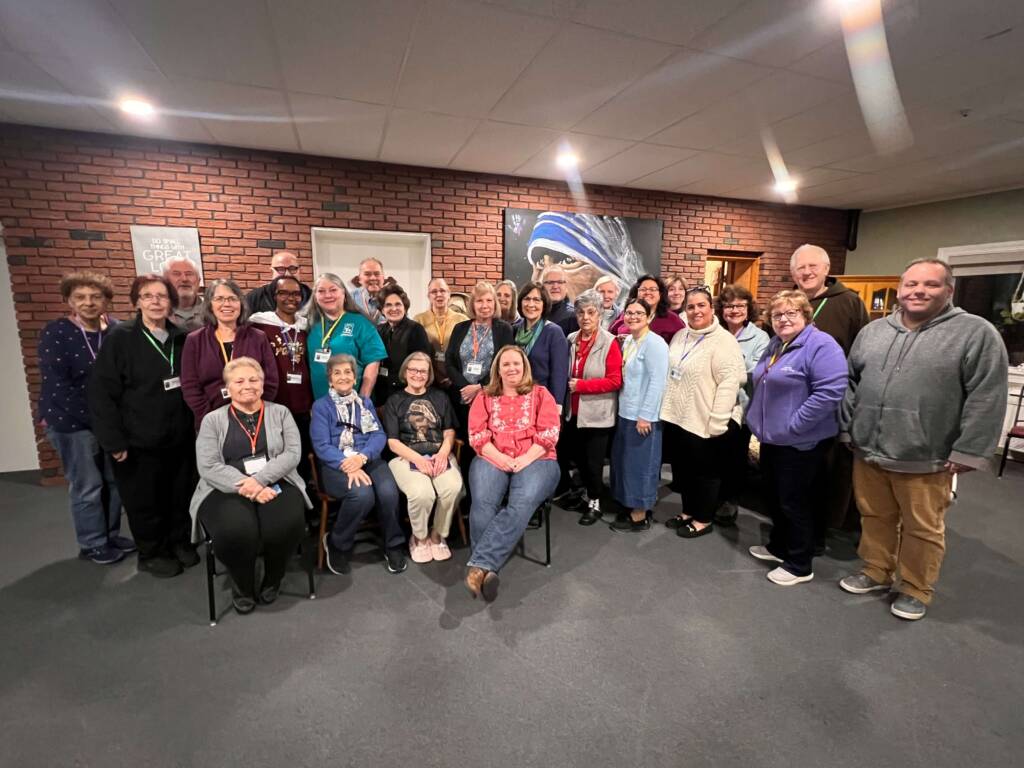
The retreat took place over one weekend at Holy Cross Retreat House in North Easton, Massachusetts (where Nancy is the Director). Thirty-two people crossed geographical and denominational borders to take part in an experience Nancy spent two years preparing for. Though they all arrived as strangers, by the end of the weekend, they had built true Franciscan “fraternity.”
The weekend’s program opened with a singular image. Participants were invited to “board the boat,” a gesture drawn from Timothy Schmalz’s sculpture Angels Unawares, which depicts refugees and migrants crowded together on a vessel, anonymous and vulnerable and dignified all at once. It was an invitation into the retreat’s central theme before a single word of theological theory had been spoken, to choose to journey toward an unknown shore, together.
That spirit of vulnerability carried through the weekend. On Saturday evening, the group gathered for Taizé prayer, the contemplative, repetitive chant tradition originating from the ecumenical Taizé Community in France. The simplicity of Taizé creates conditions for presence over performance, which aligned naturally with a retreat asking participants to dissolve the borders that fragment and diminish them.
The weekend closed with a reflection on Sister Thea Bowman’s 1989 address to the United States Catholic Bishops, a moment Nancy had first encountered in her Cultural Theology coursework in the MTS-FT program. Bowman, a Franciscan Sister of Perpetual Adoration and a Black woman, sat before the bishops (while living with cancer) and spoke on Black Catholic Spirituality. Sr. Bowman brought her whole self: her heritage, her suffering, her joy, her brilliance. She did not diminish herself to belong or soften her words. Her witness became, for Nancy and for retreat participants, a living image of haecceitas, and what it looks like to be wholly, freely, and fearlessly who God created you to be.
“Not Perfectly, Not Flawlessly, But Wholly”
The moment she stepped in front of her retreat participants was the first time in perhaps a decade that Nancy felt she fully presented herself without retreating behind the borders that past trauma had constructed. The MTS-FT program hadn’t handed her a roadmap for that moment, but Nancy felt it had stretched, strengthened, and formed her for it.
In her own words, she offered her capstone “not perfectly, not flawlessly, but wholly.” The willingness to show up without fragmentation is precisely what the Franciscan tradition asks of its students, and precisely what Sister Thea Bowman had modeled in her address. By the end of the weekend, the theological and the personal had become inseparable.
The response from participants was overwhelmingly positive. Several asked about a second retreat. Nancy doesn’t yet have a blueprint for what comes next, and she says she isn’t anxious about that. The capstone brought her to a place where she doesn’t need to have the next step figured out, but trusts that she will when the time is right.
What the MTS-FT Program Made Possible
Nancy arrived at her capstone with a theological language developed over two years of immersion in Franciscan spirituality, philosophical theology, and personal formation borne of a program that takes vocational discernment as seriously as academics.
The capstone is the point where academic theology becomes practice. Students enter MTS 599 having spent two years building theological literacy, and they leave having applied it to something real; this can be a community, a question, or a ministry need they felt called to address. For prospective students discerning whether the MTS-FT is the right program, Nancy’s experience is a concrete answer to what the outcome can look like.
First, the MTS-FT coursework gave Nancy the context to understand haecceitas as a living truth with pastoral application. The Tijuana immersion experience transformed her understanding of borders into barriers, both physical and theoretical, that people navigate at great personal cost. FST faculty created the conditions for Nancy’s Franciscan voice to develop into something genuinely her own. When the moment came to offer that voice to others, she was ready.
The MTS-FT is a graduate degree, but its measure of success is vocational. It is designed to equip students with the theological depth and personal formation to do purpose-driven work, however they feel called. If you feel ready to develop your own Franciscan voice, explore the 100% online Master of Theological Studies – Franciscan Theology today.