
Key Takeaways
- Nursing titles come from three separate systems. A license (CNA, LPN/LVN, RN) sets legal scope, a degree (ADN, BSN, MSN) reflects education, and a job title reflects an employer’s assignment.
- All three RN routes lead to the same license. An ADN, BSN, or diploma each ends in the NCLEX-RN, so the degree affects career options, not legal scope.
- Most hospitals prefer BSN-prepared RNs. The American Association of Colleges of Nursing (AACN) reports 69.8% of employers strongly prefer BSN graduates, and Magnet hospitals require a bachelor’s for 100% of nurse managers.
- Career advancement starts with education. A higher license, leadership title, or APRN role each depends on further study.
The letters after a nurse’s name may look like a single ranking system, but they come from three separate ones that most people never see labeled. A state board of nursing issues a license such as certified nursing assistant (CNA) or registered nurse (RN), a school confers a degree such as an associate degree in nursing (ADN) or a bachelor of science in nursing (BSN), and an employer assigns a job title such as Charge Nurse or Clinical Nurse Educator. The license sets what a nurse may legally do, the degree reflects how a nurse was educated, and the job title describes what a nurse does inside one organization.
Those systems come together at the same time in a single nurse. For example, the same person can be an RN by license, a BSN graduate by education, and a charge nurse by job title. This guide sorts the different levels of nursing in order across all three systems, from CNA through the RN license, ADN through the doctorate, and the job titles layered on top. Once you know which system a title belongs to, the whole ladder makes sense.
What Do Nursing Titles Actually Mean?
A nursing title tells you one of three things about a nurse:
- What a state allows them to practice
- What a school prepared them to do, or
- What an employer put them in charge of
The trick is knowing which one you’re looking at.
- Licenses answer to the law. A state board of nursing grants CNA, licensed practical nurse or licensed vocational nurse (LPN/LVN), and RN credentials, and each one carries a defined scope of practice that sets the boundaries of what the nurse can legally do. A license transfers with the nurse from one job to the next; not having it ends the ability to practice. This is the only one of the three systems with legal force behind it.
- Degrees answer to the classroom. A college or nursing school awards the ADN, BSN, master of science in nursing (MSN), and doctoral degrees, and each reflects the depth of a nurse’s education rather than a grant of authority. A degree never expires, and it stays on the résumé regardless of where the nurse works or whether they hold an active license.
- Job titles answer to the employer. A hospital or clinic assigns titles such as Charge Nurse, Nurse Manager, Clinical Nurse Educator, and Chief Nursing Officer, and each defines a nurse’s responsibility inside that one organization. Change employers, and the title can also change or disappear altogether, even when the license and degree stay exactly the same.
The table below compares the three systems side by side.
| Licenses | Degrees | Job Titles | |
| Issued by | A state board of nursing | A school | An employer |
| Defines | Legal scope of practice | Educational preparation | Responsibility inside one organization |
| Examples | CNA, LPN/LVN, RN | ADN, BSN, MSN, DNP, PhD | Charge nurse, nurse manager, chief nursing officer |
The Levels of Nursing in Order
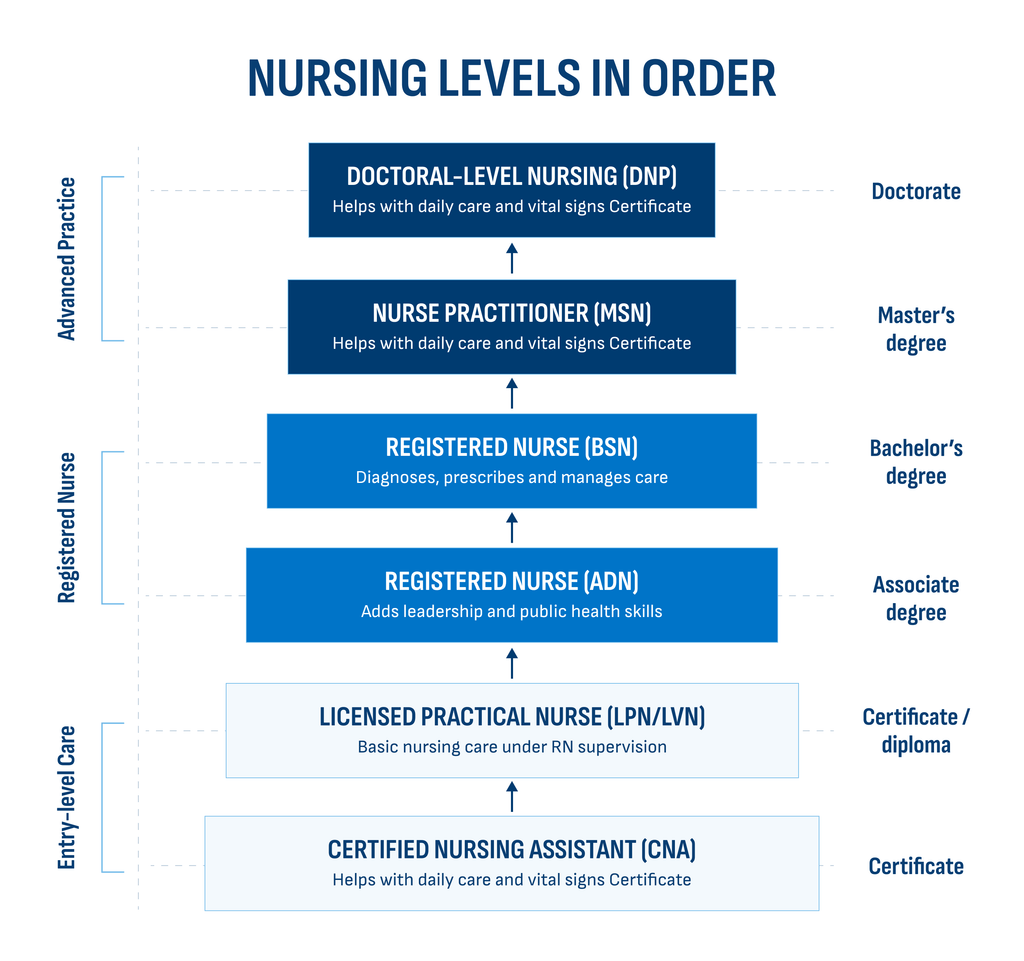
Nursing levels follow a clear order, from entry-level licensure through graduate degrees, and every step changes both what you are prepared to do and what the law lets you do. Education, licensing exam, pay, and job outlook all shift as you move up the ladder, and each role comes with its own reality and path to the next rung.
| Level | Education | Exam | Responsibilities | Median Annual Salary | Job Outlook (through 2034) |
| CNA | State-approved training program | State competency exam | Basic patient care and daily living support under supervision | $39,530 | 2% |
| LPN/LVN | ~1-year practical nursing program | NCLEX-PN | Routine nursing care under RN or physician direction | $62,340 | 3% |
| RN | ADN, BSN, or diploma | NCLEX-RN | Assessment, care planning, medication administration, and care coordination | $93,600 | 5% |
| MSN | Master’s in Nursing | National certification, for APRN paths specifically | Advanced practice, leadership, education, or informatics, depending on track | $132,050 (APRN roles) | 35% |
| DNP or PhD | Doctoral program in nursing | No exam for the degree itself | Systems-level practice, executive leadership, faculty, or research | $158,194 (chief nursing officer) | Varies by role |
1. Certified Nursing Assistant (CNA)
A CNA handles the hands-on work of daily living, helping patients eat, bathe, dress, and move while tracking vital signs and flagging changes for the nursing team. It is direct, physical, people-centered work, and for many nurses, it is the first job they have in healthcare.
The title typically stays the same across settings, but the work inside it does not. For example:
- In long-term care, you build ongoing relationships with residents you see every shift.
- In a hospital, the pace turns over faster and the patients change constantly.
- In home health, the work happens one-on-one in someone’s house, with more independence and less backup nearby.
Many people become CNAs as an entry point while they are finishing up school and preparing for the next role, since the training is short and the schedule can flex around classes. Moving up to LPN/LVN or RN means going back for the required program and passing the licensing exam.
2. Licensed Practical Nurse or Licensed Vocational Nurse (LPN/LVN)
An LPN/LVN provides routine nursing care, monitoring patients, giving medications where the state allows, and reporting up to an RN or physician. The scope falls above a CNA’s and below an RN’s, and an LPN/LVN works under the direction of licensed nurses and doctors rather than independently.
The two names describe the same license, with most states using LPN and California and Texas using LVN, so a nurse who relocates keeps the same scope under whichever name the new state uses.
Where these nurses work has changed over time, with more LPN/LVN roles concentrated in long-term care and outpatient settings than in hospitals. For anyone who wants to advance, an LPN-to-RN bridge program credits prior licensure and experience, which shortens the path to the RN license rather than starting it over.
3. Registered Nurse (RN)
Three routes can lead to the RN license:
- An ADN
- A BSN, or
- A hospital-based diploma.
All three culminate with the same NCLEX-RN and the same license, so the route a nurse takes does not change what the license itself permits on day one.
The RN is the pivot point of the whole ladder, and it gets a dedicated breakdown further down, covering daily responsibilities, specialties, and work settings.
4. Graduate Degree Above the BSN: The MSN
The master of science in nursing is the degree one level above the BSN. It opens roles in advanced practice, leadership, education, and informatics, and it is the entry point for the most clinically autonomous nursing roles.
One path the MSN leads to is advanced practice. An advanced practice registered nurse (APRN) is a clinical role, not a separate degree or a rung on this ladder. Reaching it means earning the MSN, passing national certification in a specialty, and gaining state authorization to practice in that role. Four nationally-recognized roles fall under the APRN umbrella.
- Nurse practitioners
- Certified registered nurse anesthetists
- Certified nurse-midwives
- Clinical nurse specialists
The degree can also prepare nurses for leadership, faculty and informatics roles that don’t require APRN licensure. Some positions may require or prefer additional professional certification, but that certification is separate from APRN certification. In these tracks, the MSN expands a nurse’s career opportunities without changing the underlying RN license.
5. Post-Graduate Degrees Above the MSN: DNP and PhD
Above the MSN are two doctoral degrees, the doctor of nursing practice (DNP) and the doctor of philosophy (PhD), which serve different purposes.
- The DNP is a terminal practice degree focused on applying evidence at the systems level, translating research into stronger care across a unit, a facility, or a health system.
- The PhD in nursing is a research degree that produces that evidence in the first place, preparing nurses for scholarship and academic research.
Whichever a nurse earns, a DNP or PhD is a degree rather than a license, added on top of an existing RN or APRN credential. It qualifies them for executive leadership and faculty positions, but it does not widen their legal scope of practice.
For nurses pursuing advanced study, USD offers several graduate options, including the MSN in Nursing Leadership, a HyFlex Clinical Nurse Specialist program, the DNP, and the PhD in Nursing.
What Is a Registered Nurse, and What Do RNs Do?
Registered nurses do the coordinating work that holds patient care together. On a given shift, an RN assesses patients, administers medications, builds and updates care plans, teaches patients and families how to manage a condition, and keeps the rest of the care team aligned on what each patient needs. The RN is often the person who sees the whole picture of a patient’s care and makes sure nothing falls through the gaps.
Registered nurses also supervise the levels below them, directing the work of LPNs, LVNs, CNAs, and home health aides on the team. The RN license comes with a wider scope than the ones beneath it, which is why that supervision falls to the RN.
Common RN specializations include:
- Critical care, for patients whose conditions can turn quickly
- Perioperative nursing, in the operating room before, during, and after surgery
- Oncology, working with cancer patients through treatment
- Neonatal, caring for newborns who need extra support
- Nephrology, focused on kidney care and dialysis
- Public health, working with communities rather than individual bedsides
RNs practice in a wide range of settings, though hospitals employ the largest share, followed by ambulatory healthcare services such as outpatient clinics and physicians’ offices. The setting a nurse chooses affects the specialty options, the schedule, and the pace of the work.
RNs can also build careers away from direct patient care. A BSN qualifies nurses for dozens of non-bedside and clinical career paths, from informatics and case management to leadership and research.
RN Levels Explained: ADN-Prepared vs. BSN-Prepared Nurses
Both the ADN and the BSN lead to the same RN license, the same NCLEX-RN, and the same legal scope of practice on day one. A nurse who earns an ADN and a nurse who earns a BSN can stand at the same bedside, do the same job, and have the same authority when they start.
The difference is in the preparation and where it takes a nurse over time. An ADN takes two to three years at a community college and focuses on the clinical skills needed to pass the NCLEX-RN and start working. A BSN takes about four years and adds coursework in leadership, evidence-based practice, population health, and nursing informatics on top of that clinical foundation.
That added preparation is what can expand a nurse’s options down the road. Employers tend to look for a BSN when filling supervisory roles, staffing specialty units, and hiring for non-bedside positions. The degree is also a prerequisite for graduate study in nursing.
[RELATED] See how the ADN and BSN compare across education, cost, and career outcomes >>
What Does “BSN RN” Mean in a Clinical Setting?
When a nurse lists credentials on a badge or in a signature, the letters follow a set order. “BSN, RN” is one example, describing a nurse who holds a bachelor of science in nursing and an active registered nurse license. The degree comes before the license because nurses list their credentials from the most permanent to the least, and a degree is permanent while a license has to be renewed and specialty certifications can lapse.
A credential string reflects a nurse’s education and licensure but not their rank or seniority. The license portion, RN here, is what sets the legal scope, and the degree portion tells a patient or colleague how that nurse was prepared. Reading the letters in order is enough to know both at a glance.
That preparation is exactly what an employer looks at when deciding employee responsibilities. A bachelor’s degree signals training in evidence-based practice, quality improvement, and systems-level thinking, which is why the letters after a nurse’s name can influence the assignments and opportunities that come their way.
[RELATED] Weigh the full return on a BSN in career advantages, salary potential, and job outlook >>
Nursing Job Titles Set by Employers
Job titles are the third system, and the one with the least standardization. An employer assigns them, which means the same title can describe different work at different hospitals, and two nurses with identical licenses and degrees can have different titles depending on where they work.
Most employer titles fall into one of two groups. The first is an organizational ladder, where each rung comes with more oversight than the one below it. For example:
| Chief Nursing Officer Sets nursing strategy across the whole organization |
| Director of Nursing Oversees several departments |
| Nurse Manager Manages the daily operations of a unit or department |
| Charge Nurse Leads a single unit during a shift |
The second group names roles by function instead of rank. These are specialized positions rather than supervisory ones, so a nurse in any of them typically focuses on a specific area of expertise instead of managing a team.
| Clinical Nurse Educator Trains nursing staff | Case Manager Coordinates care across settings | Clinical Informatics Specialist Bridges nursing practice and health IT | Quality Improvement Nurse Analyzes data to improve care quality |
Most employer titles come with an education requirement the employer sets, which is where the degree system feeds back into the job-title system. A hospital that requires its nurse managers to hold a BSN is using the degree system to control who gets the title.
How Does Nursing Education Affect Scope, Leadership, and Responsibility?
Education affects a nurse’s scope and responsibilities in two different ways, and which one applies depends on whether the nurse is moving to a new license or earning a higher degree under the license they already hold.
Moving to a new license is the only way education changes what a nurse may legally do. Each step from CNA to LPN/LVN to RN requires a specific level of education, and passing that threshold grants a wider legal scope. The education qualifies the nurse for the new license, and the license is what expands what the law allows.
Earning a higher degree works differently, because it leaves legal scope untouched. An RN with a BSN and an RN with an associate degree have the same license, so the degree changes what an employer will assign rather than what the law permits. The broader BSN coursework in leadership, informatics, and population health is what qualifies a nurse for those added responsibilities, even though it grants no new legal authority.
Graduate study is the dividing line for roles beyond the bedside. Every APRN role and senior administration position requires education past the bachelor’s, so the degree, not the license, determines who reaches them. The push toward higher nursing education reaches past individual careers, since the National Academy of Medicine has linked a more highly educated nursing workforce to stronger patient outcomes across the health system.
How Do Nurses Move From One Level to the Next?
Most nurses advance one step at a time, earning the next credential while still working, which is why bridge and completion programs are built around employed nurses. Each move up has its own established route:
| From | To | Route |
| CNA | LPN/LVN | Practical nursing program, then NCLEX-PN |
| LPN/LVN | RN | LPN-to-ADN or LPN-to-BSN bridge |
| ADN RN | BSN RN | RN to BSN completion program |
| BSN | MSN | Graduate program, opens APRN or leadership roles |
| MSN | DNP or PhD | Doctoral program in nursing |
The order above is the common path, not a required one. Entry points vary, and a nurse can start at different rungs depending on prior education and goals, so the ladder describes how the levels relate rather than a sequence everyone follows.
Why Do Many Hospitals Prefer BSN-Prepared RNs?
The preference for BSN-prepared nurses is measurable, and the hiring data makes it plain. The American Association of Colleges of Nursing found that 25% of employers require a bachelor’s degree for new nursing hires and 69.8% express a strong preference for BSN graduates. The U.S. Bureau of Labor Statistics reflects the same trend, listing a bachelor’s degree as the typical entry-level education for registered nurses.
The workforce has shifted to match. According to the National Council of State Boards of Nursing, more than 70% of registered nurses now hold a baccalaureate or higher as their highest level of nursing education, up from the 47% who entered the profession with a bachelor’s degree.
Magnet recognition is part of what drives the preference at the leadership level. Magnet is a designation the American Nurses Credentialing Center awards to hospitals that meet a rigorous set of nursing-excellence standards, and its eligibility criteria require 100% of nurse managers and nurse leaders to complete a baccalaureate or graduate degree in nursing. For a hospital pursuing or holding that status, a bachelor’s-prepared leadership team is a baseline requirement.
[
The RN to BSN Pathway for Working Nurses
For a working RN who already holds an ADN or a nursing diploma, the RN to BSN program at the University of San Diego offers a pathway to the bachelor’s degree. It is built for nurses who are balancing a job and personal commitments alongside school.
Coursework is fully online, and the clinical practicums are arranged in the student’s own area. USD handles the part that can be challenging for online nursing students. Academic directors coordinate each student’s preceptor and placement directly, and placement costs are included in tuition, so students never have to find a clinical site on their own.
Prior units are not lost. Up to 60 to 69 units transfer in, and tuition is $600 per unit, which puts the program at $25,800 to $31,200 for the 43 to 52 units required, the same for every student regardless of where they live.
The program also feeds directly into graduate study. Nine units are shared between the BSN and the MSN in Nursing Leadership, so a nurse who continues on can earn both degrees in roughly three years, well ahead of pursuing them separately.
Your Next Step Up the Ladder
The letters after a nurse’s name make more sense once you know they come from three systems working together. A license sets what a nurse may legally do, a degree reflects how far that nurse took their education, and a job title names the responsibility an employer hands them. A single nurse holds one from each at the same time, which is why “BSN, RN, Charge Nurse” describes three facts about one person rather than a single rank.
Across all three systems, career advancement tends to start with education. Earning a higher license means completing the schooling that license requires. Taking on bigger assignments or a leadership title usually means holding the degree an employer looks for. Even the roles beyond the bedside, from nurse practitioner to nursing faculty, call for graduate study on top of the bachelor’s. Moving up almost always means going back to school.
Before taking that step, find out the full picture of what a BSN actually returns. Download the ROI of a BSN for the full breakdown of salary, advancement, and job security.
Frequently Asked Questions
How long does it take to earn a BSN if you are already an RN?
Most RN to BSN completion programs take 12 to 18 months of part-time study, and some accelerated tracks finish in as few as nine months. The exact timeline depends on how many prior credits transfer in and how many courses a nurse takes at once. Because these programs credit existing licensure and coursework, they take far less time than a traditional four-year BSN.
How much more do BSN nurses make than ADN nurses?
BSN nurses typically earn more per year than ADN nurses, though the exact amount depends on factors such as experience, location, specialty and work setting. Working from the BLS median for registered nurses, Nurse.org estimates BSN nurses earn $5,000–$20,000 more annually, and the American Nurses Association projects the difference adds up to more than half a million dollars over a 30-year career. Much of that comes from access to higher-paying roles rather than base pay alone.
Can you work full-time while earning a BSN?
Yes, you can work full-time while earning a BSN, which is exactly what many RN to BSN programs are designed for, with online coursework that fits around a full-time schedule. Clinical practicum hours, where required, are usually arranged at a site near you rather than at a set time and location on campus. Most students in these programs keep working the entire time they study.
Is it worth going back for a BSN?
For most nurses, a BSN pays off, and it tends to do so quickly. Industry estimates suggest many recover the cost of an RN to BSN program within one to three years through higher pay and expanded eligibility. The degree also qualifies a nurse for leadership and specialty roles that many employers reserve for bachelor’s-prepared staff, along with the option to pursue graduate study later on.
Do you lose your ADN credits when you go back for a BSN?
No, you do not lose your ADN credits when you move on to a BSN. Completion programs apply that prior coursework toward the degree, granting advanced standing for an existing RN license and the classes behind it. Many programs accept a large block of transfer credit, which is why a nurse rarely repeats material already covered in an associate program. A transcript review determines exactly what applies.
Which is harder to attain, CNA or RN?
Becoming an RN is considerably more demanding than becoming a CNA. CNA training often takes a few weeks to a few months and ends in a state competency exam. RN preparation typically involves two to four years of college-level science and clinical coursework and ends in the NCLEX-RN, a comprehensive licensing exam. The RN role also requires broader clinical judgment in daily practice.