Key Takeaways
- A theory of change maps an organization’s actions to its desired impact.
- Every theory of change model includes a problem statement, resources, activities, outputs, outcomes, impact and assumptions.
- Theories of change use backward design, starting with the desired end goal and working in reverse.
- Nonprofits, NGOs, public health entities and businesses all use theories of change to strengthen strategic planning, accountability and evaluation.
- Theory of change is just one of the humanitarian planning tools students in USD’s MS in Humanitarian Action program learn how to use.
The theory of change model is a powerful tool that enables you to map out the connections between actions, resources and a desired impact. Whether you’re working in nonprofit organizations, businesses or social enterprises, understanding the details of this approach can help drive meaningful results.
What Is a Theory of Change Model?
A theory of change model is an illustration or description that helps organizations determine how and why a particular change is needed or expected to occur. This structured planning tool outlines the specific steps and connections that link an intervention or activity to a desired outcome. In other words, it details the causal chain of current and future events that ties your actions to the results you hope to achieve.
Why Is a Theory of Change Important?
The theory of change model provides an organization with a clear roadmap for achieving specific goals. Not only does it enhance strategic planning, but it also increases accountability and transparency, helping both stakeholders and the community at large understand (and critique and improve) the process.
Additionally, a theory of change offers a valuable framework for monitoring and evaluating progress, and it effectively communicates the logic and rationale behind a project or program to an external audience.
This type of model is widely used across various industries and sectors, including nonprofits, non-governmental organizations, public health entities, educational institutions and environmental agencies. Businesses may also use theory of change models as part of their corporate social responsibility initiatives.
7 Key Components to a Theory of Change
To effectively employ a theory of change model, it’s important to understand the main elements of planning and evaluating a program’s success. These components form the model’s foundation, ensuring that every step is aligned with the ultimate goal.
- A problem statement: A clear definition of the problem or issue at hand. Some common considerations include: Who is affected? What are the harms or costs involved (including their incidence, prevalence, severity)? What are the circumstances under which this is a problem (times, places, political environment, demographics, etc.)? What are the causes and etiology of the problem (including current hypotheses and theories)?
- Resources: The funding, staff and materials needed to implement the activities.
- Activities: Specific programmatic actions and initiatives undertaken to achieve the desired outcomes.
- Outputs: Direct, immediate results of the activities. These often have a one-to-one correspondence with the activities.
- Outcomes: Short-to-medium term changes or benefits that result from the outputs. Project outcomes are often, though not exclusively, measured at the level of the beneficiary – either the individual or the household. Program outcomes may often, but not always, apply to those same units or to larger collectivities (e.g. schools, communities, etc.). (Note: The term “outcomes” often refers to a specific level of objective, which is typically above outputs but below overarching goals, though this can vary by organization. The terms “intermediate result” and “objective” are sometimes used.)
- Impact: The long-term effect or goal that the project or program aims to achieve. This is often defined at the community level.
- Assumptions: The beliefs and conditions that must work for the theory of change to succeed. Assumptions about how, why, or under what circumstances the change can be expected to take place. These may also be conversely framed as risks: conditions or events that might thwart the expected change.
It’s important to note that theories of change, along with logical frameworks (LogFrames) and results frameworks, are typically developed using a process of backward design, meaning that organizations typically start by first identifying the desired end goals or outcomes.
Theory of Change Example
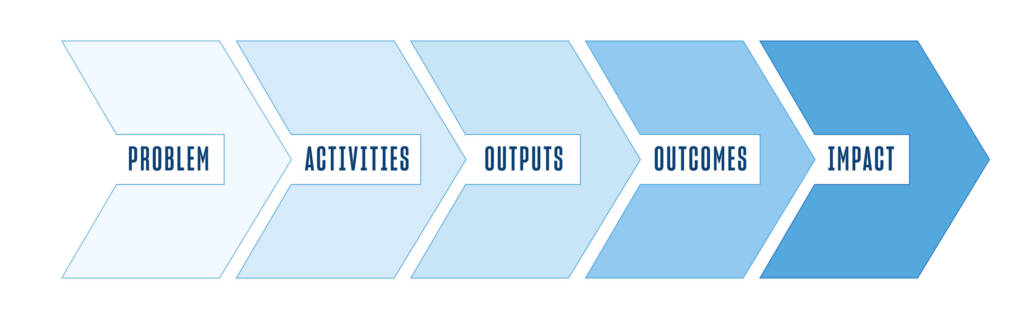
One of the ways to diagram a theory of change is through the use of a logic model, which is a visual representation that depicts the relationship between the resources, activities, outputs and impacts of a particular project or program. The goal is to clearly show how you can achieve your desired results.
Example problem: Gang violence in a particular neighborhood
Brief explanation: Theory of change for a conflict resolution program intervention that trains gang members in alternative dispute resolution (ADR) techniques such as mediation and facilitation.
- Activities: Hold ADR training sessions for eligible gang members
- Assumption: Gang members will be interested in attending. Transportation to the training facility will not be problematic. Gang members have adequate time during the training schedule.
- Resources: Training space, trainers and relevant educational materials
- Assumption: Adequate space is available. Trainers are ready and eager to participate. The community is supportive of the training, with no disruptive protests. If materials or additional resources are needed, funding is readily accessible
- Outputs: Gang members graduate from the program
- Assumption: Gang members attend every session; there are no logistical or participation problems
- Outcomes: Interpersonal conflicts are first addressed using ADR techniques
- Assumption: Gang members will employ learned techniques
- Goal: Reduced neighborhood gang violence (as measured by number of violent incidents, injuries or deaths per week, etc.)
- Assumption: Gang conflicts can be resolved using ADR techniques. The unemployment rate and broader city-wide crime rates do not significantly increase.
A Fundamental Tool for Effective Humanitarian Action
The theory of change model provides a structured approach to planning and implementing humanitarian projects and programs. It can also help organizations map out their strategic efforts and clarify how specific actions will lead to particular outcomes.
If you’re looking to learn more about these types of humanitarian tools, resources and concepts, consider the University of San Diego’s Master of Science in Humanitarian Action. The 100% online curriculum is designed to prepare action-minded professionals with the skills, knowledge and tools to help solve some of the world’s biggest challenges.
Frequently Asked Questions
What’s the difference between a theory of change and a logic model?
The difference between a theory of change and a logic model is that a theory of change explains why and how change is expected to happen, while a logic model shows how a program’s resources lead to activities, outputs and outcomes. A theory of change includes the causal reasoning and assumptions behind a program’s approach. A logic model is typically a visual representation of that pathway and can be one way to communicate a theory of change. Because it explains the reasoning behind the pathway, a theory of change is the broader concept.
What’s the difference between a theory of change and a logframe?
The difference between a theory of change and a logframe is that a theory of change explains how and why a program is expected to create change, while a logframe is a management and evaluation tool used to track whether a project achieves its objectives.
A logical framework, or logframe, is typically a matrix that connects each level of objective with indicators, means of verification and assumptions. Humanitarian and development donors often require logframes as part of funding proposals because they help demonstrate how a project will measure progress, manage implementation and report results. A theory of change often informs the development of the logframe by defining the causal pathway the project aims to follow.
What’s the difference between outputs and outcomes?
The difference between outputs and outcomes is that outputs are the direct, measurable products of program activities, while outcomes are the changes that result from those outputs. For example, the number of people trained is an output, while the ability of participants to apply new skills after training is an outcome. The practical distinction is control: organizations can usually directly measure and influence outputs but can only contribute to outcomes. Impact refers to the longer-term, population-level change that outcomes help create.
How do you write a theory of change?
To write a theory of change, organizations typically start by defining their desired long-term impact and mapping the steps needed to achieve it. This backward design process identifies the outcomes needed to create that impact, the outputs needed to produce those outcomes, the activities that generate those outputs and the resources required. Organizations should also document assumptions at each stage and test whether the proposed pathway logically connects activities to results.
Do funders require a theory of change?
Many funders require a theory of change or ask applicants to describe one as part of a grant proposal. Foundations, government agencies and institutional donors often use theories of change and logical frameworks to evaluate whether organizations seeking funding have clearly considered how their activities will lead to measurable results. Requirements vary by funder, so applying organizations should review each funder’s guidelines rather than assume there is one standard format.
How often should a theory of change be updated?
A theory of change should be updated regularly because it is most effective as a living document rather than a fixed plan. Organizations commonly revisit their theory of change during annual planning cycles, at the close of a project phase or when monitoring data shows that an assumption no longer holds. Significant changes in context, funding or target populations may also require updates because the original pathway to impact may no longer apply.