Health information management (HIM) has grown far beyond paper records. Today, the most successful professionals leverage health informatics to organize, analyze, and interpret vast amounts of digital data that directly inform patient care, improve operational efficiency, and guide strategic decision-making. This data-driven shift is creating new career paths for health information professionals who are ready to combine clinical expertise with technology and informatics skills.
The Evolving Landscape of Health Information Management
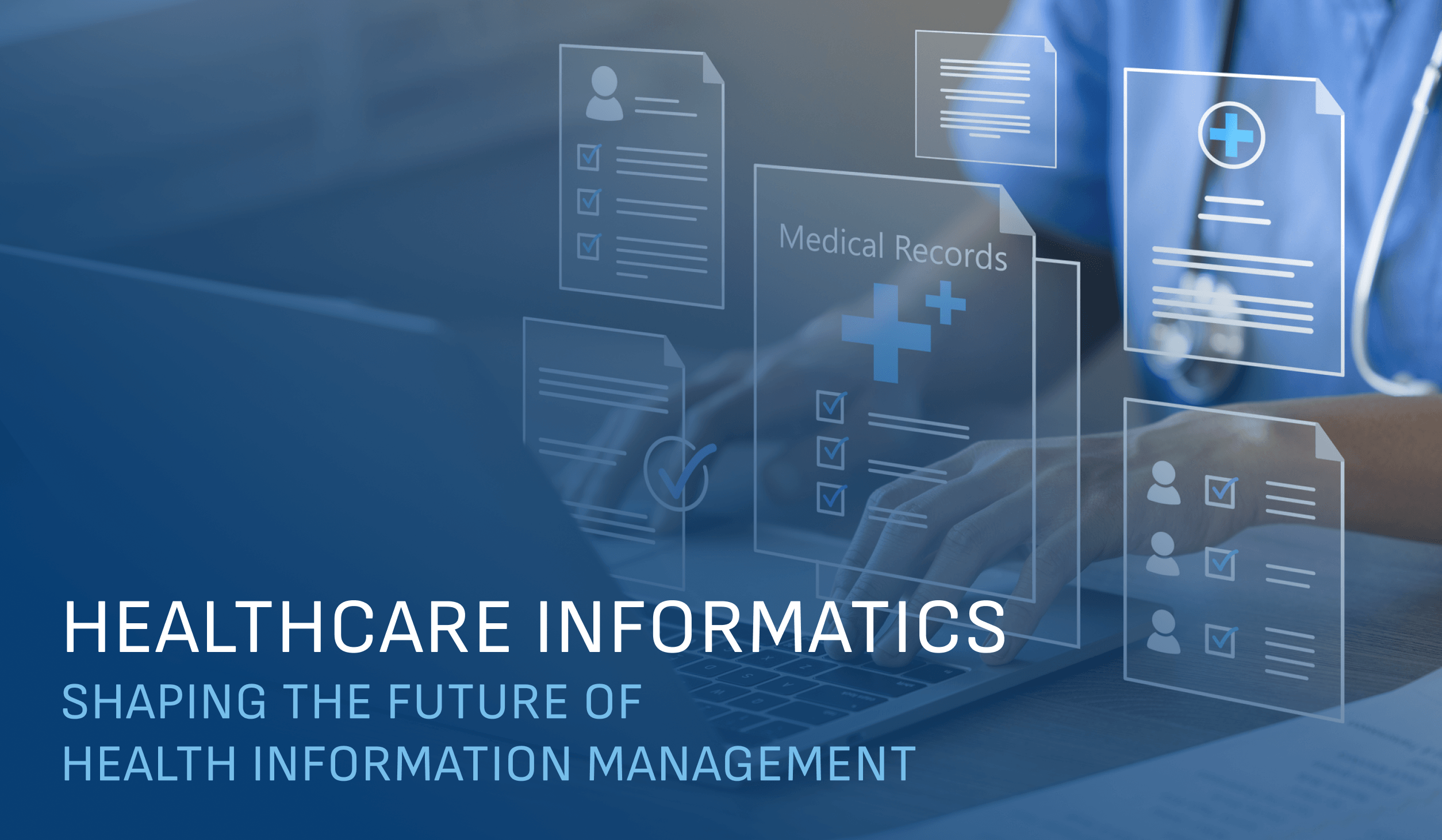
Healthcare information today encompasses far more than it did just five or ten years ago. Modern health information includes virtually any type of physical and digital data related to a patient, such as lab results, X-rays, clinical notes, diagnoses, and demographic details. This information can be viewed on its own or analyzed as part of larger data sets to support care decisions, research, and operational planning. Increasingly, health information is stored, shared, and managed digitally.
As a result, health information management has expanded well beyond traditional recordkeeping. During the 1800s and early 1900s, health information management focused primarily on physical documentation.
Over time, the field has expanded to include electronic health records (EHRs), electronic health information exchanges (HIEs), medical coding and classification systems, and data analysis and reporting. Modern information management software is also increasingly powered by artificial intelligence and machine learning, enabling healthcare organizations to improve accuracy, efficiency, and decision-making while maintaining compliance and data security.
[RELATED] Your Guide to Health Information Technology Terminology
How Health Information Management Professionals Are Expanding Their Roles Through Informatics
Health information management professionals play an important role in health informatics by ensuring hospitals and healthcare systems accurately capture data integrity. By applying informatics tools and principles, they help transform raw data into useful insights that support patient care, improve operational efficiency, and inform better decision-making.
As healthcare becomes increasingly data-driven, health information management professionals are expanding their roles through informatics, often without even labeling it as such. Many are already working in areas that combine technology, data, and patient care as their responsibilities evolve beyond traditional records management and coding.
This shift reflects a broader evolution within the field. What once centered on administrative computing has grown to include clinical data storage, decision support systems, and sophisticated, AI-driven informatics platforms. Today, health information management professionals are increasingly involved in initiatives such as:
- Electronic health systems that improve usability, data quality, and accuracy
- Leading data privacy and security efforts to protect sensitive information
- Implementing AI-driven solutions that streamline documentation and reduce billing and coding errors
Emerging Career Opportunities in Health Information Management
As healthcare organizations continue to digitize operations and rely more heavily on data-driven decision-making, informatics skills are becoming essential for current and future professionals. The career outlook for these opportunities is extremely strong: According to the U.S. Bureau of Labor Statistics (BLS), employment for health information technologists and medical registrars, which are both part of health information management, is projected to grow 15% through 2034.
Health informatics has become so integral that the American Health Information Management Association (AHIMA) has renewed its commitment to the field and outlined key initiatives, including:
- Expanding learning opportunities and professional certifications to strengthen informatics expertise
- Promoting policies and standards that enhance the impact of health information professionals
- Fostering collaborations and partnerships to advance innovation in health informatics
- Offering practical tools and guidance to help members navigate new technologies and changing industry needs
According to the AHIMA Career Map, emerging roles for health information professionals with informatics expertise include positions such as chief data officer, data governance manager, chief health informatics officer, decision support analyst, HIM project analyst, and more.
[RELATED] How to Prepare for a Job in Health Informatics
How a Health Informatics Master’s Degree Can Help Health Information Management Professionals Advance [Benefits of an Advanced Degree]
For health information management professionals who are aiming to move into strategic, high-impact roles, a master’s degree in healthcare informatics can be a powerful next step. These programs build on existing health information management experience while equipping students with advanced skills in data analytics, digital health, and health IT leadership.
Many programs offer flexible online formats, enabling professionals to continue working while preparing for a career transition or advancement.
Ready to Take the Next Step in Your Health Information Career?
Whether you’re looking to transition into health informatics or advance your expertise in your current health information management role, an advanced degree can equip you with the skills, knowledge, and experience to reach your goals. The University of San Diego’s Master of Science in Health Care Informatics is available online or in-person, full-time or part-time, so you can earn your degree in as little as 20 months at a pace that fits your life and career aspirations.