Key Takeaways
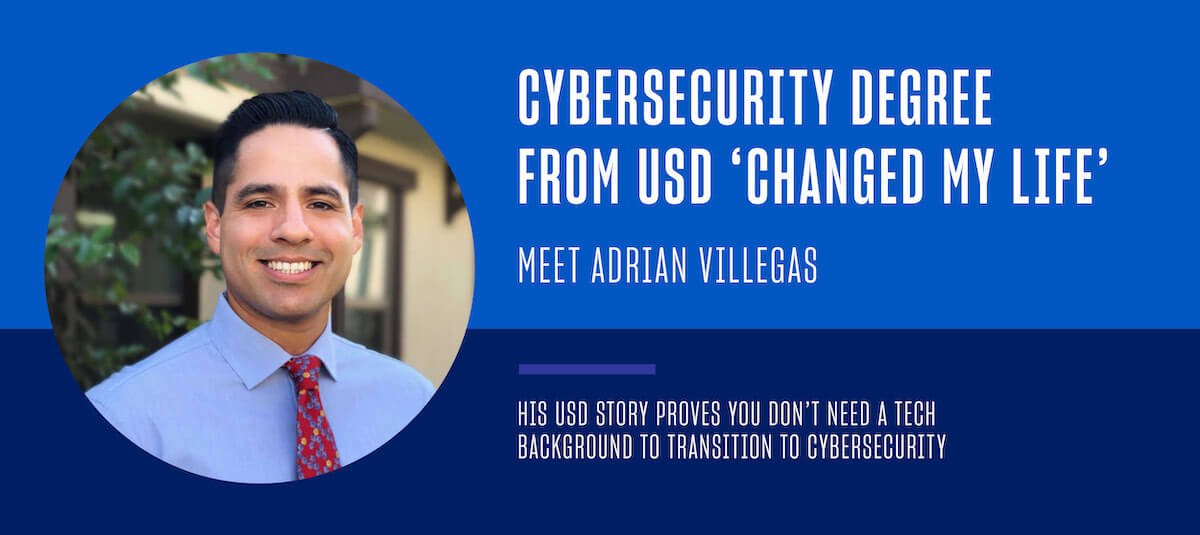
- A non-technical background is not a barrier to a cybersecurity career, and the right program makes the difference. Adrian Villegas went from 12 years in retail security operations to a role as an information security analyst with no prior IT experience.
- Transferable skills like leadership, problem-solving and team management are genuinely valued in cybersecurity. Adrian’s professional experience gave him a strong foundation, even without a technical degree.
- USD’s online format is built for working professionals managing real-life demands. Adrian completed the 20-month program while working full time, buying a home and welcoming his first child.
- USD’s career support resources played a direct role in Adrian’s job search success. Guidance on resume writing, networking and alumni outreach helped him land his information security analyst role at NextGen Healthcare.
- Investing fully in the program, academically and professionally, pays off. Adrian credits the faculty, curriculum and peer community with transforming both his career and his confidence.
If you’re considering a career in cybersecurity but don’t have a technical background, you’ll want to meet Adrian Villegas, a recent graduate of our online Master of Science in Cyber Security Operations and Leadership program.
‘Looking for Something More Challenging’
Adrian, who had earned a bachelor’s degree in criminal justice, had been working in security and operations at Target for 12 years when he knew he wanted to go back to school. He wasn’t sure what kind of advanced degree was the right choice, just that he was “looking for something more challenging.”
His wife suggested a career within security operations and IT, which piqued Adrian’s interest. He started researching colleges and universities and narrowed his focus to cybersecurity because he was fascinated with the inner workings of businesses and corporations.
A Good Fit for a Working Professional
The University of San Diego was one of the first schools that he came across, and it seemed like a good fit since Adrian was looking to continue working while he earned his degree. He wanted an academic program that could accommodate his work schedule, and he liked what he read about USD’s online degree.
In terms of quality, flexibility and tuition cost, USD met all of Adrian’s requirements.
“USD was always hitting every check mark,” he said. Plus, the school came highly recommended from a few friends.
Adrian reached out to USD and was encouraged to apply, even though he didn’t have a technical background. He did, however, have plenty of professional experience in a variety of skills sets that are essential to cybersecurity positions, such as leadership, problem-solving, working with employees and clients and managing a team. Adrian had also been working at Target during its 2013 data breach, so he knew the value and importance of cybersecurity within a business.
“My background definitely gave me the confidence to do this,” he said. “I knew that I just had to learn as much as I could about the technical aspect.”
He took a few classes on Python programming and information security, submitted his application — and was accepted. He started the 20-month program in January 2019, all while juggling a full-time job, buying a new home and starting a family (their first child born a few months later in April).
“The program really did help me with how to manage my time efficiently,” Adrian said, adding that he couldn’t have done it all without such strong support from his wife.
‘I Invested in This Program, and I Got Everything I Wanted Out Of It’
Six months into the program, Adrian started thinking critically about how to transition to a career in cybersecurity. He credits much of his success to Sue Kelly, USD’s assistant director of Career Exploration and Experiential Learning, who provided a wealth of career-related information, including tips on resume writing and networking.
She also recommended that Adrian reach out to USD alumni on LinkedIn. He did, and received a response from someone who recommended the company NextGen Healthcare, which is where Adrian started a new job as an information security analyst in January 2020.
[RELATED] How to Start a Career in Cybersecurity >>
“I tell everyone ‘USD and the program changed my life.’”Since he didn’t have a technical background, he feared that me might not be accepted into a master’s program and therefore wouldn’t be able to successfully pursue his chosen career.
But USD changed all that, and ever since, he’s been a huge advocate of the school’s Master of Science in Cyber Security Operations and Leadership program — so much so that he’s inadvertently recruited two new people to the program who are now interested in pursuing careers in cybersecurity. He credits his success to his support system — the program, faculty, his family and his classmates.
“Honestly, this program helped me, the faculty helped me, and if it wasn’t for them, I wouldn’t be where I am today,” he said. “I invested in this program, and I got everything I wanted out of it.”
frequently asked questions
What transferable skills from other industries apply to cybersecurity?
Skills developed outside technology can transfer well into cybersecurity, particularly in operations, governance and leadership-oriented roles. Experience managing people, coordinating across departments, handling incidents under pressure, documenting processes and explaining complex issues to non-specialists can all be relevant. Backgrounds in retail and physical security, law enforcement, military service, auditing, healthcare and customer-facing work can also provide useful experience. What you typically need to develop is a foundation in cybersecurity and technology. The specific skills employers prioritize vary by role, but communication, problem-solving and sound judgment can complement technical knowledge in many cybersecurity positions.
Should you take technical courses before applying to a cybersecurity master’s program?
Taking introductory technical courses before applying can help candidates from nontechnical backgrounds prepare for graduate-level cybersecurity coursework. Introductory courses in programming, networking or information security fundamentals can provide a useful foundation, particularly for students who have limited experience with computing. Some cybersecurity master’s programs also require or recommend prerequisite courses for students without a relevant technical background, which can affect the total number of units and time required to complete the degree. Because admission and prerequisite requirements vary, prospective students should check the specific program’s requirements to determine what preparation they need.
How do you use a university alumni network in a job search?
A university alumni network can help you connect with professionals who have experience in their target industry or role. Searching a school’s alumni directory or LinkedIn by employer, job title or field can help identify people with relevant experience. Rather than immediately asking for a referral, consider asking an alumnus about their career path, role or transition into cybersecurity. Universities may also offer career services that can help with networking strategies, outreach and resume preparation. These conversations can help career changers learn about the field and build professional connections.
Is a criminal justice background useful in cybersecurity?
Yes, a criminal justice background can be useful in parts of cybersecurity, particularly investigative, compliance and risk-focused roles. Knowledge of evidence handling, investigative procedures, legal processes and regulatory requirements can apply to areas such as digital forensics, incident response, cybercrime investigation, compliance and risk management. Professionals transitioning from criminal justice may still need to develop technical cybersecurity fundamentals, depending on the role they want to pursue. The ability to connect technical findings with legal, investigative or procedural requirements can be particularly relevant in roles that bridge cybersecurity and criminal justice.