
In a field like law enforcement in which there are few, if any, strict requirements for a college degree, it’s natural to wonder whether it’s worth it to pursue a criminal justice bachelor’s degree or a master’s degree in law enforcement leadership. Here are some things to consider as you weigh your options.
A quick note before diving in: salary data, promotional requirements, and how much a degree actually moves the needle varies a lot by state, by agency type, and by department size. A captain at a large metro department and a chief running a 15-person rural sheriff’s office are operating in very different worlds, and the points made in this post land differently depending on which one describes your situation.
Job Security and Career Growth in Law Enforcement
Going back to school requires a real financial and time commitment, so it matters that the payoff is worth the investment. In law enforcement, that payoff still looks strong, and for a few reasons that have only gotten more pronounced in recent years:
- Agencies are struggling to staff up. A 2024 survey from the International Association of Chiefs of Police found that more than 70 percent of responding agencies said recruitment is harder now than it was five years ago, with departments operating at roughly 91 percent of authorized staffing levels on average. That gap is opening doors for candidates who can show leadership readiness and an enthusiasm to grow and promote.
- The retirement wave hasn’t finished. As experienced sergeants, lieutenants, captains and chiefs retire, agencies need people ready to promote, and those roles increasingly go to candidates with formal leadership training in addition to their field experience and years on the job.
- Public safety is not a discretionary budget line. Unlike private-sector roles, law enforcement positions are far less exposed to the kind of layoffs that come with a slow economic quarter. Crime prevention, emergency response, and community safety remain priorities in good years and bad.
The Bureau of Labor Statistics projects that overall employment of police and detectives will grow about 3 percent from 2024 to 2034, roughly in line with the average for all occupations, with about 62,200 openings projected each year nationally. Most of those openings come from people retiring or moving into other work rather than from new positions being created, which is exactly the kind of turnover that rewards candidates with leadership credentials already in hand.
The Law Enforcement Career Path: From Patrol Officer to Police Chief
Climbing the ranks in law enforcement looks different from a typical corporate career ladder, but the underlying logic is the same: to move from an early-career officer or deputy role into a sergeant, lieutenant, or captain position, and eventually into a chief or executive-level role, you need a combination of field experience and formal leadership education.
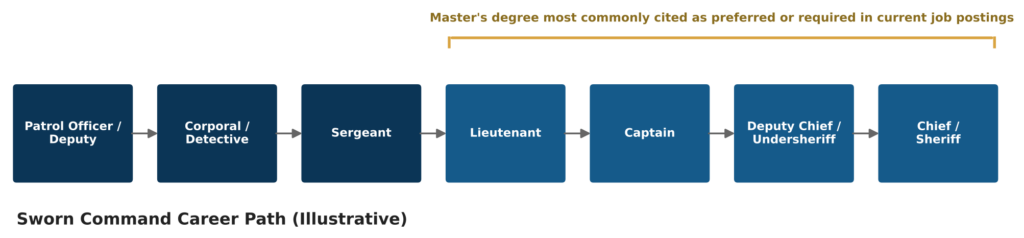
An associate degree used to be enough to stand out in a promotional process. Today, the bar has moved. A review of current job postings for chief-level and command-level positions shows a clear pattern: a bachelor’s degree is typically the minimum requirement, and a master’s degree is now commonly listed as preferred, sometimes required, for candidates competing for the top command roles. One Police Foundation study found that more than 35 percent of police chiefs nationally already hold a master’s degree, well above the share found at the patrol level.
[RELATED] Police Education Study: 35.1% of Chiefs Have Master’s Degree
So Do You Need a Degree to Promote in Law Enforcement?
An examination of 2026 job postings confirms a shift in educational requirements and preferences. While a master’s degree is rarely an absolute requirement, it’s increasingly the differentiator for candidates competing for command and chief-level roles. Here are a few examples of what agencies are currently asking for in leadership postings:
Chief of Police for the City of Firebaugh, CA
$95,197 – $127,573 annually
Requires ten years of responsible law enforcement experience and five years of management or supervisory experience in a municipal police department or county sheriff’s organization.
Chief of Police for the Village of Lemont, IL
$160,000 – $165,000 annually
Requires a bachelor’s degree in criminal justice or a related discipline, with a master’s degree preferred, along with 20 years of experience as a full-time officer, including 10 years of supervisory experience and five years at the senior command level.
Chief of Police for a Municipal Department in ID
Requires a bachelor’s degree in criminal justice, law enforcement, or a related field, with a master’s degree preferred, plus ten years of progressively responsible experience in local law enforcement and at least three years in a command position.
The pattern holds across agencies of very different sizes and in very different parts of the country: a bachelor’s degree gets a candidate into consideration, and a master’s degree increasingly moves that candidate to the top of the list. If you’re aiming for leadership responsibilities and the pay that comes with them, education is no longer optional in the way it once was.
Does a Law Enforcement Degree Matter More at Large or Small Agencies?
It’s worth being direct about something the “get a master’s degree” argument can gloss over: the leadership-readiness case for a graduate degree matters most at agencies with the size and structure to have a real promotional ladder, formal command tracks, and competitive candidate pools. A large metro department fielding dozens of applicants for a captain position is going to lean heavily on differentiators like education. A small rural sheriff’s office with fewer than 20 sworn staff, where the next chief may be whoever’s next in line and willing to take the job, is a different situation entirely. Salaries for chiefs of small-town departments run well below big-department pay, sometimes into the same range as senior officers at larger agencies.
That doesn’t mean a master’s degree has no value at a small agency. The leadership, budgeting, and personnel management skills still apply directly to the job, and rural agencies are not exempt from the recruitment and retention pressure described earlier; if anything, some rural departments face it more acutely, with fewer resources to compete on pay. But the promotional-ladder logic, that a degree helps you stand out against other qualified candidates, is less relevant when there may not be much of a candidate pool to stand out from in the first place. If you’re leading or hoping to lead a small department, the more relevant case for a graduate degree is less about competitive differentiation and more about building the specific skills needed to run a department with a small staff and a small budget.
[RELATED] Want to be a Chief of Police? Career Advice for Aspiring Law Enforcement Leaders
Kelly Blackwelder was already chief of the Town of Elon Police Department in North Carolina when she decided to pursue her Master’s in Law Enforcement and Public Safety Leadership. She was upfront about wondering whether a graduate degree would even matter at that point in her career. Her answer, after finishing the program: “I had to remind myself that I was worth the investment.” For a leader already running a small department, the payoff wasn’t a promotion. It was sharper writing, research, and presentation skills, and more confidence making the calls the job already required her to make.
A Growing Leadership Path for Non-sworn and Professional Staff
Nationally, civilian and professional staff make up roughly 30 percent of the more than one million people working in local law enforcement, and that share is growing as agencies lean further into what’s often called civilianization: shifting records management, crime analysis, victim advocacy, dispatch and communications, property and evidence handling, and administrative functions to professional staff so sworn officers can stay focused on patrol and investigations. The Police Executive Research Forum highlighted this shift as a defining trend in modern policing in a 2024 report on integrating professional staff into agency operations.
That shift is creating real leadership opportunities outside the sworn ranks. Records supervisors, communications and dispatch supervisors, crime analysis managers, and police services managers increasingly oversee teams, manage budgets, and sit at the table for department-wide planning, work that calls for the same leadership, communication, and organizational skills a sworn commander needs. A graduate degree built around law enforcement leadership can support that growth just as directly for a professional staff member managing a records unit as it does for a lieutenant managing a patrol shift. Programs designed for the full law enforcement and public safety community, rather than sworn officers exclusively, are increasingly built with this reality in mind, welcoming dispatch supervisors, community service officers, administrative officers, and other professional staff alongside sworn students in the same classroom.
In Their Own Words: Is a Law Enforcement Degree Worth It?
The clearest answer to the “is it worth it” question often comes from the people who have actually weighed the return themselves. A few perspectives from law enforcement professionals across all ranks and assignments who decided to pursue a graduate degree:
“The LEPSL program provided me with a competitive edge among my peers. Although I brought 7 years of business management experience into my law enforcement career, the leadership challenges specific to policing demanded a different focus which is what the University of San Diego have built this program around.” -Detective Chris Woodrow, Morgan Hill, CA
“I am convinced that the skills amassed throughout the MS-LEPSL program were largely responsible for my appointment to Chief of Police,” said John Myrsiades, Chief, Plymouth Township, Pennsylvania.
“The degree is not only manageable, but its applicability to real-world career dynamics has already paid me dividends,” said Ozzie Knezovich, Sheriff, Spokane County.
“A graduate degree has become the industry standard for those who seek executive level positions in law enforcement. In a continued effort to develop ones leadership capabilities throughout your career, the LEPSL degree at USD will meet and exceed your expectations,” said Shawn Butler, Chief (Ret.).
“I recently took a job as Chief of a small agency and I use lessons from LEPSL every day to handle challenges from personnel management to budgeting. My capstone website turned out so well that I used it in my Chief selection process and was told it gave them a better sense of who I am than my resume alone.” Chief Cristyn Zett, Ross Township, PA
“Although I enrolled in LEPSL to earn a master’s degree for my resume, what I received was so much more. The contemporary coursework was immediately relevant to our rapidly changing social and political environment. At the end of my LEPSL journey, I was much more confident in my ability to lead my department through difficult challenges, strengthened by the support of my new LEPSL alumni network of students and faculty.” – Chief Jeff Liu, East Palo Alto, CA
[RELATED] Why a Deputy Police Chief Decided to Earn a Second Master’s Degree
Law Enforcement Salaries in 2026
Salary in law enforcement depends on education, geographic location, rank, and years of experience. According to the Bureau of Labor Statistics’ most recent Occupational Employment and Wage Statistics survey (May 2025), the national mean annual wage for police and sheriff’s patrol officers was $79,200, with a median annual wage of $76,210. California continues to lead the country in both employment levels and pay for this occupation.
States with the highest reported pay for police and sheriff’s patrol officers (mean annual wage):
| State | Mean Annual Wage |
| California | $111,630 |
| Washington | $96,770 |
| Alaska | $93,380 |
| New Jersey | $57,650 |
| Hawaii | $88,120 |
Source: BLS OEWS, 2025
The pay picture opens up further once you move into a supervisory role. First-line supervisors of police and detectives, a broad BLS category that spans everything from patrol sergeant and detective sergeant up through lieutenant, captain, and even chief, earned a national mean annual wage of $112,190 as of May 2025, well above patrol-level pay.
States with the highest reported pay for first-line supervisors of police and detectives (mean annual wage, all titles in this BLS category combined):
| State | Mean Annual Wage |
| California | $161,180 |
| New York | $134,220 |
| Maryland | $113,520 |
| Florida | $99,470 |
| Georgia | $79,090 |
Source: BLS OEWS, May 2023
The Overtime Reality Behind the Base Salary Numbers
Base salary is only part of the picture, especially with staffing shortages as widespread as they are right now. In California, for example, a 2026 Public Policy Institute of California analysis of statewide law enforcement staffing data found that average overtime pay for California officers grew from about $10,000 in 2011 to more than $25,000 by 2023, as agencies leaned on existing staff to fill gaps left by unfilled positions. That same analysis found a meaningful split by agency type: officers at non-rural agencies averaged about $28,000 in overtime pay in 2023, compared to about $16,000 at rural agencies, reflecting real differences in call volume, staffing depth, and overtime budgets between large and small departments.
The pattern shows up nationally too. Industry pay analyses looking at 2025-2026 compensation data consistently find that overtime can add anywhere from 20 to 40 percent on top of base pay in high-demand jurisdictions, with mandatory overtime becoming routine in some understaffed cities. That extra pay comes at a real cost in burnout and turnover, but it’s also part of the honest financial picture for anyone weighing whether further education and leadership readiness are worth pursuing right now.
How a Law Enforcement Degree Can Pay Off Directly
Even setting aside promotion, a number of agencies build education directly into their pay structures. In El Paso, Texas, for example, officers with a master’s degree from an accredited college receive an additional $200 per month, about $2,400 a year, on top of standard pay, with additional bumps available for advanced POST certification. Some Massachusetts departments, including Cambridge, use percentage-based education incentives: officers with an associate degree receive a 10 percent bonus, a bachelor’s degree earns 20 percent, and a master’s degree earns 25 percent. Structures like these vary widely by department and by state, so the specific dollar impact of a master’s degree depends heavily on where you work, but they illustrate that the financial case for education isn’t only about winning a future promotion. It can show up in your paycheck well before that.
Frequently Asked Questions About Earning a Law Enforcement Degree
Do I need a college degree to become a police officer?
No. Most entry-level police officer and deputy sheriff positions require only a high school diploma or equivalent, plus academy training. A degree becomes far more relevant once you’re aiming for promotion into supervisory or command roles.
Is a master’s degree worth it for law enforcement leadership?
For candidates competing for sergeant, lieutenant, captain, or chief-level positions, a master’s degree is increasingly the differentiator, and more than 35 percent of police chiefs nationally already hold one. Many current job postings for command-level roles list a master’s degree as preferred, and some list it as required. That said, the case is strongest at agencies with a real competitive promotional process; a small department with a thin candidate pool weighs it differently.
Does a master’s degree matter as much at a small or rural department?
The leadership and management skills still apply, but the competitive advantage of a degree matters less where there isn’t much of a promotional field to compete against. At small agencies, the stronger case for a graduate degree is building the specific skills needed to run a department with limited staff and resources, rather than standing out in a crowded field of candidates.
Can non-sworn or professional staff benefit from a law enforcement leadership degree?
Yes. As agencies rely more on professional staff to lead records, communications, crime analysis, and support functions, the leadership, budgeting, and organizational skills covered in a graduate program apply directly, whether the person managing a unit carries a badge or not.
What’s the difference between a criminal justice degree and a law enforcement leadership degree?
A traditional criminal justice degree tends to cover the broader justice system: courts, corrections, and criminology theory. A law enforcement leadership degree, like USD’s MS-LEPSL program, focuses specifically on the skills needed to lead a department: budgeting, personnel management, community relations, and organizational leadership.
How long does it take to earn a master’s degree while working full time?
Programs designed for working law enforcement and public safety leaders, like USD’s MS-LEPSL, are built around that reality. The MS-LEPSL program is a 31-unit degree that most students complete in five semesters, about 20 months, while continuing to work full time.
Is law enforcement still a stable career path?
Yes. BLS projects steady, if modest, employment growth through 2034, and current staffing shortages across the country mean agencies are actively competing for qualified candidates, particularly those ready to step into leadership roles.