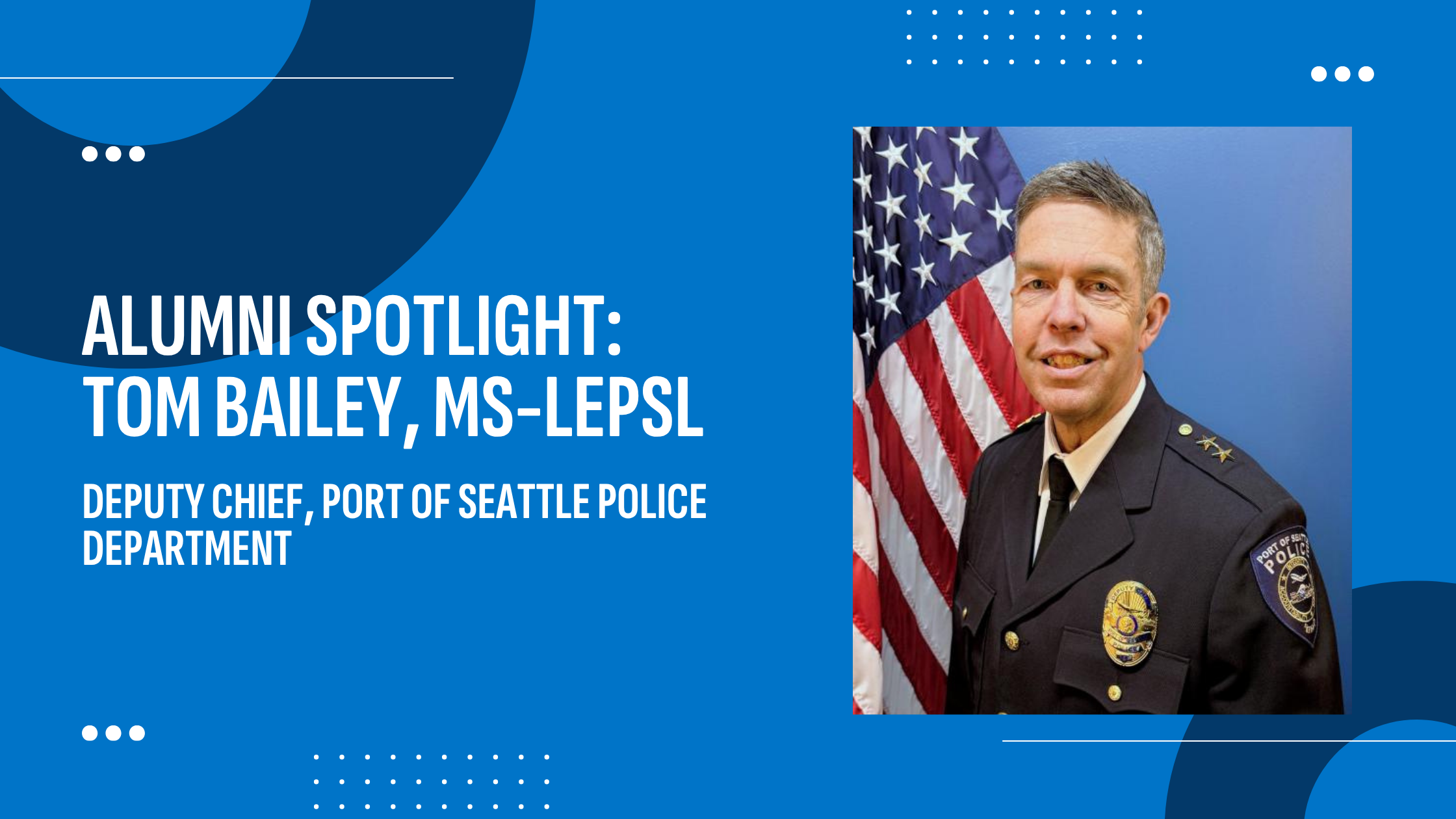
Tom Bailey has worked in civilian law enforcement for more than 20 years. A veteran of Operation Desert Storm, where he served in Saudi Arabia as a military policeman in the Army, he has since worked as a law enforcement professional in almost every possible capacity – from patrol to detective to community resources and now Deputy Chief. He is a 2017 graduate of the MS in Law Enforcement and Public Safety program at the University of San Diego, and credits his experiences with the program for his promotion from Training Sergeant to Commander. As Tom said in reference to his assessment for Commander, “I spoke quite a bit about the USD program and all of the themes we are discussing, and I know it made all the difference.”
Why did you decide to become a law enforcement professional?
I always wanted to find a job where I could help other people and I thought entering law enforcement would be a good opportunity to do that. The variety of different things you can do in law enforcement appealed to me as well.
Why did you decide to pursue a Master’s in Law Enforcement and Public Safety?
Getting a master’s was always something that I wanted to do and I’m not sure why I put it off for so long! I had my eye out for a master’s program with a leadership emphasis, and I found a lot of programs that were master’s of criminal justice or public administration but it was hard to find that combination I was looking for. My chief actually came across the LEPSL program and told me about it. It was exactly what I wanted. I started working on the application the next day.
The MS-LEPSL program is extremely relevant and contemporary for our industry today. Law enforcement is facing challenges in terms of public perception and how we are being characterized in the media. The LEPSL curriculum focuses on those contemporary issues we, as law enforcement professionals, are facing in the field today. With all the challenges that law enforcement faces today, we have a unique opportunity to make change and improve our communities.
Why did you choose the University of San Diego?
There are a lot of leadership programs and a lot of criminal justice programs out there but this is the only one I know of that combines the two. Plus, I grew up in San Diego and know what a strong reputation the school has. I was always very envious of my friends who were able to go to the University of San Diego.
Do you think education is important for police officers and those in law enforcement positions?
I think education is super important in law enforcement. A lot of departments are now incentivizing higher education. The demands and complexity of the job are increasing and we need people who can handle those challenges. What you learn most through higher education is how to collaborate with others and find answers to complex problems. You learn how to plan and organize and how to prepare professional reports presenting answers to those complex problems. And you learn how to make those answers understandable to a variety of people. I think there are a lot of street savvy people who can do a great job as law enforcement professionals, but if you add some education on top of law enforcement skills it is just going to improve the success of everybody.
“In my assessment for the position of commander, I spoke quite a bit about the program and all of the themes we had been discussing, and I know it made all the difference. I came out number one of five candidates.“
Deputy Chief Tom Bailey, MS-LEPSL
What did you most enjoy about being a student in the MS in Law Enforcement and Public Safety Leadership program?
I loved that we learned about contemporary issues and how to apply solutions to a lot of the problems we are currently facing. Whether they are being sensationalized or not, they are affecting police legitimacy and we are learning ways to mitigate that. The LEPSL faculty is awesome. They are extremely responsive, well educated and very experienced. Toward the end of the program, in my assessment for the position of commander, I spoke quite a bit about the program and all of the themes we had been discussing, and I know it made all the difference. I came out number one of five candidates.
What skills did you develop during the LEPSL program, and how did they impact your effectiveness on the job?
I came out of the LEPSL program better prepared to improve the perception of our law enforcement legitimacy from the outside. But just as important, I learned strategies to help change police culture from the inside. I am interested in how we interact not only with our communities but with each other. We have to empower our people to solve problems without getting mired in bureaucracy.
What advice would you give to someone considering enrolling in the MS in Law Enforcement and Public Safety Leadership?
LEPSL a great program and you will learn theory, how to apply it and it how it is being applied right now. The best time to start the program was a year ago but the next best time is now. I would advise anyone considering a master’s degree in law enforcement or criminal justice to look at this program — it really combines everything. I believe this program will make a difference for our profession, and that there has never been a more important time to educate our force.
How did you feel about the online component?
I loved that the program was online. I didn’t know how I would do with an online program, but I also knew that finding a program I could attend in person would be nearly impossible since I work full time and have five kids. Once in the program, I found myself more engaged and working harder than I did in my undergraduate program. The coursework is self paced but has enough structure so that you don’t fall behind. We also constantly interacted with other students — it’s actually part of the curriculum each week. And that was one of the best parts of this program – learning from other students across the country and hearing about all their varied and diverse experiences.
How has the LEPSL program helped you in your career today?
I was a training sergeant when I enrolled, and my role required me to stay abreast of contemporary issues. Just halfway through the degree program I found myself bringing ideas back to my department. I later promoted to commander and now serve as Deputy Chief. Having this degree gave me an advantage beyond just the degree title – through completing this program I advanced my knowledge in a way that absolutely set me apart.
What are your overall feelings about the program?
The experience of being a LEPSL student was much greater than I expected. From the very first class I was shocked with how much feedback the professors were providing on our assignments and discussions. Even though the program is online I really felt a sense of connection to the university and the faculty and the other students.