Love innovating and creating new things? Interested in playing an essential role in driving a company forward and staying ahead of the competition? You may have what it takes to be a research and development manager.
It’s a highly respected and well-paid position that requires continuous learning, extensive experience in research or engineering and the ability to lead and inspire teams. Keep reading to learn more about what it takes to build a career in R&D management.
What Is a Research and Development Manager?
Research and development (R&D) managers play a pivotal role in driving innovation and advancing an organization’s competitive edge. They’re responsible for overseeing and coordinating research and development activities that result in new products, improved technologies and meaningful enhancements to organizational capabilities.
At a high level, R&D managers lead multidisciplinary teams of scientists, engineers and product developers, guiding their efforts to transform complex technical challenges into practical, high-performing solutions. It’s their responsibility to cultivate an environment where teams have the capability and resources to push the boundaries of innovation but also the guidance and oversight to uphold the highest standards of quality and performance.
At a strategic level, R&D managers ensure that all initiatives are closely aligned with the organization’s broader goals and priorities. This involves setting clear objectives, managing resources effectively and maintaining accountability for budgets, schedules and technical outcomes. They are the strategic leaders who balance and drive both scientific and commercial success.
What Does a Research and Development Manager Do?
Everything an R&D manager does is meant to align innovation with business strategy, ensuring efficiency and cultivating a strong technical team. Below are the core responsibilities typically associated with this role.
- R&D Team Leadership
R&D managers provide leadership and direction to teams of scientists, engineers and developers, guiding them through complex technical challenges while encouraging collaboration and innovation. They act as mentors, supporting team members’ professional development and creating an environment that balances creativity with accountability. - Project Management
They oversee projects across the full development lifecycle, from early idea generation to prototyping, testing and launch. This includes setting clear objectives, defining milestones and proactively addressing risks to keep projects on track and aligned with organizational goals. - Strategy Development and Initiatives
A critical responsibility is aligning R&D activities with broader business strategies. Managers identify emerging opportunities, translate high-level goals into concrete research initiatives and position their teams to deliver innovations that serve both customer and organizational needs. - Budget Management and Resource Allocation
R&D managers are responsible for managing budgets effectively, making decisions on how to allocate financial and human resources to maximize impact. This often requires balancing competing priorities and ensuring that investments are directed toward the most promising opportunities. - Cross-Functional Collaboration
This role requires collaboration with marketing, sales and production teams to ensure that R&D outputs are relevant, scalable and market-ready. By working across functions, they help bridge technical innovation with customer needs and business outcomes. - Performance Monitoring and Reporting
R&D managers measure outcomes against milestones, budgets and technical specifications, while communicating results to senior leadership. Their reporting not only highlights successes but also provides insights for continuous improvement. - Following Trends and Emerging Technologies
R&D managers have to turn some of their attention outside the organization to actively monitor industry trends, competitive activity and technological advances. They have to proactively identify ways to incorporate new tools and methods into their organization’s research. This future-oriented mindset ensures the company remains agile and innovative. - Regulatory Compliance and Safety Standards
Maintaining compliance with regulations and safety standards is essential. R&D managers ensure that processes and products meet required guidelines, minimizing risks related to quality, safety or certification while upholding industry best practices. - Mentorship and Talent Development
Finally, they play a vital role in developing the next generation of innovators by mentoring team members and supporting career growth. Through coaching and creating opportunities for advancement, they foster a culture of learning and resilience.
What Are the Key Outcomes of R&D Management?
The impact of an R&D manager is measured not only in completed projects but also in how their leadership drives innovation, operational efficiency and business growth. These outcomes reflect the value they deliver to the organization.
- Accelerated Development of New Products and Technologies
By providing strong leadership and effective project oversight, R&D managers help reduce time-to-market. They streamline processes so that innovative ideas can be transformed into viable products and technologies more quickly. - Enhanced Responsiveness to Market Changes and Customer Needs
Their ability to align R&D with market intelligence ensures that products remain relevant and adaptable. This responsiveness allows companies to meet shifting customer expectations and stay competitive in dynamic markets. - Improved Resource Management and Budget Adherence
Through careful allocation of resources and disciplined budget oversight, R&D managers ensure that projects remain financially sustainable. Their decisions maximize return on investment and prevent waste. - A Culture of Innovation and Continuous Improvement
They create a team culture that embraces experimentation and continuous learning. This environment not only supports breakthrough innovation but also encourages incremental improvements that strengthen products and processes. - Direct Contribution to Growth and Profitability
The success of an R&D manager is measured by the business value of their work. By ensuring that research translates into marketable products and revenue-generating opportunities, they make research efforts a direct driver of organizational growth.
Commonly Used R&D Tools and Techniques
R&D managers rely on a diverse toolkit to guide projects from concept through commercialization. The following isn’t a comprehensive list, but it is a guide to some of the commonly used tools that support planning, collaboration, technical analysis and innovation management.
Project Management Software
Used to track tasks, deadlines and team progress across multiple projects to allocate resources effectively, visualize workflows and ensure accountability at each stage of development.
Popular Examples
- Jira
- Asana
- Trello
Product Lifecycle Management (PLM) Systems
Provide centralized control of product data and processes across the entire product lifecycle to ensure traceability, version control and compliance.
Popular Examples
- Siemens Teamcenter
- PTC Windchill
Data Analysis and Simulation Tools
Enable teams to model, simulate and analyze technical systems before physical prototypes are built to reduce risk, improve accuracy and speed up innovation.
Popular Examples
- MATLAB
- ANSYS
Idea Management Software
Facilitate the collection, evaluation and prioritization of ideas from employees, customers or partners to better filter concepts into actionable projects.
Popular Examples
- Brightidea
- IdeaScale
Collaboration Platforms
Support communication and knowledge sharing within cross-functional and geographically distributed teams to coordinate efforts and keep stakeholders aligned.
Popular Examples
- Microsoft Teams
- Slack
- Confluence
Knowledge and Document Management Systems
Provide secure storage and structured access to technical documentation, research findings and project reports, ensuring that information is preserved and easily accessible.
Popular Examples
- SharePoint
- M-Files
Prototyping and CAD Tools
Enable engineers and product designers to create and test digital prototypes, speeding up development while reducing material costs.
Popular Examples
- SolidWorks
- AutoDesk Inventor
In addition to technical tools, R&D managers apply proven management frameworks, such as those listed below, to structure innovation, balance risk and accelerate outcomes.
| Stage-Gate Process A structured approach that divides product development into stages separated by “gates.” At each gate, leadership reviews progress, budget and risk before approving the project to move forward. | Design Thinking A human-centered problem-solving framework that emphasizes empathy, creativity and iterative prototyping to foster innovation and experimentation. |
| Agile and Scrum Agile emphasizes adaptability and iterative progress, while Scrum provides a structured framework of short “sprints” with regular reviews and retrospectives. | Lean Innovation Focuses on reducing waste and accelerating learning cycles. By testing hypotheses quickly and refining based on feedback, teams avoid over-investing in unproven ideas. |
| Systems Thinking Encourages managers to view R&D challenges holistically, considering the interdependencies between technical, organizational and market factors. |
Where Do R&D Managers Sit In an Organization?
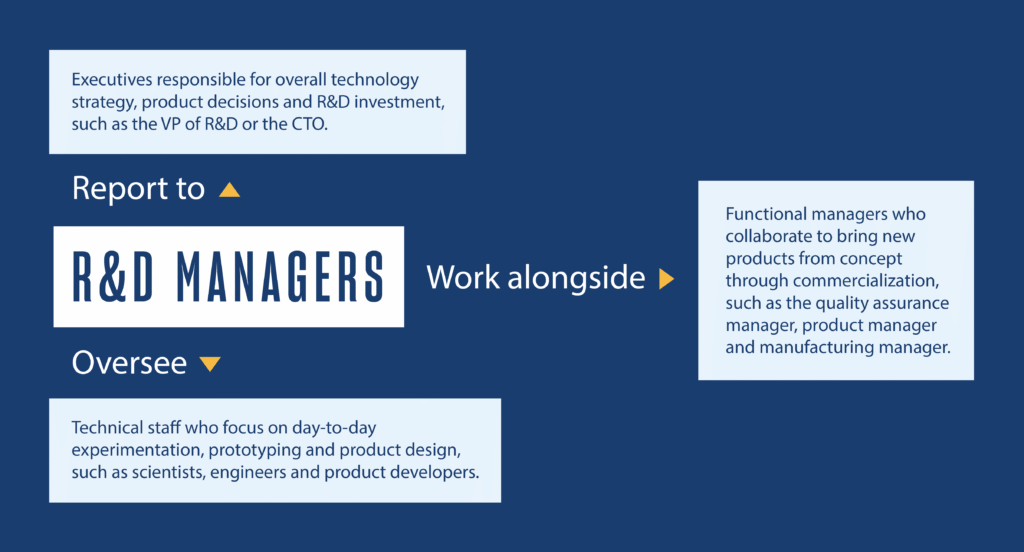
While an R&D manager is not usually at the executive decision-making level, they’re the ones who have to ensure that visionary ideas turn into commercially viable results. They are often the “bridge” between business strategy and technical execution, ensuring that innovation is both technically feasible and commercially valuable, providing real value for customers and stakeholders.
This puts most R&D managers at the mid-to-senior management level, typically positioned between frontline technical contributors (scientists, engineers and product developers) and executive leadership (directors, VPs or chief officers).
In Which Industries Do R&D Managers Usually Work?
R&D managers are found across a wide range of industries. Any company that is developing and testing new products to sell can use a skilled R&D manager, including:
| Pharmaceuticals and Biotechnology Oversee the discovery, development and testing of new drugs, therapies and medical devices. | Technology and Software Drive the development of software platforms, AI systems, cloud solutions and consumer applications. |
| Automotive and Transportation Lead projects focused on electric vehicles, autonomous driving, fuel efficiency and advanced materials. | Consumer Electronics Oversee the design and testing of devices such as smartphones, wearables and smart home technology, often working in fast-paced, highly competitive markets. |
| Aerospace and Defense Oversee highly complex research in aircraft, spacecraft and defense systems. | Medical Devices and Healthcare Technology Manage cross-functional teams to bring new diagnostic tools, imaging technologies and patient care solutions to market. |
What Is the Job Outlook for R&D Managers?
The exact salary you earn as an R&D manager will vary based on your experience, skills, certifications, education and employer. As of September 2025:
- Salary.com estimates a salary between $134,000 to $156,000
- Glassdoor has a wider salary range of $116,000 to $207,000
As a management position, the projected job growth is strong, with the U.S. Bureau of Labor Statistics estimating that overall employment in management occupations will grow faster than the average for all occupations from 2024 to 2034.
Steady job growth and competitive salaries are likely to continue, as global spending on research and development has reached a record high of almost $1.7 trillion. The United States, in particular, offers lots of opportunities, as it leads global R&D spending with nearly $784 billion, as of 2023.
R&D Manager vs. Engineering Manager vs. Project Manager
In technology-driven industries, especially in larger organizations, leadership roles often intersect. While an R&D manager, engineering manager and project manager may all contribute to the same initiative, each role has a distinct focus and purpose. Together, they form a complementary leadership structure that balances innovation, technical execution and organizational efficiency.
R&D Manager (Research & Development Manager)
Primary Focus: Innovation, discovery and developing new technologies, products or processes.
The R&D manager leads the early stages of product and technology development. They oversee lab work, prototypes and validation testing, ensuring that emerging concepts have both technical merit and business potential. R&D managers often coordinate with external partners — universities, research institutions or innovation networks — to stay at the forefront of scientific and technological advancement. Their ultimate goal is to transform new ideas into opportunities that can be handed off for engineering development.
Engineering Manager
Primary Focus: Technical execution, people management and delivering functional systems or products.
The engineering manager takes concepts validated by R&D and ensures they are engineered into reliable, scalable and high-quality systems. They manage engineering teams, oversee product architecture and design and review technical outputs such as code, hardware schematics or system specifications. While deeply technical, the engineering manager is also responsible for people management, including building strong engineering teams, developing skills and sustaining technical excellence across the organization.
Project Manager
Primary Focus: Planning, coordination and ensuring projects are delivered on time, within scope and within budget.
The project manager provides structure and organization to innovation and engineering efforts. They define project scope, build schedules and track deliverables to ensure accountability across the team. This role involves managing resources, risks and dependencies, as well as communicating progress to stakeholders. Unlike R&D or engineering managers, they typically do not define technical solutions or scientific direction; instead, they ensure work is organized, prioritized and completed successfully.
In practice, these roles often share similar leadership responsibilities. An R&D manager may manage project budgets; an engineering manager may contribute to strategic innovation; a project manager may identify technical risks. However, their core lenses differ:
- The R&D Manager asks: “Is this idea feasible and valuable?”
- The Engineering Manager asks: “Can we build this solution effectively and at scale?”
- The Project Manager asks: “How do we deliver this outcome on time and within constraints?”
For example, when developing a new medical device:
- The R&D Manager might lead research on new materials or technologies, develop prototypes and validate their performance.
- The Engineering Manager would then guide the design of a manufacturable product, ensuring compliance with technical standards.
- The Project Manager would coordinate timelines, budgets and regulatory milestones to ensure the product launch stays on track.
| R&D Manager | Engineering Manager | Project Manager | |
| Primary Focus | Innovation, discovery and developing new technologies, products or processes | Technical execution, people management and delivering functional systems or products | Planning, coordination and ensuring projects are delivered on time, within scope and within budget |
| Core Responsibilities | – Leads exploratory research and early-stage concepts – Manages idea pipelines and feasibility studies – Oversees lab work, prototypes and validation testing – Coordinates with academic or innovation partners | – Manages engineering teams – Plans and executes product architecture and design – Reviews code, system design and engineering processes – Ensures technical standards, scalability and quality | – Defines project scope, schedule and deliverables Manages timelines, resources, risks and budgets – Communicates with stakeholders – Monitors progress with Gantt charts or Agile boards |
| Key Deliverables | Prototypes, feasibility reports, proof-of- concept studies, validated ideas ready for engineering | Functional designs, production-ready systems, tested and reliable products | Project plans, progress reports, completed deliverables within agreed scope and budget |
| Guiding Question | “Is this idea feasible and valuable?” | “Can we build this solution effectively and at scale?” | “How do we deliver this outcome on time and within constraints?” |
To further the expertise of this article, we recommend including quotes from an EML SME who can speak to how these positions work together
Requirements to Become an R&D Manager
Educational Requirements
- Most R&D Managers begin with a bachelor’s degree in engineering, science or a related technical discipline. This foundation provides the technical literacy required to understand complex systems, products and technologies.
- Earning an advanced degree is helpful to advance to a leadership position. A master’s degree relevant to the field of operations — such as biotechnology, pharmaceuticals or advanced materials — or in technical leadership will help build essential research methodology, critical thinking and innovation skills. Programs that offer instruction in marketing, finance and operations are especially helpful.
- Specialized certifications can also strengthen credentials and demonstrate applied knowledge in leadership and process management. Recommended options include:
- Certified Project Manager (CPM): Validates skills in planning and executing complex projects.
- Certified Research Administrator (CRA): Demonstrates expertise in managing research programs and compliance.
- Lean Six Sigma Certification: Provides process improvement and efficiency tools, valuable for scaling R&D operations.
Work Experience
The amount and type of experience required for an R&D manager position will vary by organization, but all will require several years of experience that highlight technical knowledge and leadership capabilities. Essential areas of expertise include:
- Technical Mastery: A strong grounding in a specific discipline related to the business area is essential to build credibility and guide technical teams effectively.
- Leadership and Management: Experience leading teams, coaching individuals and resolving conflicts is essential for demonstrating how a job applicant can manage diverse, cross-functional groups.
- Communication: Demonstration of clear, persuasive communication is critical, as R&D Managers must explain complex technical concepts to non-technical stakeholders, from executives to marketing teams.
- Problem-Solving: A portfolio of work that highlights the job candidate’s ability to frame complex challenges, analyze data and guide teams toward solutions.
- Strategic Thinking: A candidate should be able to explain how to connect technical exploration with organizational goals, ensuring innovation delivers measurable value.
4 Steps to Becoming a Research and Development Manager
If possible, ask Program Director GB Singh for a quote about this career path
Research and development qualifications can come from many different backgrounds. If you’re interested in working toward becoming a research and development manager, there are a few pathways you can take:
- Technical role transition: If you have a background in engineering, science or technology, you can build on your technical knowledge and problem-solving abilities, supplementing them with leadership and business skills.
- Project manager career shift: If you have experience in project management and a history of leading complex projects, particularly in technical or scientific domains, you could focus on building the credentials and skills needed to manage projects in earlier stages of development.
- Cross-disciplinary development: You can translate your unique understanding of customer needs and market trends from working in sales and marketing, design or user experience to innovation and development. You’ll need to build up your technical skills and knowledge.
To maximize your success, follow these four essential steps toward building your career.
- Earn Your Degree. Begin with a bachelor’s degree in engineering, science or a related technical field to gain the necessary technical background. Pursue a master’s degree or Ph.D. for advanced knowledge and research skills, and look for ways to build business and management skills
- Build Your Credentials. Research different certifications to pursue and relevant professional organizations to join, such as the Product Development and Management Association (PDMA) or the Institute of Electrical and Electronics Engineers (IEEE).
- Prioritize Work Experience. Start in entry-level research or engineering positions to understand the intricacies of product development and innovation. Seek opportunities to lead projects or teams and build experience in cross-functional collaboration
- Build Your Network. Connect with professionals in your industry through conferences, seminars and professional associations. Create a portfolio or detailed resume of research projects, product development and any innovative solutions you’ve helped to implement
If you’re interested in learning more about how to shift from technical work toward a management position, then download our free eBook, From Engineer to Leader: How to Transition from the Technical to Management Path for the questions and career examples that can provide you with a clear path forward.