As environmental issues grow increasingly urgent due to our changing climate and scarcity of resources, more organizations are supporting the need for action from young scholars and new innovators.
Unfortunately, resources and educational opportunities are not equitable. Not everyone is afforded the same opportunity to attend college or university, to travel in order to develop their skills or to work and collaborate with other, equally passionate students. This is untenable, as these global issues require study and action from all regions in order to bring about effective change.
Environmental scholarships and sustainability scholarships can help provide students with financial aid to travel and attend programs in sustainability, global health and social justice. These environmental studies scholarships are especially helpful for international students who wish to attend specific programs and who, in turn, can bring different perspectives and new approaches.
Beyond helping with tuition and travel costs, scholarships can:
- Highlight a student’s achievements
- Provide connections with a wide network of contacts
- Distinguish graduates from other job candidates
But finding scholarships is the first step. This blog post offers a starting point.
Want to Work with Other Professionals Toward Sustainable Solutions?
Learn About the Transdisciplinary MESH Program in Our On-Demand Webinar
— Watch Now
Sustainability Scholarship List
First, a note: Despite the length and details of this list, it is not comprehensive. There are many more scholarship opportunities available, some specific to certain fields or institutions.
For additional resources and financial assistance, consider searching nonprofits and other organizations dedicated to science and technology as they relate to the environment and sustainability. The American Geophysical Union, National Science Foundation and the Association for the Advancement of Sustainability in Higher Education are a few to review.
And of course, you should always contact the financial aid department of the university you plan on attending to learn about assistance.
American Association of University Women International Fellowships
- Website: AAUW.org
- Amount: $20,000–$25,000
- International fellowships for women who have attained at least a bachelor’s degree, do not hold U.S. citizenship and plan to conduct full-time study or research. Eligible candidates must display English language proficiency, have extraordinary academic achievement and intend to return to their home country upon graduation.
Aga Khan Foundation International Scholarships
- Website: AKDN.org
- Amount: Tuition and living expenses for the first two years of study (50% grant, 50% loan)
- Postgraduate scholarships for international students from Bangladesh, India, Pakistan, Afghanistan, Tajikistan, Kyrgyzstan, Syria, Egypt, Kenya, Tanzania, Uganda, Madagascar and Mozambique who are studying at a U.S. or Canadian post-graduate institution. Applicants need to have consistently excellent academic records, genuine financial need, be admitted to a reputable university or program of study and committed to studying AKDN’s areas of focus, including health and nutrition, agriculture and food security or economic inclusion.
American Meteorological Society (AMS) Graduate Fellowship
- Website: Ametsoc.org
- Amount: Nine-month stipend ($5,000–$26,000) plus partial travel support to attend the AMS annual meeting.
- Fellowships are for graduate students entering their first year of graduate school and pursuing a degree in atmospheric or related sciences at a U.S. accredited institution. Applicants must have a minimum GPA of 3.0 on a 4.0 scale and be a U.S. citizen or hold permanent resident status.
Brown & Caldwell Scholarships
- Website: brownandcaldwell.com
- Amount: Varies
- Brown & Caldwell offers undergraduate and graduate scholarships for environmental and water treatment studies, women and minority students in STEM fields, engineering students and other related academic concentrations. Most applicants must have a cumulative GPA of 3.0 or higher on a 4.0 scale and be a U.S. citizen or hold permanent resident status.
DoSomething
- Website: dosomething.org
- Amount: Varies
- Scholarship opportunities are for students between the age of 13 and 25 who live in the U.S. or are U.S. citizens living abroad. Applicants are expected to complete volunteer, social change and civic action campaigns tied to current scholarship opportunities listed on the DoSomething homepage.
Dr. Nancy Foster Scholarship Program
- Website: fosterscholars.noaa.gov
- Amount: Up to a $47,000 annual scholarship
- Scholarships for independent graduate-level studies in oceanography, marine biology or maritime archaeology. All eligible applicants must be U.S. citizens who are admitted to a relevant graduate program at an accredited institution.
Fulbright Foreign Student Program
- Website: foreign.fulbrightonline.org
- Amount: Varies, stipend based on cost of living
- Fulbright offers several different grants, including ones for international students who wish to study in the United States each year. Qualified candidates must possess a first- or upper second-class honors bachelor’s degree, be accepted at an accredited graduate school, display academic merit, pass the GRE or GMAT exam and submit a curriculum vitae. Fulbright fellows must return to their home country for at least two years after funding.
Garden Club of America Fellowship in Ecological Restoration
- Website: gcamerica.org
- Amount: Annual grant of $8,000
- This grant is open to graduate students whose field of study can range from forestry and ecology to applied plant sciences and evolutionary biology. Eligible candidates must be enrolled in a leading accredited U.S. institution in environmental sciences and be engaged in research study in the recovery of ecological integrity.
National Environmental Health Association (NEHA) Scholarships
- Website: NEHA.org
- Amount: $2,650 for the undergraduate and $3,750 for the graduate scholarship
- These scholarships are for students who are enrolled in an environmental health program at an institution that has gained accreditation from the Environmental Health Accreditation Council (EHAC). For consideration, all applicants must submit an official copy of an academic transcript, a faculty letter of recommendation and one reference letter from an active NEHA member.
PEO International Peace Scholarships
- Website: peointernational.org
- Amount: Up to $12,500
- Scholarships are awarded to women from outside the U.S. or Canada who are seeking their master’s or PhD degrees in the United States or Canada. Eligible applicants must be enrolled full-time at an accredited college, not hold U.S. citizenship or be a permanent resident. Applicants will need to have a full year of coursework remaining, exhibit financial need and apply before starting their dissertation research.
Recycling Education and Research Foundation National Scholarships
- Website: recycledmaterials.org
- Amount: $2,500–$5,000
- Scholarships are open to certificate, undergraduate or graduate students enrolled in programs that support the scrap processing or the recycling industry. Eligible applicants should be in applicable fields, which include mechanical engineering, material engineering, sustainability, industrial design and water management.
Rotary Foundation and Clubs
- Website: Rotary.org
- Amount: Tuition for one to four years of study
- Scholarships are for college graduates and professionals studying peace and conflict resolution as well as for undergraduate and graduate students studying abroad to promote peace, fight disease, provide clean water and sanitation, support mothers and children, promote education and grow local economies.
Schlumberger Foundation Faculty for the Future Award
- Website: SLB.com
- Amount: Up to $50,000 per year for a PhD and $40,000 for a postdoc
- Fellowships for women from eligible countries who have been admitted to an accredited host university and are pursuing PhD and postdoctoral studies in the physical sciences, engineering, technology, biological sciences and related STEM disciplines. Recipients must be dedicated to teaching as a university faculty member in their home countries after graduation.
Switzer Fellowship
- Website: switzernetwork.org
- Amount: $17,000
- This one-year fellowship is for graduate students who are dedicated to environmental improvement. For consideration, applicants must be U.S. citizens, permanent residents or a refugee or asylum seeker and must be enrolled within an accredited academic institution within California or any of the six New England states.
Theodore Gordon Flyfishers Founders Fund Scholarship
- Website: tgf.org
- Amount: $5,000
- Available to students who are studying an environmental field, will be entering their first or second year of graduate school and intend to work in environmental conservation in the Northeast U.S. Eligible recipients must be U.S. citizens and possess at least a 3.5 out of 4.0 GPA within an environmental concentration.
Top Tips for Finding and Applying to Environmental Sustainability Scholarships
If you’ve exhausted the list featured in this blog post or want to explore other avenues to financial aid, there are even more places to look for environmental or sustainability scholarships.
For U.S. nationals and international students studying in the U.S., consider these strategies:
- Use the U.S. Department of Labor’s scholarship search tool to explore potential scholarships and grants related to sustainability and environmental studies.
- Contact your state, territory or commonwealth’s education agency to learn about available scholarships for environmental or sustainability programs. Professionals with a degree related to environmental studies are in high demand, and state and local agencies want to support young people pursuing this type of education.
For students interested in studying abroad, try:
- Searching on International Scholarships for available scholarships and loans.
- Searching the International Education and Financial Aid (IEFA) database for international scholarships and financial aid assistance.
- Reviewing active scholarship programs offered by the World Bank’s Development Economics Vice Presidency.
If you feel like getting creative, try any one of these strategies for finding environmental scholarships:
- Review scholarships offered by your university and specific academic departments.
- Explore opportunities from professional associations in sustainability, environmental science and related fields.
- Look for scholarships tailored to your demographics, major or career interests.
- Start your search early and track deadlines with a calendar or reminder system.
- Connect with faculty, academic advisors and alumni of your preferred program to uncover scholarship leads.
- Follow relevant organizations and scholarship providers on social media.
- Subscribe to scholarship newsletters or email alert systems for updates on new opportunities.
- Customize your applications to highlight academic achievements, research and sustainability-related experience.
Important Information to Remember When Applying for Scholarships
While grants are awarded based on need, scholarships are awarded more on the basis of merit. When applying for scholarships, be sure to check if you meet the listed criteria and that you are able to provide all required information.
You will have to apply for financial aid at the time you submit your application for admission to a program. Any and all students requesting any form of financial aid (like scholarships, fellowships or student employment) within the U.S. must submit applications for financial aid:
- FAFSA for U.S. citizens
- International Student Application for Financial Assistance for international students.
If you’re a first-generation college student then you may also be eligible to receive assistance from support networks like College Greenlight.
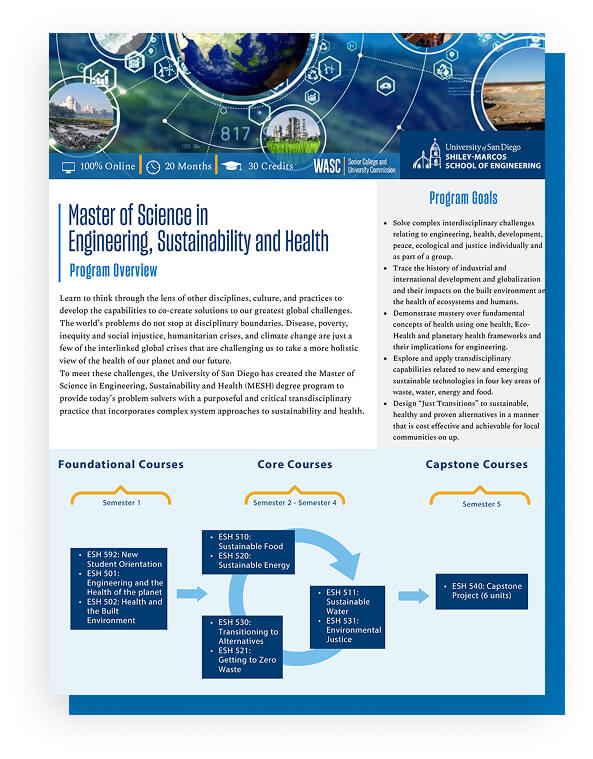
If you’re interested in attending the University of San Diego’s online Master of Science in Engineering for Sustainability and Health program, then you have assistance at your disposal. Contact the USD office of financial aid for information on scholarships, loans and other forms of assistance.
Frequently Asked Questions
What GPA do I need to qualify for sustainability scholarships?
Requirements vary depending on the scholarship, but many programs look for applicants with a GPA of 3.0 or higher on a 4.0 scale. Some competitive awards, especially those for graduate students or research-based programs, may expect a higher GPA and evidence of strong academic performance in relevant courses. Always review each scholarship’s specific eligibility criteria before applying.
Is it difficult to get a sustainability scholarship for a master’s program?
Competition can be strong, but there are many scholarships available for qualified applicants pursuing sustainability-related master’s degrees. Students who demonstrate academic excellence, leadership, community involvement and a clear commitment to environmental or social impact tend to stand out. The key is to apply early, apply often (each year or semester) and tailor each application to the specific values and goals of the scholarship provider.
When should I start applying for sustainability scholarships?
It’s best to start applying at least 6 to 12 months before your intended program start date. Many scholarship deadlines fall well before university admission deadlines. Starting early gives you time to gather recommendation letters, refine essays and research multiple opportunities. Keeping a calendar or reminder system for deadlines can make the process much easier to manage.
Are sustainability scholarships available for international students?
Yes. Many scholarships specifically support international students pursuing degrees in sustainability, environmental science, global health or related fields. Some are offered by universities, others by international organizations, nonprofits or government programs such as the Fulbright Foreign Student Program or Aga Khan Foundation International Scholarships. Always check the eligibility requirements; some scholarships are open only to certain nationalities or regions, while others welcome applicants from around the world.
![Preview image of What Is Sustainable Development? [+ Key Principles]](https://onlinedegrees.sandiego.edu/wp-content/uploads/2022/10/sustainable-development-1024x550.jpg)