Key Takeaways
- Keep your teacher cover letter to one page with four or fewer paragraphs. Include your contact information, greeting, introduction, two body paragraphs and closing.
- Tailor your approach to your experience level. New teachers should emphasize student teaching, career changers should highlight transferable skills, and experienced teachers should showcase leadership and measurable results.
- Address career gaps, limited teaching experience or grade/subject changes briefly and directly.
- Support your qualifications with measurable results, such as improved test scores or attendance, while following student privacy laws.
- Complement your resume instead of repeating it. Use your cover letter to convey your personality, values and interest in the role.
- Before submitting, verify the hiring manager’s name, match the job title exactly and customize every detail for the school.
If you’re researching teacher cover letter tips and best practices, chances are you are either in the market for a new job or at least beginning to think ahead to your next opportunity.
As you’re well aware, your cover letter is a vitally important messaging document that must be thoughtfully crafted to A) catch the eye of potential employers/recruiters and B) entice them to learn more about you by reviewing your resume.
Well, you’ve come to the right place because, when it comes to teacher resume and cover letter advice, we’ve got you covered.
Designed to apply to both new and seasoned educators alike, this post serves as a guide to writing an effective teacher cover letter that will help you land your next job.
We’ll share key tips and best practices, along with several teacher cover letter examples that you can use for inspiration — plus, a downloadable template you can use to write an A+ cover letter!
Put Your Best Foot Forward
Download our template to start writing your best cover letter yet.
LOOKING FOR TEACHING JOBS?
"*" indicates required fields
Start with Structure: How to Format Your Teacher Cover Letter
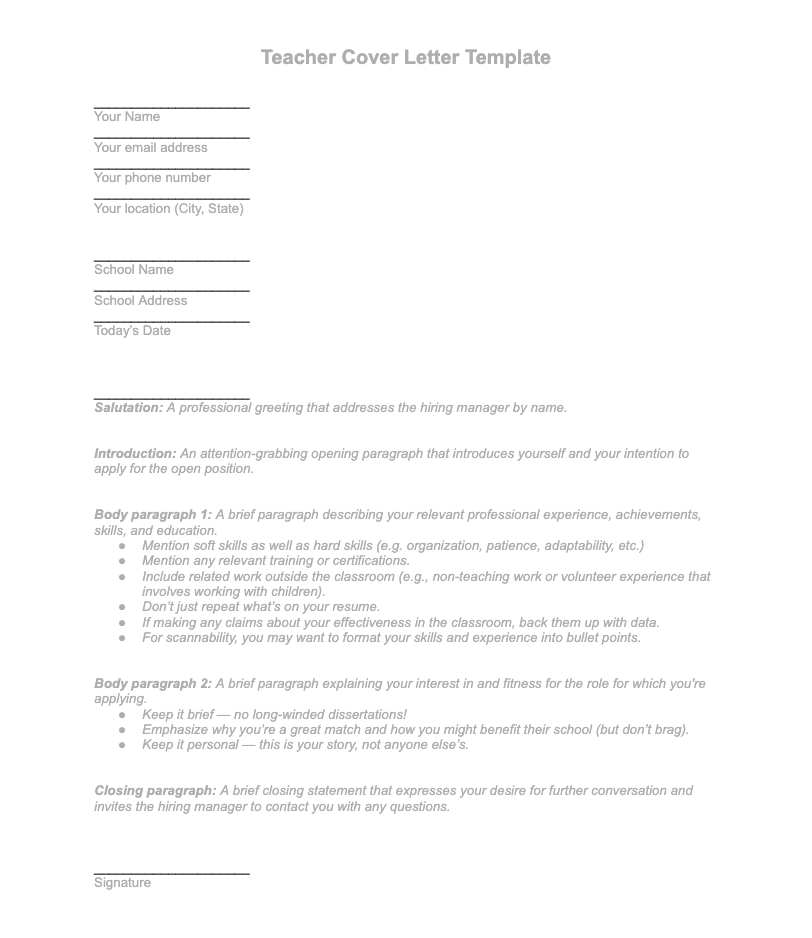
A teacher cover letter is much the same as a cover letter for any other position — the structure is fairly standard, with the content customized to the role and your experience. A cover letter should be one page, no more than four paragraphs, easily scannable and include the best way to reach you. The reader should not have to look very hard to find everything they need to know about you.
The best teacher cover letters have the following components:
- Your contact information: Provide your name, email address, phone number and where you live (just city and state is fine).
- The school’s contact information: Though you may not be sending your cover letter and resume by mail, this confirms your intention to apply to a specific school.
- Date: The date you’re submitting your application materials.
- Salutation: A professional greeting that addresses the hiring manager by name. It’s customary to preface their name with “Dear.”
- Introduction: This is a one-or two-sentence statement that introduces you and expresses your intention to apply for the open position.
- Body paragraph 1: A brief paragraph describing your relevant professional experience, achievements, skills and education.
- Body paragraph 2: A brief paragraph explaining your interest in and fitness for the role for which you’re applying.
- Closing paragraph: Once more, a brief closing statement that expresses your desire for further conversation and invites the hiring manager to contact you with any questions.
- Your signature: You may simply write your name or, for a more personal touch, you can add a real signature — hand-written or digitally placed.
Why all the brevity? Hiring managers likely sift through dozens of applications a day, especially at competitive schools. You want your materials to stand out for their scannability, so that the reader can see whether you would be the right fit within just a few seconds.
What Else to Include in Your Teacher Cover Letter
If you include all of the components above, you will have an excellent chance of capturing any hiring manager’s attention and (hopefully) starting a conversation with them.
While most cover letters follow a similar format, with the introduction, body content and conclusion all containing relatively the same kind of information, the body paragraphs are where you can really highlight your uniqueness. The portion of your cover letter where you describe your skills and experience is your oyster — without repeating what’s on your resume, consider including any of the following elements:
- Include teaching specialties such as subject expertise, special education curriculum design and even extracurricular responsibilities.
- When it comes to your education, you’ll want to note whether you have your master’s degree in education. Having an MEd does not necessarily equate to teaching experience, but many schools will prioritize candidates with graduate degrees over those with only bachelor’s degrees.
- Mention soft skills as well as hard teaching skills, such as organization, patience, adaptability, etc.
- Mention any relevant training or certifications. If you can point to a certificate in a specific teaching method or school leadership training, you may be considered for other open positions.
- Educational equity and inclusion is critical to school and student success. Even if you don’t have experience teaching units on disability activism or racial justice, expressing a commitment to learning about and teaching students of different backgrounds is a highly valued quality.
- Include related work you’ve done outside the classroom, such as tutoring, non-teaching work or volunteer experience that involves working with children.
- If you’re making any claims about your effectiveness in the classroom, try to back them up with numbers. If you’re currently a teacher considering other schools, be sure to keep track of your own class’s performance so you can cite these metrics in future cover letters.
- However, please note that teachers cannot freely share specific class or student data. It is your responsibility to adhere to school, state and federal restrictions concerning student privacy.
- Teachers are never done learning. Expressing a commitment to ongoing education and professional development in your cover letter will communicate that you are passionate about developing your craft.
Each item should only take one to two sentences to explain. For scannability, you may want to format your skills and experience into bullet points.
Some teaching applicants include a postscript in their cover letters following their signature. While this is not necessary, it is a fine place to put something that doesn’t fit naturally into the body of your cover letter. However, only include a postscript if absolutely necessary (“By the way, I remember competing against Sacred Heart’s epic debate club back in 1998 — if I couldn’t beat them then, joining them now would be the next best thing!”).
Your postscript should add value or personality, or be something the hiring manager absolutely needs to know, otherwise it can look extraneous and unprofessional.
Cover Letter Goals by Career Stage
The most common mistake teachers make is writing the same kind of letter regardless of where they are in their career. Before drafting your own, identify which career stage most closely reflects your current situation. Each one calls for a different primary goal, a different emphasis and a different strategy for grabbing the hiring manager’s attention.
Cover Letters for New Teachers
Primary goal: Demonstrate potential and preparation in the absence of extensive classroom experience.
What to emphasize:
- Student teaching placements: describe the grade level, school context and specific instructional strategies you implemented, not just the fact that you completed the requirement
- Academic preparation, including your degree, any specializations and relevant coursework that speaks directly to the role
- Transferable experience from tutoring, coaching, mentoring, camp counseling or other work with young people
- Enthusiasm for the specific school: reference something concrete about its mission, student population or instructional approach that drew you to apply
- References or supervising teachers who can speak directly to your classroom readiness
What to avoid:
- Apologizing for limited experience or drawing attention to it; lead with what you do bring, not what you lack
- Generic statements about loving children or wanting to make a difference without any specific evidence to support them
- Restating your resume line by line; the cover letter should add context and personality, not repeat credentials
Sample opening line:
“My student teaching placement at a Title I elementary school, where I designed and delivered differentiated reading instruction to a 3rd grade class of 27 students, confirmed what my education program began: that early literacy intervention is where I am meant to do my most important work.”
Cover Letters for Career Changers
Primary goal: Reframe prior professional experience as directly relevant to teaching and pre-empt any skepticism about the transition.
What to emphasize:
- The specific skills from your previous career that translate to teaching: project management, client communication, training and onboarding, data analysis and public speaking all have direct classroom equivalents
- Any classroom exposure gained during your transition, including substitute teaching, tutoring, alternative certification coursework or observation hours
- Your subject matter expertise as an asset rather than a consolation, particularly if your background is in a high-demand area such as STEM, healthcare, law or skilled trades
- A clear and confident narrative about why you are making this change now, grounded in a specific moment or realization rather than a vague desire for something new
What to avoid:
- Over-explaining or over-justifying the career change; one confident, well-framed sentence is more persuasive than a paragraph of reassurance
- Industry-specific language from your previous field that hiring managers in education will not recognize or value without translation
- Framing your previous career as something you are escaping rather than a foundation you are building on
Sample opening line:
“After eight years designing technical training programs for engineering teams, I have spent the past year bringing those same instincts into middle school classrooms, and I am ready to make that transition permanent as a licensed STEM educator.”
Cover Letters for Veteran Educator or Leadership Candidate
Primary goal: Signal readiness for expanded responsibility and demonstrate impact that extends beyond your own classroom.
What to emphasize:
- Leadership experience (formal or informal) including department chair roles, curriculum writing, new teacher mentoring, professional development facilitation and committee work
- Quantifiable outcomes from your teaching and leadership work, with specific data wherever possible
- A clear articulation of why this particular role represents the right next step in a deliberate career progression
- Evidence of ongoing professional growth, including graduate study, certifications, conference presentations or published work
- Your philosophy of teaching or leadership, stated briefly and backed by a concrete example from your career
What to avoid:
- Recounting basic classroom responsibilities that are assumed at your experience level; hiring committees for leadership roles expect classroom competence as a baseline
- A cover letter that reads like a summary of your resume rather than a forward-looking case for why you are ready for this specific role
- Underselling your leadership contributions by describing them as informal or incidental. Own them!
Sample opening line:
“In twelve years in the classroom and four as department chair, I have learned that the most lasting instructional improvements happen when teachers are supported to take ownership of their own professional growth. That conviction is what draws me to the instructional coaching role at [School Name].”
Tips to Make Your Cover Letter Stand Out
Think of your teaching cover letter like an elevator pitch. Pretend you have 30 seconds to “sell” your skills and enthusiasm for the role — how do you “hook” the reader?
Before you set pen to paper or fingers to keyboard, be sure to research the school you’re applying to. It’s generally good practice to customize your cover letter for every job application, and that means knowing something about the school, department or role you’d be filling. It’s quite easy to tell if an applicant is just copy-and-pasting the same cover letter for multiple job applications.
For example, is the school known for its competitive mathematics team? Does it have an award-winning drama department? Are its standardized test scores consistently in your state’s 90th percentile? If the role you’re applying for relates in any way to the school’s differentiating factor, be sure to acknowledge it in your introduction.
Here are some other ways to bump your application to the top of the pile.
- Keep it brief: No one wants to read your master’s thesis in a cover letter. Leave the longer explanations of your experience and teaching philosophy for your interview.
- Accentuate the positive: Your application materials should not only convey why you want the position, but how your unique abilities and assets could benefit the school and its students. Emphasize why you’d be a great match with specific reasons — but don’t brag.
- Keep it personal: There are plenty of great cover letter templates and examples out there, but they should only serve as suggestions for what yours will be. This is your story to tell, not anyone else’s. Expressing your passion for teaching will position you as a dedicated, valuable asset to any school.
- Proofread: As a teacher, this should be a no-brainer — but don’t be the one teacher who forgets to proofread! Take your time, re-read and ask a colleague to give your cover letter a once-over before submitting your application. Many people treat their cover letter as an afterthought, but remember that it’s the cover to the rest of your application.
To use another teaching comparison, remember that your cover letter counts for a significant portion of your “grade.” As Christian Eilers writes for Zety, “That means treating it like a crucial final exam instead of an inconsequential pop quiz.”
Resume-Ready Paragraph Blocks
These sample paragraphs are designed to be pasted directly into your cover letter draft and customized with your own details. Each section offers two variations; choose the one that best fits your voice and career stage, then replace the bracketed placeholders with your specific experience.
Opening Hook: Lead with Passion or Connection to the School
- Variation A — School mission or student population focus: “When I learned that [School Name] prioritizes [specific value, approach or student population, e.g., project-based learning, multilingual learners, restorative practices], I recognized it immediately as the environment where my experience in [relevant area] would have the greatest impact. I am writing to apply for the [Position Title] role and to share why I believe this is the right fit for both of us.”
- Variation B — Student impact or defining classroom moment: “There is a specific moment in teaching that I return to often. [Brief, specific description of a classroom moment or student breakthrough that shaped your approach]. That experience has defined my practice ever since, and it is the reason I am drawn to the [Position Title] role at [School Name].”
Opening Hook: Lead with Subject Passion or Career Purpose
- Variation A — Subject expertise and purpose: “My commitment to teaching [subject area] began long before I entered a classroom. [One sentence on your background or connection to the subject.] At [School Name], where [reference something specific about the school’s academic program or values], I see an opportunity to bring that depth of knowledge and that sense of purpose to [grade level or student population].”
- Variation B — Career changer or non-traditional background: “My path to teaching [subject area or grade level] is not traditional, but the skills I developed over [number] years as a [previous role] have given me a foundation that few candidates bring directly to the classroom. I am confident that my background in [specific area] positions me to make an immediate and lasting contribution to [School Name]’s students.”
Evidence Section: Outcomes and Classroom Impact
- Variation A — Data-driven outcomes: “In my [number] years teaching [subject and grade level] at [School/District Name], I [specific accomplishment with data, e.g., led a curriculum redesign that resulted in a 24% improvement in 5th grade reading assessment scores, or reduced chronic absenteeism in my classroom by 30% through a family engagement initiative I designed and launched]. I bring the same combination of intentional planning and data-informed reflection to every aspect of my practice.”
- Variation B — Relationship and culture-centered outcomes: “My most significant accomplishments as an educator have not always shown up in test scores, though I am proud of those results too. At [School/District Name], I [specific example of building classroom culture, supporting a struggling student population or leading a community-building initiative]. I believe that [brief statement of teaching philosophy], and that belief shapes every instructional decision I make.”
Evidence Section: Leadership and Contribution Beyond the Classroom
- Variation A — Formal leadership role: “Beyond my classroom, I have contributed to [School/District Name] as [role, e.g., department chair, curriculum committee member, mentor teacher], where I [specific contribution and outcome]. I am looking for a role where I can continue to grow as both an educator and a leader, and the [Position Title] at [School Name] represents exactly that opportunity.”
- Variation B — Informal leadership and professional development: “I have always understood professional growth as a responsibility, not a requirement. Over the past [number] years I have [specific examples, e.g., completed my MEd in Curriculum and Instruction, facilitated three district-wide professional development sessions on differentiated instruction, co-authored a new 6th grade science unit adopted across the district]. I am energized by collaboration and committed to contributing to a school community well beyond my own classroom.”
Closing: Interview Invitation and Value Statement
- Variation A — Forward-looking and confident: “I would welcome the opportunity to discuss how my experience in [specific area] can contribute to [School Name]’s work with [student population or specific goal]. I am available at your convenience and can be reached at [phone number] or [email address]. Thank you sincerely for your time and consideration. I look forward to the conversation.”
- Variation B — Mission-aligned and personal: “Teaching at [School Name] is a deliberate choice based on what I know about your school’s commitment to [specific value or mission element]. I am eager to bring my skills, my experience and my enthusiasm for [subject or student population] to your team. Please feel free to contact me at [phone number] or [email address] at any time. I look forward to hearing from you.”
A note on customization: The most effective cover letters will replace every bracketed placeholder with language that is specific to you and the school. Hiring managers read dozens of letters; specificity will make yours memorable.
How to Address Difficult Situations in Your Career
Some of the most important content in a cover letter addresses what a hiring manager might already be wondering. The scenarios below are among the most common uncomfortable situations teachers face when applying. The sample lines demonstrate how to address each one directly, professionally and without over-explaining.
Career Gap
Do not ignore a significant gap or hope the hiring manager won’t notice — they will. Address it briefly, frame what you did or learned during that time as relevant where possible, and pivot immediately to your readiness and enthusiasm for returning to the classroom. One sentence is enough.
Example: “After stepping away from the classroom to [brief, honest reason, e.g., care for a family member, address a health matter, relocate], I used that time to [any relevant activity, e.g., complete my MEd coursework, stay current through professional reading and substitute work, volunteer with a youth literacy program], and I return to teaching with a renewed clarity of purpose and a skill set that is stronger for the experience.”
Lack of Formal Teaching Experience
Candidates with limited or no licensed teaching experience should resist the urge to apologize and instead lead confidently with the experience they do have, framing it in the language of teaching rather than the language of the role they are leaving.
Example: “While I have not yet held a licensed classroom teaching position, my [number] years of [tutoring, coaching, youth program leadership, student teaching, substitute work] have given me direct, sustained experience with [grade level or student population] and the conviction that this is the work I am meant to do.”
Switching Grade Levels
Hiring managers will notice a grade level switch and may question whether you understand the developmental and instructional differences involved. Acknowledge the transition directly and demonstrate that you have done your homework.
Example: “Having taught [previous grade level] for [number] years, I bring a deep understanding of the foundational skills students need to succeed at the [target grade level]. I have spent the past [time period] preparing for this transition through [observation, coursework, professional development or mentoring from colleagues at the target level].”
Switching Subject Areas
A subject area switch raises questions about content expertise. Lead with whatever genuine connection exists between your previous subject and the new one, and demonstrate your preparation for the content demands of the role.
Example: “My background in [previous subject] has given me a strong foundation in [transferable skill, e.g., analytical reasoning, research methodology, data interpretation] that translates directly to [new subject] instruction. I have supplemented that foundation with [specific preparation, e.g., coursework, self-study, co-planning with current colleagues in the department] to ensure I am fully prepared to meet the content demands of this role.”
The sample lines are intentionally concise. Each is designed to occupy one to two sentences within a larger paragraph rather than stand alone as a full explanation. The goal in each case is to address the concern, demonstrate self-awareness and move on, not to dwell.
Before You Hit Send: Application Verification Checklist
A preventable error caught too late can undermine even the strongest cover letter. Work through this checklist before submitting any teaching application. Five minutes can save you from the most common mistakes that cost candidates interviews!
Personalization and Accuracy
- The hiring manager or principal’s name is spelled correctly. Verify against the school’s official website, not just the job posting, as postings sometimes contain errors.
- The school name and district are spelled correctly and consistently throughout both the cover letter and resume
- The position title in your cover letter matches exactly the title listed in the job posting
- Your cover letter references something specific about this school that could not apply to any other school, i.e. its mission, student population, program or values
- Every bracketed placeholder in your cover letter has been replaced with your own specific content; no “[School Name]” or “[Position Title]” left unfilled
File Naming and Format
- Your cover letter file is named in a professional, consistent format: LastName_FirstName_CoverLetter_SchoolName_Year (e.g., Smith_Jane_CoverLetter_RiversideElementary_2026)
- Your resume file follows the same naming convention: LastName_FirstName_Resume_SchoolName_Year
- Both files are saved as PDFs unless the posting specifically requests Word documents
- File sizes are reasonable; large files can cause upload errors in application portals
Tailoring and Alignment
- Your cover letter introduction is specific to this role and school, not a version you have used elsewhere without customization
- Keywords from the job posting appear naturally in both your cover letter and resume
- The experience and accomplishments highlighted in your cover letter align with the specific priorities stated in the posting
- Your cover letter adds context and personality to your resume rather than repeating it line by line
Supporting Materials
- References are prepared, current and have been notified that they may be contacted; do not list anyone who has not given explicit permission
- If a portfolio is referenced in your cover letter, the link is active, accessible without a login and up to date
- Any required attachments are included and correctly labeled, e.g., transcripts, certifications, writing samples
- If the application requires separate uploads for each document, every file has been uploaded to the correct field
Final Proofreading Pass
- You have proofread your cover letter at least twice: once for content and once for spelling, punctuation and grammar
- A trusted colleague or mentor has reviewed the letter for clarity, tone and impact
- No sentences begin with “I”; vary your sentence structure to avoid a monotonous, self-centered opening to every line
- The closing paragraph includes a clear and professional invitation for the hiring manager to contact you, with your current phone number and email address
Submit only when every item above is checked. Applications with personalization errors, mismatched file names or missing attachments signal a lack of attention to detail, the one quality every hiring committee assumes a teacher must have!
Teacher Cover Letter FAQs
How long should my teacher cover letter be?
As a general rule, keep your cover letter brief — no one wants to read your master’s thesis as part of your application. Your cover letter should have a short intro, an explanation of your experience and skills, any significant accomplishments, awards or certificates, and a short conclusion summarizing your interest in the position. Always end with an invitation for the hiring manager to contact you, and sign your name (a signed letter is always a nice touch, even if it’s a digital signature). Leave the longer explanations of your experience and teaching philosophy for your interview.
How long should my teacher cover letter be?
As a general rule, keep your cover letter brief — no one wants to read your master’s thesis as part of your application. Your cover letter should have a short intro, an explanation of your experience and skills, any significant accomplishments, awards or certificates, and a short conclusion summarizing your interest in the position. Always end with an invitation for the hiring manager to contact you, and sign your name (a signed letter is always a nice touch, even if it’s a digital signature). Leave the longer explanations of your experience and teaching philosophy for your interview.
Do I need to submit a cover letter if the job posting doesn’t ask for one?
In most cases, you should submit a cover letter even if the job posting doesn’t ask for one. Unless the posting explicitly states that cover letters are not accepted, submitting one signals professionalism and genuine interest in the role, two qualities every hiring committee values. A well-crafted cover letter gives you an opportunity to make a case for your fit that a resume alone cannot. The only exception is an application portal that does not include a field for cover letter uploads, in which case a brief, professionally written email submitting your materials can serve the same purpose.
Should my cover letter repeat what is already on my resume?
No, your cover letter should not repeat what is already on your resume. This is one of the most common cover letter mistakes teachers make. Your resume documents your credentials and experience; your cover letter interprets them. Use the cover letter to explain why your most relevant experience matters for this specific role, to provide context that a bullet point cannot convey and to give hiring managers a sense of your voice, values and enthusiasm for the position. If your cover letter could be replaced by a second copy of your resume, it needs to be rewritten.
Can I email my cover letter instead of uploading it to an application portal?
Whether you email your cover letter instead of uploading it to an application portal depends on how the school or district is accepting applications. If the posting directs candidates to an online portal, submit all materials there; emailing documents separately can create confusion and may mean your application is not properly logged. If the posting invites direct applications by email, your cover letter can serve as the body of the email itself, with your resume and any other required materials attached. In either case, follow the submission instructions in the posting exactly and confirm your file naming and format before sending.