Key Takeaways
- A cybersecurity engineering degree can help you land a government position. Subah credits her USD degree as a key reason she advanced from a contractor to a full-time federal employee at the U.S. Fish and Wildlife Service.
- USD’s MS in Cyber Security Engineering stands out because few schools offer a program focused specifically on engineering. That technical distinction made USD a clear choice for a software developer looking to deepen her expertise.
- The online program’s structured format enables working professionals to earn their degree without disrupting their careers. Subah completed the program while working full time and found group collaboration surprisingly seamless.
- Coursework translates directly to real-world responsibilities. From technical white papers to virtual sandboxes and data encryption, Subah applied what she learned at USD immediately in her federal role.
- Collaboration and openness to feedback matter as much as technical skill. Subah advises prospective students to check their ego and lean on classmates throughout the program.
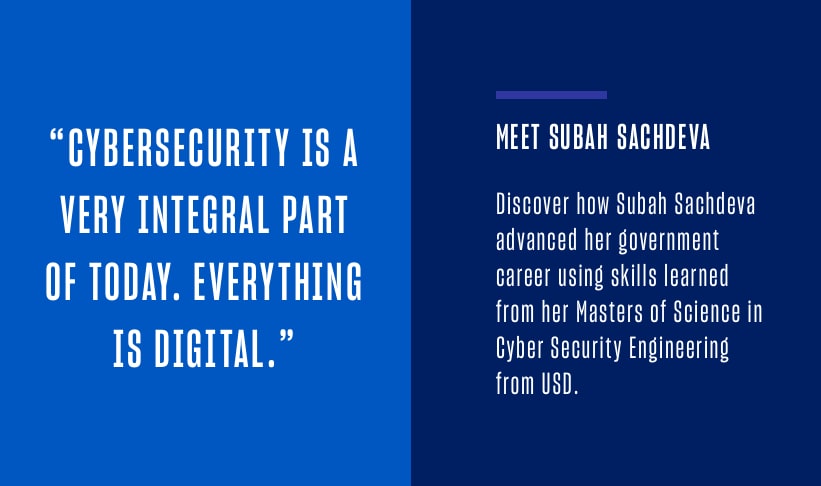
From New York to Chigaco, “Cybersecurity Is a Very Integral Part of Today. Everything’s Digital.”
Coding Is in Her DNA
Coming from a family of engineers, Subah Sachdeva had many role models in the technology industry at an early age. She began teaching herself to code at age 13, noting with a chuckle, “It was the only area that was consistent that kept me out of trouble, probably.”
Subah pursued an undergraduate degree in computer science but quickly moved into information systems. She worked as a technology associate and web application developer at the Fashion Institute of Technology in New York before moving to beautiful Lakewood, Colorado.
An Exciting Opportunity Appears
In Colorado, Subah secured a contracting position at Astor & Sanders as a software developer and was promoted to senior software developer. She soon became a full-time employee of the United States Fish and Wildlife Services (USFWS). Subah credits her employment partially to her cybersecurity education. “I think part of the reason I got converted [from a contractor] to a Fed [Federal Employee] was because I decided to invest in a cybersecurity engineering degree.”
USD Is One of the Few Schools to Offer a Cyber Security Engineering Degree
Subah decided to pursue a master’s degree in cybersecurity because cybersecurity is an integral part of a software engineer’s job. She wanted to invest in additional education to make herself more of a competitive candidate and further her career. The skills she acquired while earning her USD degree are essential to her current position. “Cybersecurity is a very integral part of what we do as software engineers.”
The journey to finding USD was fairly simple since not many schools offer a Master of Science in Cyber Security Engineering as a major. Subah found that the majority of cybersecurity programs focused on business or politics, but not engineering. She enrolled in the remote program and was able to take classes while working her full-time job in Colorado.
From Coder to Classmate
In the program, Subah learned a variety of cyber engineering skills and had unforgettable experiences with classmates and professors. She was impressed that the remote program was so organized and structured, and how easy it was to work in groups. “One of the most important aspects of being in cybersecurity, especially in this program, is being able to work well with others.”
One surprising skill she learned was how to create a well-written technical white paper. She didn’t realize the full benefit of this skill until she was training 16 agents at the USFWS on an app and was pulling together documentation. She wrote a simple technical outline, which helped shape her training.
She also found value in learning to set up a virtual sandbox during the program. It was a truly educational experience and has helped in her professional day-to-day responsibilities. Subah also enjoyed her cryptography coursework, which included a strong programming aspect. One of her assignments was to make an application to encrypt sensitive data, which was a new and exciting skill.
What’s Next?
Subah enjoys a variety of tasks in her current position: working in Javascript, coding, doing database work, training special agents, and more. Recently, she was able to visit the Rocky Mountain Arsenal National Wildlife Refuge and help code apps for the Federal Government.
Although she’s not too concerned about the future, she has loose plans to finish paying off student loans and potentially pursue another degree down the road. The IT industry, especially the cybersecurity field, is fast-paced, so additional education is never out of the question.
Advice for Prospective Students
“Work as a team. It’s very easy to have your ego kind of stand in the way and cause a lot of conflicts,” says Subah. “Be ready to take criticism […] because you don’t know it all.” She encourages prospective students to lean on classmates for support and recommends that they have some technical background, even if it’s self-taught.
From the Fashion Institute of New York to the U.S. Fish and Wildlife Services, Software Engineer Subah Sachdeva has paved her path, with the help of USD, and is looking forward to continuing her cybersecurity engineering career.
frequently asked questions
How do you get a cybersecurity job with the federal government?
To get a cybersecurity job with the federal government, start by searching for positions on USAJOBS, the government’s central hiring portal, and carefully review each job announcement’s qualifications and application requirements. Federal applications are evaluated against the qualifications and other criteria listed in the announcement, so your resume should clearly show how your education, experience and skills match the position. Most federal resumes are currently limited to two pages, although specific application requirements can vary. Cybersecurity positions may fall under different occupational series and grades, which affect qualification requirements and pay. The federal hiring process can take longer than many private-sector hiring processes, and positions may have citizenship, suitability or security requirements depending on the role.
What’s the difference between working as a federal contractor and a federal employee?
The main differences between working as a federal contractor and a federal employee are who employs you and the terms of your employment. Contractors are employed by private companies that perform work for federal agencies, while federal employees work directly for an agency. Contractors receive their pay and benefits from their employer rather than the federal government, and their positions can be affected when contracts are renewed, recompeted or ended. Federal employees receive benefits associated with federal employment and generally have greater job protections than contractors. Working as a contractor can provide experience in federal environments, but moving into a federal position generally requires applying through the applicable federal hiring process rather than automatically converting from contractor status.
Do software engineers need cybersecurity skills?
Software engineers increasingly need cybersecurity skills because security is part of the software development process rather than something that can always be addressed after development is complete. Depending on their role, software engineers may need to understand secure coding practices, common vulnerability classes, authentication and authorization, dependency and supply chain risks and appropriate uses of cryptography. Frameworks such as NIST’s Secure Software Development Framework encourage organizations to integrate security practices throughout the software development life cycle. For software engineers, developing security skills can therefore strengthen an existing career path without requiring a move into a dedicated cybersecurity role.
How much technical writing is involved in cybersecurity engineering?
Technical writing can be a significant part of cybersecurity engineering work, particularly in roles that involve architecture, risk management, compliance or regulated environments. Cybersecurity engineers may contribute to documentation such as system security plans, assessment findings, technical specifications, procedures, training materials and runbooks. Written documentation can be particularly important in government and regulated environments because organizations may need to demonstrate how security controls are implemented and maintained. The amount of writing varies by role, but the ability to explain technical concepts clearly to both technical and nontechnical audiences is an important overall cybersecurity skill.
Do you need a technical background for a cybersecurity engineering master’s program?
You don’t necessarily need a technical background for a cybersecurity engineering master’s program, but these programs generally require or expect more technical preparation than programs focused primarily on cybersecurity policy, management or leadership. Coursework may cover areas such as secure software development, cryptography, network security and systems security, which can require familiarity with programming and computer systems. Some programs require prerequisite coursework or other preparation for students who lack that foundation, while others may consider relevant professional or self-taught experience. Requirements vary by program, so prospective students should review the specific program’s admissions requirements rather than assume that a nontechnical background automatically qualifies or disqualifies them.