Key Takeaways
- A cybersecurity master’s degree can lead directly to top-tier opportunities. Paul Cho landed a security engineer role at Salesforce before he even graduated. High demand for qualified professionals makes this kind of fast career launch increasingly common.
- USD’s online program format is designed for working professionals who need flexibility without sacrificing rigor. Cho was able to earn his degree while continuing to work full time and found the academic experience exceeded his expectations.
- The peer learning environment at USD exposes students to senior-level cybersecurity professionals. Collaborating with classmates like CIOs and financial industry architects gave Cho real-world perspective that sharpened his skills.
- The writing and analytical work required in the program directly mirrors on-the-job expectations. Cho noted that producing executive white papers at Salesforce felt like a natural extension of his graduate coursework.
- Passion and curiosity matter as much as technical skills in a cybersecurity career. Cho advises aspiring professionals to be genuinely driven by a desire to learn technology and make a meaningful impact, not just compensation.
What if you could graduate from a cybersecurity master’s degree program and walk straight into a dream job at one of the world’s top tech companies?
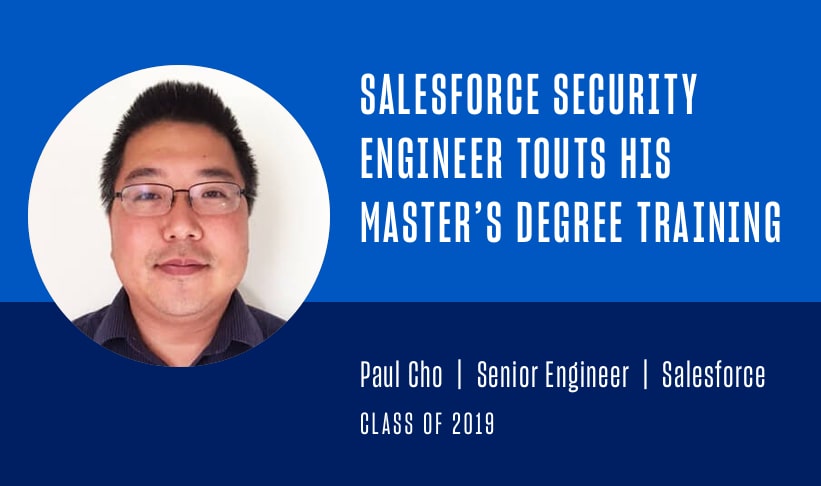
With such high demand for trained cybersecurity professionals, this scenario is more realistic than ever. Just ask Paul Cho, who earned his cybersecurity master’s degree in May 2019 and started work as a security engineer at Salesforce in May 2019.
“It’s exciting,” he said. “I actually interviewed with them on the last day of my finals and they made me an offer before I graduated.”
Passion for Technology: ‘I Was One of Those Kids’
For Cho, recent events are the culmination of an interest in technology that dates back to his childhood. “Early on, I was one of those kids that liked to figure out how things worked on a computer,” he said.
His innate curiosity about computers led first to jobs in tech support, customer service and as a computer game tester; then to university help desk roles and a position as a computer systems analyst at Stanford’s SLAC National Accelerator Laboratory.
“I’ve always been in technology and I think cybersecurity has always been an interest of mine,” he said, but “it took me a while to find the field of cybersecurity.” Of course, online security has been an issue since the dawn of the internet, but “cybersecurity” didn’t become an everyday term, or a full-fledged industry, until more recently when big companies started getting hit with data breaches.
“What kind of set it off for me is, I was working at Stanford and I was reading about all these massive breaches. I mean, there’d been breaches before but these breaches were millions of records and billions of dollars of damage and I felt that that’s an area of technology that could be improved, and so that’s why I went into the degree program.”
Master’s Degree Program ‘More Than Exceeded My Expectations’
Cho said he did “a lot of research” before selecting the University of San Diego program, which is offered in an innovative online format that was well-suited to his need to continue working full time while earning his degree.
“The program itself gives a very strong foundation” for a potential career in cybersecurity and “it’s a fantastic format,” said Cho, who spoke favorably of the program’s rigorous academic approach and of learning through a mix of video, audio, discussions with peers, written assignments, problem solving and more. He said some of the work he is doing now at Salesforce, writing two to three executive-type white papers a week, is “very similar to what I was doing” in the degree program. Overall, his experience in the USD program “more than exceeded my expectations.”
“The support structure with the school itself, with the professors, was excellent,” he said. “They were always available to answer questions and, more than that, their feedback on assignments was really invaluable. It made me aware of areas that I needed to work on.”
“I felt pretty lucky to be in the peer group was in,” Cho continued, because it enabled him to learn through interacting with senior-level cybersecurity professionals. In one assignment, a project involving secure software design, his classmates included a chief information officer and a financial industry software architect. He described the collaboration as an “eye-opening” experience in which “I had to raise my game and I learned a lot from it.”
Cybersecurity Careers: ‘A Definite Shortage of Qualified People’
For Cho, earning his master’s degree in a field that he loves was definitely worth the investment.
“A cybersecurity career is well-compensated. But for me, entering the field wasn’t so much about the compensation,” he said. “I wanted to do something that mattered; I wanted to make a difference. I think technology is a way that society can be improved and one of the things that has to happen for technology to flourish is it has to be secure.”
[RELATED] How to Start a Career in Cybersecurity >>
As for career advice, Cho suggested that a passion for technology and a desire to make a positive impact should be more important motivators than compensation. “If you’re interested in a career in cybersecurity you have to have a desire to learn, and specifically to learn technology. You have to be curious about it. You have to be unafraid of the unknowns in technology.”
For those who find this type of work inspiring, employers are definitely hiring for high-quality cybersecurity jobs. “There’s so much that needs to be done in the field, so many new technologies coming out. There’s a definite shortage of qualified people. I mean I see that even in the Salesforce organization. They’re having a hard time finding qualified people, and they need people,” said Cho. “I think the opportunities are unlimited.”
frequently asked questions
What does a security engineer do at a cloud or software company?
A security engineer at a cloud or software company generally focuses on protecting the products, applications and infrastructure the company builds and operates. Responsibilities can include reviewing system designs, building and maintaining security tooling, working with development teams on secure practices, evaluating cloud configurations and identity controls and responding to security issues affecting customers. The work often involves close collaboration with engineering teams rather than a separate security function operating alone. Specific responsibilities vary considerably based on the company’s size, products and how its security organization is structured.
How much writing is involved in cybersecurity work?
Writing is a larger part of cybersecurity work than many people expect, particularly as professionals move into senior and specialized roles. Depending on the position, that can include incident reports, risk assessments, security policies, audit documentation and briefing materials for executives who need to make decisions without technical detail. The ability to communicate findings clearly can influence whether security recommendations are understood and acted on. Roles in governance, risk, consulting and leadership tend to involve more writing, while some hands-on technical positions may involve less, although documentation is part of nearly every security job.
Can you earn a cybersecurity master’s degree while working full time?
Yes, many cybersecurity master’s students complete their degrees while working full time, and online and part-time formats can make it easier to balance coursework with a job. Programs vary in how much flexibility they offer, including whether coursework is asynchronous, how many courses are taken at once and whether any on-campus attendance is required. Course loads and total credit requirements also affect how long a part-time path takes. Employer tuition assistance can make the arrangement more feasible. If you’re considering a program, ask about weekly time expectations, course schedules and attendance requirements rather than relying on general estimates.
Can a master’s degree help you get hired at a large technology company?
Yes, a master’s degree can strengthen your candidacy at a large technology company, though it’s generally one consideration among several rather than a deciding factor. An advanced degree may be useful for roles that involve research, specialized technical domains or certain leadership responsibilities, and some employers may list a master’s as preferred or required for particular positions. Technology companies also weigh demonstrated technical ability heavily, often through technical interviews and practical assessments. Individual outcomes vary widely based on prior experience, specialization, timing and the specific role. Hiring conditions in cybersecurity also change over time, so the value of a master’s degree can vary with the job market.