Master of Science in Health Care Informatics Informatics Specialization

Request Information
Ready to Learn More About the MS In Health Care Informatics?
Lead the Digital Transformation of Modern Healthcare
As healthcare systems become increasingly complex, the industry needs leaders who can bridge the gap between clinical care and technical innovation. The Health Care Informatics specialization — our most popular track — is designed for professionals who want to master the systems, ethics, and leadership strategies required to improve patient outcomes at scale.
This track provides a comprehensive foundation in the technical, analytical, and innovative skills for modern health informatics. The curriculum uniquely balances technical proficiency with a focus on healthcare leadership, values, and social justice, preparing graduates to manage mission-driven technology and advocate for equitable care. By learning from active practitioners across all facets of the field, graduates are equipped to lead digital transformation in a number of careers such as health or clinical informaticist, health care consultant, EHR trainer or implementation specialist, clinical analyst or a health informatics team leader.
This track is for students who:
- Are transitioning from the bedside and want to leverage clinical experience to design more intuitive, efficient EHR workflows.
- Want comprehensive expertise and exposure to different aspects of the field through a well-rounded curriculum.
- Have an interest in exploring the intersection of social justice and healthcare technology, ensuring that digital tools serve diverse populations.
- Are planning to pursue leadership roles within healthcare informatics.
20
Average number of months it takes to graduate from the program
16–18
Hours per week students can expect to spend on coursework for each 3-unit course
Informatics Curriculum HIGHLIGHTS
- 10 courses for a total of 30 units over 5 terms
- 8 core courses
- 2 specialization courses
- Online students take one 7-week class at a time. Courses are taken year-round in the spring, summer, and fall terms.
- Campus students take 3, 14-week courses concurrently in the evening. Courses are taken in the fall and spring semesters, with the option to add on courses in the summer semester.
- Optional elective courses may be available
Orientation
Online: Before starting your first term, you’ll be required to complete the program orientation course. This self-paced course typically takes about 12-16 hours to finish, depending on your familiarity with online learning platforms. While you can complete it at your own pace, it is mandatory, so please plan your schedule accordingly.
Campus: Orientation for on-campus students will be scheduled near the start of the term and coordinated with you directly by a member of our team.
Core Courses – Taken By All Students
The curriculum includes the following courses:
| Course | Units |
|---|---|
|
Explore the intersection of healthcare delivery, information management, and artificial intelligence, focusing on the ethical, regulatory, a… |
3 |
|
Focus on advanced database design, modeling, and management within the healthcare environment. Gain the technical SQL skills and systems eng… |
3 |
|
Gain a comprehensive exploration of electronic health records (EHRs) and clinical documentation, combining theoretical regulatory frameworks… |
3 |
|
Examine the legal and ethical frameworks governing healthcare AI and data privacy. Learn to mitigate liability through risk-management tools… |
3 |
|
Focus on foundational analytic methods for population health by training to query healthcare databases, construct demographic and clinical c… |
3 |
|
Building on analytical foundations, transform complex healthcare datasets into interactive dashboards and data models that drive clinical, f… |
3 |
|
Integrate biostatistics and advanced research methods to evaluate healthcare programs. Gain the data stewardship, security, and analytical s… |
3 |
|
Integrate health informatics theory with practical application through an independent project and reflective ePortfolio focused on evaluatin… |
3 |
Informatics Specialization Courses
| Course | Units |
|---|---|
|
Cover the complete systems development life cycle and project management methodologies, such as Lean Six Sigma and Agile, to prepare for the… |
3 |
|
Utilize an experiential learning approach to explore leadership theories, ethics, and social justice principles, to be equipped with the pro… |
3 |
Optional Elective for On-Campus Students (Not Part of Your Degree Requirements)
| Course | Units |
|---|---|
|
Gain practical experience in real-world healthcare informatics and data analytics settings, translating theoretical knowledge into practical… |
3 |

Are you an International Student?
If you are planning to seek a visa to attend the MS-HCI program
on-campus, you will enroll in a full-time course of study that includes courses from both specializations.

Technology Requirement
All students in the MS-HCI program are required to have a Windows-based computer by the start of their first term.
Degree Plans
Select your preferred learning format below to view program timelines and download your start term’s degree plan.
Online Students
Online students are admitted year-round with start options in Spring, Summer, and Fall. Courses run in 14-week terms structured as two consecutive 7-week courses, allowing you to focus on one class at a time.
- Single Specialization: 2 courses per term | Completed in 5 terms (20 months) on average.
- Dual-Track Option: 2 courses per term | Completed in 6 terms (24 months) on average.
Download a PDF of your degree plan that corresponds with your start term.
Please note: Important dates for your starting term can be found in the degree plan. Important dates for subsequent terms can be found in your student success center after acceptance.
Campus Students
Campus students are admitted year-round to begin coursework during the Fall semester. Classes meet in the evening, with required coursework held in Fall and Spring. Summer electives are optional.
- Single Specialization: 3 evening classes per semester (Fall & Spring).
- Dual-Track Option: 3 to 4 evening classes per semester (Fall & Spring).
Download a PDF of the Fall 2027 degree plan.
Please note: Important dates for your starting term can be found in the degree plan.
Frequently Asked Questions
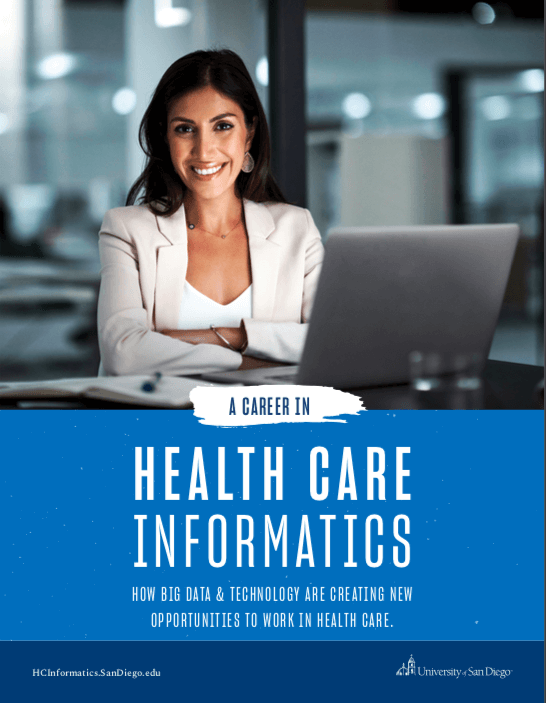
A Career in Health Care Informatics: How Big Data & Technology Are Creating New Opportunities to Work in Health Care
Free 21-page Book
Where Should We Send Your Health Care Informatics Career Guide?
"*" indicates required fields