

If you’re a BSN-prepared nurse ready to advance your career into leadership and specialized roles, a Master of Science in Nursing (MSN) can unlock new opportunities. This advanced degree offers numerous benefits, including higher earning potential, career advancement, and the knowledge and skills to make a meaningful impact on patient care, nursing practice, and healthcare as a whole.
What Is a Master’s of Science in Nursing Degree?
A Master of Science in Nursing (MSN) is a graduate-level degree designed to prepare registered nurses (RNs) for advanced practice, leadership, education, and specialized roles within healthcare through in-depth coursework and hands-on clinical experience.
MSN Curriculum
MSN curriculum typically emphasizes advanced nursing theory, leadership principles, healthcare policy, and evidence-based practice. Coursework often covers topics such as healthcare operations, team leadership, ethics, informatics, and population health.
What sets an MSN apart and makes it especially valuable is its emphasis on the business and leadership aspects of nursing, which can open doors to a wide range of career opportunities.
Many programs also incorporate clinical practicums or capstone projects, that give students the chance to apply their learning in real-world settings. Some even offer specialty tracks in areas such as nursing education or informatics, allowing you to tailor your expertise in a particular field.
Most MSN programs take about 18–24 months to complete for full-time students, though part-time study options or specialized tracks may extend the timeline. At the University of San Diego (USD), the MSN in Nursing Leadership is a 36-unit program that can be completed in approximately 20 months, with specialty tracks extending the duration to about 28 months.
Standard Admissions Requirements
While admissions requirements can vary, most MSN programs require applicants to hold a bachelor’s degree in nursing (BSN) or a related field from an accredited institution, along with an active, unencumbered RN license.
Additional materials often include official undergraduate transcripts, a current résumé, letters of recommendation, and a statement of purpose outlining your motivation for pursuing an MSN, as well as your short- and long-term career goals.
While professional nursing experience is not always required, it can strengthen your application and demonstrate readiness for graduate-level study. The GRE is not required.
Who Is an MSN For?
An MSN is an ideal choice for registered nurses who want to expand their scope of practice, take on leadership roles, or move into specialized areas of nursing. This degree is especially well-suited for:
- BSN-prepared nurses looking to advance their careers through graduate-level education and gain qualifications for administrative, educational, or advanced clinical positions.
- Nurses interested in policy or advocacy who want to influence healthcare systems, patient outcomes, and community health at a broader scale.
- Healthcare professionals with management experience who wish to formalize their leadership skills and credentials in a nursing context.
- Nurses interested in faculty or clinical educator roles who want to help shape the next generation of nursing professionals.
- Nurses drawn to informatics, combining science, data, and technology to drive healthcare process improvements, innovation, and better patient outcomes.
Specializations Options in the MSN Degree
Many MSN degree programs offer students the option to specialize in a particular area. Some of the most common include:
- Leadership: Prepares you for advanced and executive nursing roles in healthcare settings, equipping you with the knowledge, leadership principles, and practical experience needed to improve patient care and healthcare delivery.
- Nursing Education: Equips you for roles such as nursing faculty, clinical instructor, or nurse educator. You’ll also play an important role in addressing the nationwide nursing faculty shortage and shaping the future of nursing education.
- Nursing Informatics: Designed for nurses interested in the intersection of data, technology, and patient care. You’ll learn to leverage digital tools for better healthcare delivery, develop skills in data management and technology integration, and gain leadership experience to drive innovation in healthcare.
- Clinical Nurse Specialist (CNS): Ideal for those drawn to patient advocacy, system change, and nurse education. CNS students often gain experience in key areas such as critical care, perinatal, oncology, or emergency medicine, with a focus on improving patient outcomes through advanced clinical expertise.
- Nurse Practitioner Specialties: Prepares you to deliver high-quality primary care across the lifespan. NP specialties include Family Nurse Practitioner (FNP), Psychiatric-Mental Health Nurse Practitioner (PMHNP), Pediatric Nurse Practitioner (PNP), and Women’s Health Nurse Practitioner (WHNP).
- Healthcare Administration/Leadership & Management: Focuses on the business and operational side of healthcare. You’ll develop expertise in healthcare policy, finance, and organizational leadership to manage teams, improve systems, and ensure efficient care delivery.
Career Outlook and ROI: What Makes an MSN Degree Worth It?
There are many reasons why earning an MSN can be a smart career move. Here are a few of the biggest benefits.
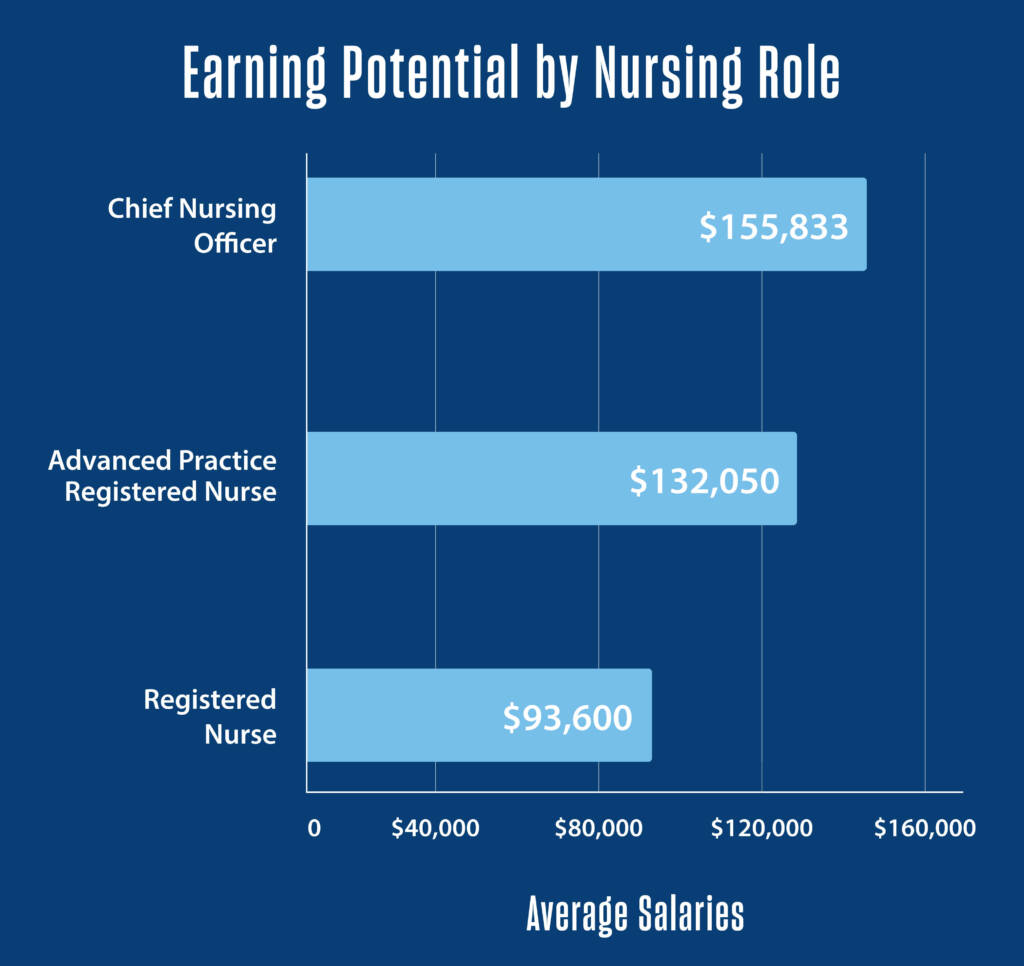
- Higher earning potential: An MSN opens the door to advanced nursing positions, such as Chief Nursing Officer or Director of Nursing, that come with increased responsibilities and higher salaries. For perspective, Registered Nurses, many of whom have a BSN, earn an average salary of $93,600, while many Advanced Practice Registered Nurses (APRNs) who typically hold at least an MSN earn an average of around $132,050. Chief Nursing Officers earn even more, with an average of $155,833.
- Expanded career opportunities: With an MSN, you’ll qualify for advanced roles across healthcare, from clinical practice to administration, opening pathways that aren’t available with a BSN alone.
- Increased job security and demand: As the demand for experienced nurses continues to grow, earning an MSN can provide greater stability and long-term job security.
- Leadership and specialization options: Your MSN also enables you to tailor your career, whether it’s stepping into leadership positions or specializing in areas like education, informatics, or advanced clinical care.
- Greater impact on patient care and healthcare policy: An MSN prepares you for senior and executive roles where you can influence patient outcomes directly and help shape healthcare policy at a broader level.
- Opportunities to teach and mentor: With an MSN, you’ll be equipped to guide the next generation of nurses by teaching in academic settings or mentoring colleagues in clinical practice.
- Professional credibility and recognition: An MSN demonstrates advanced expertise, earning you greater respect and recognition among your peers and employers.
- Stronger advocacy skills: Through advanced coursework and leadership training, you’ll gain the skills you need to advocate more effectively for your patients, the nursing profession, and the healthcare system as a whole.
- Pathway to doctoral studies: An MSN serves as an integral step to pursuing a Doctor of Nursing Practice (DNP) or PhD, preparing you for the highest levels of nursing practice or research.
Jobs Available to MSN Graduates
Are you curious about where an MSN can take you? From leadership roles in hospitals to positions beyond traditional settings, an MSN equips you with the skills to make a meaningful impact in nursing.
- Nurse Manager: A Nurse Manager oversees the daily operations of a specific unit, department, or team. Depending on the company or organization, this role may also be referred to as a Clinical Nurse Manager or Unit Manager. Average salary range: $79,500–$116,000
- Chief Nursing Officer: The Chief Nursing Officer (CNO) is typically the highest-ranking nurse in a healthcare organization, providing strategic leadership and overseeing all nursing operations. Average salary range: $126,000–$173,000
- Nurse Educator: Nurse Educators prepare and mentor the next generation of nurses in academic or clinical settings. They develop curriculum, teach courses, evaluate student performance, and may also conduct research to advance nursing education. Average salary range: $63,050–$103,370
- Clinical Nurse Leader: A Clinical Nurse Leader is an advanced generalist who coordinates, evaluates, and improves patient care at the unit or system level. Average salary range: $71,000–$104,500
- Director of Nursing: A Director of Nursing is a senior-level leader responsible for key decisions related to nursing staff. While this role shares similarities with CNO, the Director of Nursing is more involved in daily operations, whereas the CNO focuses on overall management, strategic vision, and long-term goals. Average salary range: $83,000–$125,500
- Nurse Informaticist: Nurse Informaticists work at the intersection of nursing, data, and technology. They design and optimize health information systems, analyze clinical data, and train staff on digital tools. Average salary range: $70,000–$122,500
- Healthcare Administrator: Healthcare Administrators manage the business and operational side of healthcare organizations. They oversee budgets, staffing, compliance, and policy implementation to ensure efficient delivery of care. Average salary range: $49,000–$127,500
Expanding Opportunities Beyond the Hospital
An MSN doesn’t just prepare you for leadership roles in hospitals or healthcare organizations. It also equips you for opportunities in a wide range of fields, such as:
- Public health: Supporting community health organizations, nonprofits, or government agencies to improve population health
- Corporate or consulting roles: Working at insurance companies, pharmaceutical organizations, or healthcare technology firms
- Policy and advocacy: Influencing healthcare legislation and policy
Expand Your Opportunities with an MSN from USD
If you’re ready to step into leadership and explore exciting new career opportunities, the flexible, hands-on MSN in Nursing Leadership from the University of San Diego is designed for you.
Built for nurses at all stages of their leadership journey, the program combines practical training with guidance from experienced faculty. You’ll strengthen skills in team management, strategic decision-making, and healthcare innovation, preparing you to take on diverse leadership roles and drive meaningful change in your organization.
Complete your degree in just 20 months while tailoring your learning experience to fit your professional goals and schedule.
FAQs
Can I work while earning my MSN?
Most programs, including USD’s MSN in Nursing Leadership, are designed for working nurses and include flexible and online options, allowing you to balance your career with coursework.
Do you get paid more if you have a master’s in nursing?
An MSN often opens doors to new, exciting opportunities in higher-paying leadership, education, and specialized roles compared to a BSN. Exact salary increases depend on your position, experience, and location.
How hard is a master of nursing?
An MSN program is rigorous, but it’s designed for practicing nurses. Your success depends on dedication and time management. USD’s MSN in Nursing Leadership offers support through office hours and opportunities to connect with instructors and peers, helping you make the most of your graduate experience.
What can a MSN do that a BSN can’t?
An MSN prepares you for leadership, specialized practice, teaching, policy, and specific roles that typically aren’t accessible with a BSN alone. For some positions, an MSN may be strongly preferred or even required.
Is an MSN required for admission to a DNP or PhD program in nursing?
Having an MSN can make you eligible for more program options and sometimes allows for advanced standing, but it is not universally required.