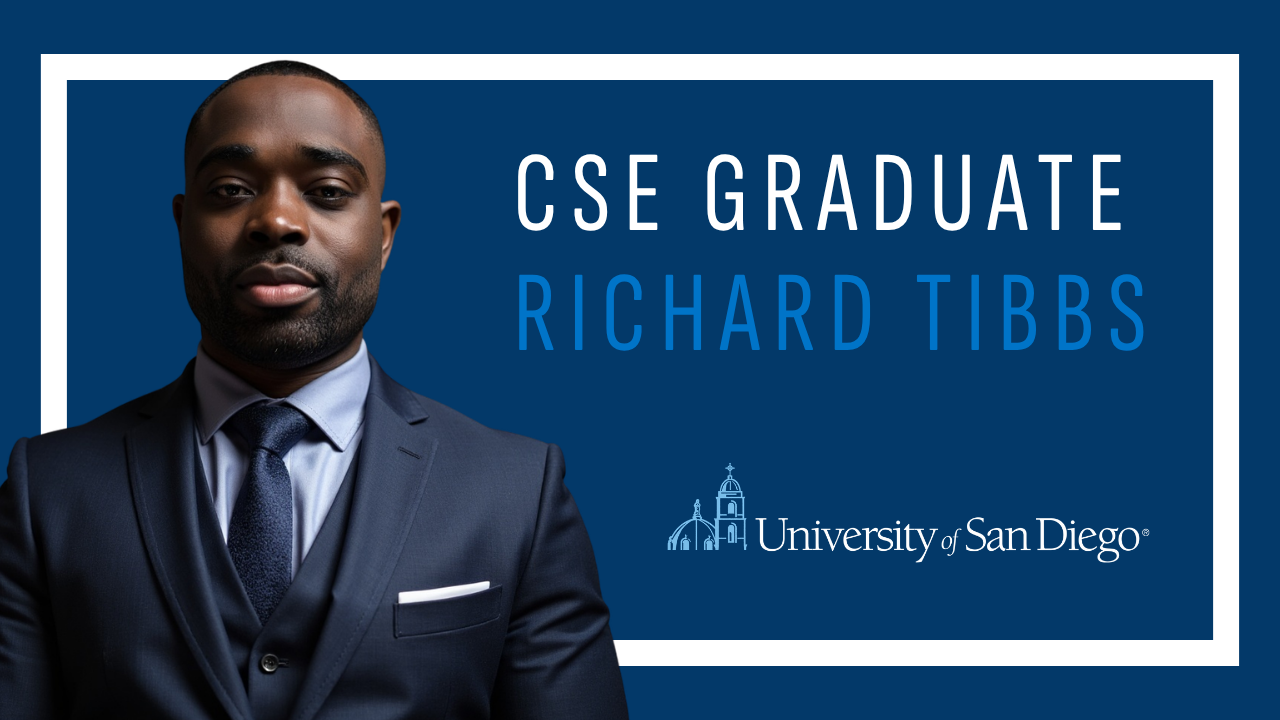
What if you could find a master’s program that perfectly balances rigorous technical skills, hands-on lab work, and an incredibly supportive community?
For graduate Richard Tibbs, choosing the University of San Diego’s Cyber Security Engineering (CSE) program was the catalyst for a dual passion: defending federal networks and shaping the next generation of cybersecurity professionals. “I wanted a program that was technical, hands-on, and lab-focused,” Richard shared, “and CSE delivered that experience.”
Aligning Passion with a Technical Curriculum
When deciding on the right path for graduate school, Richard knew he wanted a deep, technical dive rather than a broader management track.
“When I was deciding between the cybersecurity operations and leadership program and the Cyber Security Engineering program, the CSE curriculum aligned more closely with my interests,” he said. While considering other universities, USD ultimately stood out for its unique blend of:
- Hands-on labs and group projects that mirror real-world workforce skills.
An efficient program timeline designed for focused advancement. - Unmatched support for veterans.
- An inspiring on-campus environment. “USD is one of the most beautiful campuses I have visited, which made the on-campus experience even better,” Richard noted. “The campus scenery stood out every time I was there.”
Through the rigorous curriculum, Richard developed a comprehensive modern toolkit, mastering skills in security team collaboration, tool configuration, security plan development, cloud security, penetration testing, executive reporting, and adopting a vital “hacker mindset.”
The Power of Mentorship and the CAE Scholarship
Beyond the traditional classroom, Richard’s USD experience opened doors to an entirely unexpected career path: academia.
After learning about the CAE Scholarship through the NCyTE Community College Cybersecurity Fellowship Program from his Program Director, Haydar Majeed, Richard discovered a new calling.
“I have not completed the fellowship yet, but I am close to the halfway point, and it has already opened my eyes to what it takes to teach in this field,” Richard explained. “The program has helped me better understand the planning, organization, and preparation that occur before an instructor ever steps into a classroom. It has also shown me how important it is to create lessons, labs, and assessments that connect technical cybersecurity concepts to real-world workforce skills. It has opened a door I never expected to walk through and has helped me see teaching as a real possibility in my future.”
[RELATED] How to Start a Career in Cybersecurity >>
Learning from the Experts: Inside Security Testing
When asked about the most impactful part of his academic journey, one course and professor stood out: Security Testing with Professor Nikolas Behar.
“The class began with the basics of how attacks start… then progressed through attack vectors, vulnerabilities, exploitation, remediation, and reporting,” Richard said. “It gave me a better understanding of the full cybersecurity process from both the attacker and defender perspectives.”
Professor Behar’s mentorship also extended far past the syllabus:
- Career and Interview Guidance: Offering invaluable advice for post-graduation.
- Networking: Encouraging involvement in local tech events, leading to a volunteer role at BSides San Diego, which helped Richard expand his professional network.
In addition to faculty guidance, Richard credited Program Coordinator Imari Washington for providing consistent, professional, and responsive support that made his graduate experience seamless. “I did not have that same level of support at my previous school, so I really appreciated it.”
Advice for Prospective Students
For students considering USD’s Master of Science in Cyber Security Engineering program, Richard’s advice is simple: Put in the time and effort. “The program will reward you, but you have to take advantage of the opportunities available,” he advised. “One of the biggest lessons I learned is that cybersecurity requires critical thinking and the ability to approach problems from multiple angles. Sometimes the solution comes back to the basics.”
Furthermore, he emphasizes that graduation is just the beginning. “Cybersecurity is a field where learning cannot stop after graduation. New technologies continue to emerge, and staying current is paramount.”
What’s Next for Richard?
With his master’s degree in hand, Richard’s professional sights are set high: aiming to work for the federal government to contribute directly to national cyber defense, while working toward becoming a cybersecurity professor in the future. To stay ahead of emerging tech, he is currently enrolled in an AI in Business certification program to master how modern organizations leverage AI safely and effectively.