In May of 1990, I graduated from Marian College (now Marian University) in
Indianapolis, IN. During my time at Marian, I gained an appreciation of the Franciscan tradition and values from the Franciscan Sisters of Oldenburg and the many aspects of life to which it can be applied, including my chosen profession of psychology. After many twists and turns of life, in 2021, I was able to fulfill a long term dream of becoming a professed Secular Franciscan.
For me, the profession was only a beginning to a new chapter of my life which led to a burning desire to delve more deeply into the riches of the Franciscan tradition. Shortly thereafter, I came upon a notice about an online MTS program in Franciscan Theology through the Franciscan School of Theology in partnership with the University of San Diego. It seemed that the Spirit was calling me deeper into relationship with the Franciscan family, an opportunity which I eagerly embraced.
Through the MTS program, I experienced the charism of the Franciscan tradition come
alive within my being. The 800 years of the Franciscan tradition and the 2000 years of the Christian mission, under the guidance of many excellent instructors, became vibrant and renewed within my daily life, bringing insight and wisdom into our many modern struggles. Beyond information and insight, the greatest benefit of this program was the personal development in my new vocation as a Secular Franciscan, particularly in living out this ancient wisdom in my current life of work, relationships, and interaction with the world of creation.
Beyond information and insight, the greatest benefit of this program was the personal development in my new vocation as a Secular Franciscan, particularly in living out this ancient wisdom in my current life of work, relationships, and interaction with the world of creation
Journey to Assisi
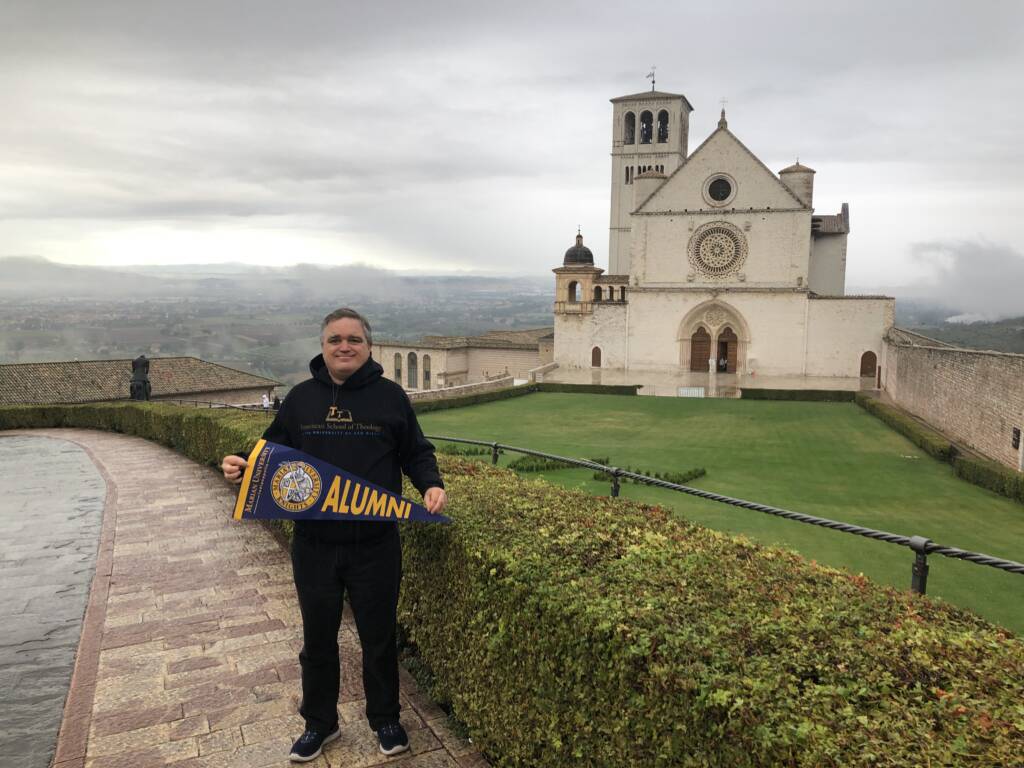
I completed the program in August of 2023 and as a celebration and summarization of my
academic journey, I joined other members of the Franciscan family on the Study Pilgrimage to Italy through the Franciscan Pilgrimage Program. During our journey, on September 17, 2023, the Feast of the Stigmata, I, along with other members of the Franciscan family, vowed religious and secular, affirmed our commitment to the Franciscan way of life in the St Michael Chapel at Fonte Colombo, the site of the finalization of the Rule of 1223 by St Francis. This was conducted through the Renewal of Commitment to Franciscan Life ritual developed by the Franciscan Pilgrimage program, which included the Franciscan commitments to obedience, poverty, and chastity as expressed in the Final Rule: “The Rule and Life of the Lesser Brothers is this: to
observe the Holy Gospel of Our Lord Jesus Christ by living in obedience, without anything of one’s own and in chastity.” (Francis, 1223) What follows are my reflections on these
commitments from a Secular Franciscan perspective with the cited quotes coming from the ritual.
The first vow is expressed as “obedience to the Spirit and the Church”.
For me this means a commitment to daily contemplation and discernment regarding both small and large decisions. Instead of reacting to situations, I am committing to listening to the Spirit of Love and the guidance of Church teachings (especially scripture) to help shape my response to the world around me and within me. In essence, trying to be attuned in every situation to what Love commands me to do.
The second vow is “poverty that imitates the life of Your Son and his most Holy Mother”.
In the secular life this does involve a life of simplicity, to view money and things as gifts to be used wisely for the good of all. However, I do believe that this involves more than just things.
This involves poverty of status, to avoid acquiring societal domination over others. When I do have authority over others, to perceive such a situation as a position of responsibility not as a position of power or privilege. This does involve some degree of kenosis, or self-emptying of expectations and demands of life, a letting go of status seeking and of ambition for anything other than to be a more loving and compassionate person.
The third vow is “chastity that frees us to love you and your people with unmeasured
love”.
This one is often limited to “avoid sexual thoughts,” which can be construed to
unrealistically deny basic biological drives. For me, this vow flows from the other two vows, in that it means to not appropriate for myself the beauty and body of another, nor to grasp at the monopolization of another to meet my needs alone. This vow is meant to redirect one’s gaze to appreciate the internal and external beauty of another as a gift and to reflect, or mirror, that beauty back to the other person. This helps the other person to grow in appreciation of their own beauty and frees them to share the gift of their beauty with others.
This secular interpretation for the modern world is the fulfillment of my Franciscan
journey that was begun at Marian University, professed in the presence of my secular fraternity, developed through the Franciscan School of Theology, and affirmed in Italy in the presence of my Franciscan family. This experience in the homeland of Francis signifies the beginning of my new life in the Secular Franciscan journey.
Pace e bene
Raymond List, OFS
REFERENCE
Francis. “The Later Rule (1223).” In Francis of Assisi: Early Documents, vol 1, The Saint,
editors Regis Armstrong, Wayne Hellmann, & William Short, 99-106. New York: New City Press, 2001.