Key Takeaways
- Sustainability degrees span 15 distinct paths, from a BA in Environmental Science to an MBA in Sustainable Enterprise. Each prepares graduates for a different corner of the field rather than one universal track.
- Expected salaries vary significantly by specialization and degree type. An Environmental Engineering Manager with an MS in Sustainable Engineering earns a median of $167,740, while a Farm Manager from a BS in Food Systems and Sustainable Agriculture earns $87,980.
- The UN defines sustainability as meeting present needs without compromising future generations’ ability to meet their own, but the field increasingly favors Julian Agyeman’s “just sustainability” framework, which adds equity and ecosystem limits to that definition.
- The strongest sustainability programs share four traits: a curriculum genuinely built around sustainability rather than added on; hands-on, applied projects; faculty with real-world experience; and opportunities to collaborate across disciplines.
- USD’s Master of Science in Engineering, Sustainability and Health (MSESH) brings ecologists, sociologists and engineers together in one transdisciplinary program, positioning graduates for leadership roles across corporate, nonprofit and NGO settings rather than one narrow specialty.
Nothing can continue unless it is sustainable, and there’s an increasing acknowledgment by world governments and the private sector that our current “business as usual” approach cannot continue. The existential threat that is climate change hangs over us all with recent dire predictions for global heat waves, extreme drought conditions, future pandemics and other crises.
But where there are challenges, there is also opportunity. Governments are researching and investing in ways to take action in response to issues like alternative fuels, food and water shortages and natural disaster recovery. More businesses are recognizing the “triple bottom line” of people, planet and profit and are looking to start initiatives and hire positions that address environmental and social issues.
If you’re looking for ways to help solve these challenges — while also hoping to support yourself with a rewarding and stable career — then pursuing a sustainability degree or other related higher education program could be your best step forward.
What Is “Sustainability”?
The United Nations, citing a seminal 1987 report from its World Commission on Environment and Development (also known as the Brundtland Commission), defines sustainability as: “meeting the needs of the present without compromising the ability of future generations to meet their own needs.” As such, most sustainable practices are designed to support either human or environmental health in a way that supports the existing environment, communities and economies.
One of the more recent and comprehensive definitions of what sustainable practices need to consider was the identification of six “Grand Challenges of the 21st Century” by the National Academies of Engineering, Sciences and Medicine. In its 2019 joint report “Environmental Engineering for the 21st Century: Addressing Grand Challenges” the National Academies defined the following challenges that needed to be met:
- Sustainably Supply Food, Water, and Energy
- Curb Climate Change and Adapt to Its Impacts
- Design a Future Without Pollution or Waste
- Create Efficient, Healthy, Resilient Cities
- Foster Informed Decisions and Actions
- Preparing the Field to Address a New Future
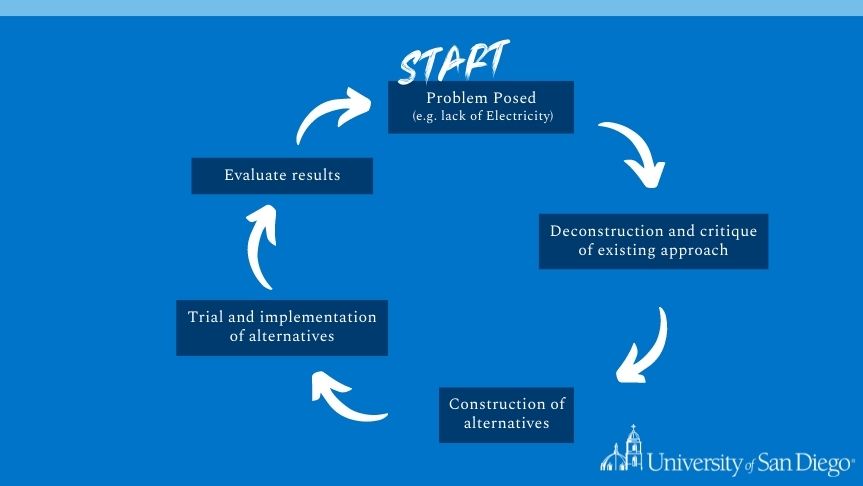
To meet these interconnected global challenges — including related matters of public health, hunger, inequity, disease and other humanitarian crises — requires bold change, innovative thinking and collaboration between industries and fields of study. Unfortunately, “sustainability” as a word has tended to become overused and misused. What some people think of as sustainable practices — such as developing sustainable energy and green technologies — only seek to maintain current systems without changing them, which is no longer adequate for addressing our current and future challenges.
We, instead, consider Julian Agyeman’s notion of a ‘just’ sustainability, which he defines as “the need to ensure a better quality of life for all, now and into the future, in a just and equitable manner, whilst living within the limits of supporting ecosystems.” That acknowledgement of limits is key, as what we think of as sustainable needs to be a regenerative practice that can design and apply techniques to restore our natural systems for future generations.
This understanding of sustainability is the only way to ensure the long-term well-being of public health and human society.
What Does a Sustainability Degree Entail?
Sustainability degrees focus on more than just environmental sustainability; instead they exist at the intersection of all environmental, social/cultural and economic systems. The study of sustainability concerns the physical and life sciences, engineering, social sciences and humanities and will also consider matters of political science, public policy, business administration and many social and cultural systems.
Due to its wide breadth, sustainability is an important consideration in many key sectors and industries, and will be a topic of study for areas including:
- Environmental protection and preservation
- Animal and plant diversity
- Energy production
- Waste reduction and recycling
- Agriculture
- Manufacturing
- Transportation
- Public health
With such a wide range, there are many colleges that develop sustainability degree programs around environmental policy or green technologies. When you’re looking for a bachelor’s or master’s degree in sustainability, you’ll first need to consider your skills and interests as well as the areas that you would prefer to work in.
Are you an engineer who would prefer to work on energy production, or do you feel that clean water is a greater concern?
If you’re going into public health, are you more passionate about disease prevention and epidemiology or is health education more your calling?
You should research the program to determine if the courses are designed to focus on practices of just sustainability — or are they “regular” programs of science/business/health with sustainability coursework built into it?
There’s a lot to consider, so to help start your research, here are 15 sustainability degree programs to consider — six bachelor’s and nine master’s — plus a general overview of their area of study.
Want to Work with Other Professionals Toward Sustainable Solutions?
Learn More About the MESH Program in Our On-Demand Webinar — Watch Now
6 Types of Sustainability Bachelor’s Degrees
1. BA in Environmental Science
The Bachelor of Arts in Environmental Science is a transdisciplinary major, intended to cover theories and areas of study across the humanities, physical, social and natural sciences. It is a starting point for further specialization into other sustainability majors and can lead to careers in public advocacy, law, journalism, public health and environmental conservation.
Potential career paths include:
- Environmental Scientist: Demand for this role is expected to increase 4% by 2034, with a median salary of $80,060 per year.
- Environmental Lawyer: The U.S. Bureau of Labor Statistics (BLS) groups environmental lawyers into the larger “lawyer” category, which is expected to increase 4% by 2034, with a median salary of $151,160 per year.
- Conservation Scientist: This role is predicted to grow 3% by 2034 and earns a median yearly salary of $69,060.
2. BA in Sustainable Development
A Bachelor of Arts in Sustainable Development focuses on understanding and upholding sustainable development goals at local, regional and global levels. This degree may offer specializations in areas of agritourism, food systems, wildlife management, urban planning, watershed conservation and education.
Potential career paths include:
- Forester: By 2034, the demand for this role is expected to increase by 3%. It earns a median salary of $69,060.
- Regional Planner: Employment for this position is expected to grow 3% by 2034, and it nets a median annual salary of $83,720.
- Wildlife Biologist: Growth for this role is expected to climb by 2% through 2034, with a median salary of $72,860 per year.
3. BS in Food Systems and Sustainable Agriculture
The Bachelor of Science in Food Systems and Sustainable Agriculture is specifically focused on the agricultural production, management and utilization of plants, animals and biofuels. These programs are often a direct line to careers in horticulture, animal agriculture, nutrition and public health.
Potential career paths include:
- Food Scientist: The BLS estimates that employment for this role will grow 6% by 2034 and earn a median yearly salary of $78,770.
- Nutritionist: Demand for this role is expected to increase 6% by 2034, with a projected salary of $73,850 per year.
- Farm Manager: Employment of farm managers is expected to decline 1% by 2034. Individuals in this role typically earn a median annual salary of $87,980.
4. BS in Environment and Sustainability
Similar to the BA programs that study the environment and sustainability, the Bachelor of Science version of the degree is a transdisciplinary approach to studying the natural world in tandem with economical and technological development. These programs will focus on the physical sciences and be more geared toward careers in air quality management, renewable energy development, waste management, pollution control and environmental engineering.
Potential career paths include:
- Environmental Engineer: Demand for environmental engineers is expected to increase 4% by 2034. The median annual salary for this role is $104,170.
- Environmental Technician: Projections estimate that employment for this role will increase by 4% by 2034, with professionals earning a median salary of $49,490 per year.
- Natural Sciences Manager: This role is expected to experience 4% growth by 2034 and take home a median annual salary of $161,180.
5. BS in Community Development
The Bachelor of Science in Community Development is a social science degree that draws upon the fields of political science, anthropology and urban studies to study the social, political, cultural and economic dynamics that shape and constrain human development. Careers that arise from studies in community development include urban planning, data analysis, environmental regulation and economic development.
Potential career paths include:
- Data Scientist: Demand for this role is high, with the BLS estimating 34% growth by 2034. Pay is also on the higher end, with those in the role earning a median annual salary of $112,590.
- Social Service Manager: Growth for this role is expected to rise 6% by 2034. The median salary for this role is estimated to be $78,240 per year.
- Urban Planner: The BLS estimates that demand for the urban planner role will grow 3% by 2034. Salary projections estimate a median annual salary of $83,720.
6. BS in Business Administration, Sustainability Management
Sustainability Management is a specific track within the Bachelor of Science in Business Administration that places the consideration and study of environmental and community responsibilities on equal footing to effective management and financial profitability. This degree fits well with those pursuing careers in entrepreneurship, business management, public relations and marketing.
Potential career paths include:
- PR Specialist: This role is expected to experience 5% growth by 2034, with a median yearly salary of $69,780.
- Fundraiser: By 2034, demand for fundraisers is projected to increase by 4%, with individuals in the role earning a median yearly salary of $66,490.
- Marketing Manager: Expect demand for this role to increase 6% by 2034, with a projected median salary of $159,660 per year.
9 Types of Sustainability Master’s Degrees
1. MS in Sustainable Engineering
A Master of Science in Sustainable Engineering seeks to support the availability of natural resources as well as account for engineering’s influence on communities, politics and economies. This transdisciplinary approach to considering holistic, sustainable systems is a popular advanced degree for those interested in renewable energy systems, product design, engineering policy and health and safety directors.
Potential career paths include:
- Environmental Engineering Manager: The BLS estimates that employment for this role will grow 4% by 2034 and earn a median yearly salary of $167,740.
- Industrial Designer: Demand for industrial designers is expected to increase 3% by 2034. The median annual salary for this role is $79,450.
- Health and Safety Engineer: Employment of health and safety engineers is expected to increase 4% by 2034. Individuals in this role typically earn a median annual salary of $109,660.
2. MS in Environmental Studies
The Master of Science in Environmental Studies is an interdisciplinary degree that brings together different areas of study, including environmental health, law, chemistry, biology and policy. As an advanced degree with a broad area of concentrations, it’s well suited for those whose careers will require a breadth of knowledge and skills, such as consultants, environmental scientists, policy analysts, educators and sustainability specialists.
Potential career paths include:
- Policy Analyst: Projections estimate that employment for this role will decline by 3% by 2034, with professionals earning a median salary of $139,380 per year.
- Environmental Scientist: Demand for this role is expected to increase 4% by 2034, with a median salary of $80,060 per year.
- Environmental Studies Professor: By 2034, the demand for this role is expected to grow 7%. It earns a median salary of $83,980.
3. MS in Environmental Science and Monitoring
The focus of a Master of Science in Environmental Science and Monitoring is to teach the skills and tools necessary to understand, measure and analyze environmental impacts, ranging from changes at the molecular level of individual organisms to issues that affect entire ecosystems. This degree is of great use for those interested in becoming natural resource managers, environmental consultants, research scientists and environmental project managers.
Potential career paths include:
- Project Manager: By 2034, demand for project managers is projected to increase by 6% with individuals in the role earning a median yearly salary of $100,750.
- Environmental Specialist: This role is expected to experience 4% growth by 2034, with a median yearly salary of $80,060.
- Microbiologist: Growth for this role is expected to climb 4% by 2034, with a median salary of $87,330 per year.
4. MS in Environment and Energy Policy
A Master of Science in Environment and Energy Policy utilizes engineering, sciences and social sciences to examine the challenges and opportunities of energy and its impact on the environment. Much of the purpose of this degree is to develop new solutions for the world’s energy needs while ensuring that policies and technologies are designed to preserve and repair the natural world. This degree is a great fit for business analysts, energy consultants, environmental scientists and directors of policy.
Potential career paths include:
- Compliance Officer: Employment of compliance officers is expected to grow 3% by 2034. Individuals in this role typically earn a median annual salary of $78,420.
- Environmental Scientist: The BLS estimates that demand for environmental scientists will grow 4% by 2034. Salary projections estimate a median annual salary of $80,060.
- Natural Sciences Manager: This role is expected to experience 4% growth by 2034 and take home a median annual salary of $161,180.
5. MS in Architecture, Sustainable Buildings
A sustainability track for a Master of Science in Architecture program will focus on the regenerative design of buildings to sustain and regenerate food, water and energy use within local ecosystems. As a multidisciplinary approach to architectural study and design, this degree is a good choice for aspiring architects, urban planners, landscapers, engineers and sustainability design specialists.
Potential career paths include:
- Architect: Demand for architects is expected to increase 4% by 2034. The median annual salary for this role is $96,690.
- Landscape Architect: Projections estimate that employment for this role will increase by 3% by 2034, with professionals earning a median salary of $79,660 per year.
- Architectural Manager: This role is predicted to grow 4% by 2034, and earns a median yearly salary of $167,740.
6. Master of Public Health, Environmental Health Focus
With a concentration/focus on environmental health, the Master of Public Health degree examines human health and its relation to the health of the environment. Taking a broad perspective, this can include a focus on work safety, infectious disease, climate change, toxins and pollutants, air quality and general living conditions. Relevant careers for graduates of this degree include environmental health engineer, research technician, health and safety specialist and data analyst.
Potential career paths include:
- Epidemiologist: Employment for this role is expected to climb 16% by 2034, with a median salary of $83,980 per year.
- Survey Researcher: This role is expected to experience a 5% decline by 2034. Professionals take home a median annual salary of $63,380.
- Biostatistician: The BLS groups biostatisticians lawyers into the larger “mathematicians and statisticians” category, which is expected to increase 8% by 2034, with a median salary of $104,350 per year.
7. MBA in Sustainable Enterprise
Alternatively called an MBA in Sustainable Innovation or Sustainable Business, the Master of Business Administration in Sustainable Enterprise places matters of sustainability — such as environmental justice, climate change and social responsibility — at the forefront of doing business. This MBA concentration is a great fit for future entrepreneurs or for anyone interested in positions such as sustainability consultant, director of compliance, environmental operations lead or chief sustainability officer.
Potential career paths include:
- Chief Sustainability Officer (CSO): As a top executive role, the BLS estimates that demand for CSOs will grow 4% by 2034. The median annual salary is $105,350.
- Compliance Director: Compliance-based positions are expected to experience 3% growth by 2034. Those working in the compliance director role typically earn an average salary of $128,297.
- Sustainability Consultant: Environmental roles, such as this one, are expected to see a 4% increase in demand by 2034. Sustainability consultants can expect to earn a median yearly salary of $102,000.
8. MBA in Energy and Environmental Focus
Energy and Environmental Focus (or sometimes referred to as an MBA in Sustainability) is a Master of Business Administration concentration that examines the business and economics of energy and its impact on environmental policies and social systems. Graduates of this program not only make great entrepreneurs but also are good fits for positions in business management, energy trading, construction management and renewable energy projects.
Potential career paths include:
- Construction Manager: This role is expected to experience 9% growth by 2034, with a median yearly salary of $106,980.
- Management Analyst: Expect demand for this role to increase 9% by 2034, with a projected median salary of $101,190 per year.
- Energy Analyst: For roles rooted in environmental science, the BLS predicts a 4% increase in demand by 2034. In terms of salary, energy analysts earn a yearly average of $86,388.
9. MS in Engineering, Sustainability and Health
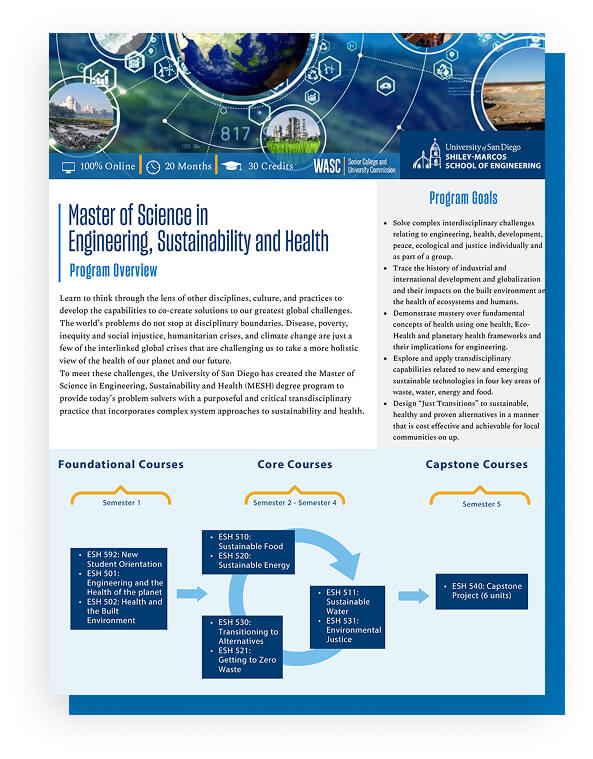
The Master of Science in Engineering, Sustainability and Health (MESH) is a transdisciplinary degree that brings a consideration of technology, engineering and health fields within a focused learning environment to solve complex challenges relating to health, human and environmental development, peace and justice. MESH graduates are well positioned for leadership and managerial roles across all types of corporate, nonprofit and non-governmental organization professions as well as careers as entrepreneurs or consultants.
Potential career paths include:
5 Reasons a Sustainability Degree Is Worth It
If you’re asking yourself whether a sustainability degree is truly worth the time, cost and commitment, you’re not alone. Whether you’re considering a bachelor’s or master’s degree, the real question is what kind of return you’ll get on that investment. The following five reasons help explain why, for many students, earning a degree in sustainability is absolutely worth it.
1. It leads to real career opportunities in a growing field.
A sustainability degree aligns with today’s priorities as well as those of the future. Green job postings have increased steadily over the past several years, and global demand continues to rise as organizations invest in sustainable development. According to the International Labor Organization, the transition to a circular economy could create up to 24 million jobs worldwide by 2030. If long-term career stability is a primary concern for you, sustainability is a field with momentum.
2. It helps you stand out in a competitive job market.
As regulations around energy use, waste, and environmental impact tighten, employers are actively seeking professionals who understand sustainability from both a strategic and practical standpoint. A sustainability degree signals that you bring specialized knowledge — and the ability to implement real solutions — to the table rather than just general interest. That differentiation can give you an edge when applying for roles.
3. It builds transferable, in-demand skills.
A sustainability degree goes beyond subject-matter knowledge. You’ll develop skills employers consistently value, including critical thinking, data analysis, communication and project management. Certain sustainability degree programs, including MESH, are project-based, meaning you gain hands-on experience tackling complex, real-world challenges, as well as skills you can apply in a wide range of careers, even beyond sustainability-specific roles.
4. It positions you to make a meaningful impact.
If you want to work to contribute to something bigger than yourself, a sustainability degree can open doors to meaningful careers focused on stewardship, social equity and responsible development. Instead of feeling limited to personal lifestyle changes, you can work at a systemic level, helping organizations, communities and governments create measurable, lasting change.
5. It offers purpose, not just a credential.
For many graduates, the value of a sustainability degree lies in the sense of purpose it brings. Knowing your work supports a healthier planet and more equitable systems can be deeply fulfilling. If meaning and impact matter to you when choosing a career path, a sustainability degree can help align what you do with what you care about.
Sustainability Career Advice From Our Experts
To truly work toward “just sustainability” keep the following advice in mind.
- Start by questioning what we are sustaining — and for whom? To avoid simple “greenwashing” and acts of mere performative sustainability you’ll need to develop your complex systems thinking and critical analytical abilities. Just building on what we already have isn’t enough; true innovation is necessary for fostering positive change on our planet.
- For the well-being of our planet, as well as for our own survival, all interventions that impact the environment must be more than sustainable — they need to be regenerative. Regenerative practices go beyond maintaining systems, they recognize how natural systems are currently impacted and design and apply techniques to restore them to improved productivity.
- Don’t be a generalist in your approach; instead make an effort to focus on solving specific problems that occur in real contexts. This requires that you escape a “business-as-usual” mindset by building your competence, confidence and credibility in sustainability studies. To be truly effective, Net Impact recommends earning a higher-level degree to further your skills, knowledge and experience.
- Finally, if you’re looking for the best sustainability master’s and bachelor’s programs, search for programs that integrate hands-on experience and practical work with academic knowledge and theory.
What to Consider When Looking for a Sustainability Degree Program
Start by looking for sustainability programs that include the following key elements:
- A clear commitment to sustainability: The program’s goals and values should be deeply embedded in its curriculum and identity, not treated as a buzzword or marketing language. This helps ensure sustainability is central to what you’re learning, not an afterthought.
- Hands-on, applied learning opportunities: Prioritize programs that move beyond theory and case studies. The strongest sustainability degrees challenge you to apply what you learn in the classroom through projects, real-world problem-solving and tangible outcomes you can point to after graduation.
- Experienced, mission-aligned faculty: Look for faculty with professional experience in sustainability, environmental impact and social justice who can connect coursework to real-world practice and emerging challenges.
- Opportunities for transdisciplinary collaboration: Sustainability challenges don’t exist in silos. Programs that encourage learning alongside students and experts from multiple disciplines help you develop more innovative, holistic approaches to complex problems.
The University of San Diego’s Master of Science in Engineering for Sustainability and Health program delivers the kind of professional development required to solve the sustainability challenges of tomorrow.
MESH brings together the wisdom of ecologists, sociologists and experts in just transitions with engineering and public health to consider what is possible to ‘sustain’ in the long term for environmental and human health. The goal is to ensure that progress and innovations are shared equitably with all communities.
If you’re interested in learning more about the MESH degree program, reach out for more information.
Hear More About the Transdisciplinary Vision Behind the MESH Program in Our
Free On-Demand Webinar — Watch Now